

Do You Need a Golf Club Fitting? What Matters and What Can Wait
Custom-fitted clubs can help you get more from your equipment, but that doesn't mean every golfer needs a professional fitting or an expensive new set. Understanding which specifications affect your game, which problems are worth investigating and what you can check yourself will help you decide where your money is best spent.
Do You Really Need to Get Fitted for Golf Clubs?
Not necessarily. If your clubs are a reasonable fit, you make reasonably consistent contact and you're comfortable with how they perform, you can keep playing perfectly well without a custom fitting.
Fitting becomes more worthwhile when you're buying a new set, replacing an important club, struggling with consistent contact, or suspecting that something about your equipment doesn't suit you. The right length, shaft, lie angle, grip and loft can help your clubs work with your swing rather than making you adapt unnecessarily to them.
The key is to solve the right problem. A fitting can help identify equipment that suits your swing, but it won't automatically fix a swing fault, and a more expensive club isn't necessarily a better fit.
A Club Fitting Is About Finding What Works for You
A golf club fitting is a process of finding equipment specifications that suit your body, your swing and the shots you want to hit.
That might mean adjusting the length of a club, comparing different shafts, checking the lie angle of your irons or testing different driver heads. A fitting can be as simple as checking a few measurements or as involved as testing a complete set of clubs using launch-monitor data.
The aim isn't to build the most expensive set possible. It's to find equipment that helps you make consistent contact, delivers a useful ball flight and feels comfortable enough that you can concentrate on playing golf.
There Are Three Different Things You Can Do
1. Check Your Existing Clubs
You can have your current clubs measured and checked for specifications such as length, lie angle, loft and grip condition. This can help identify whether something is unusual or worth investigating before you spend money on replacements. Not every specification can be adjusted economically, and some clubs have limited adjustment options.
2. Get Fitted for New Clubs
A fitter can compare club heads, shafts, lengths and other specifications while you hit shots. With a driver, for example, they may assess ball speed, launch, spin, strike location and dispersion to find a combination that performs well for you. With irons, consistent contact, launch, distance gaps and direction may be more useful than chasing one impressive shot.
3. Buy Standard-Specification Clubs
Standard or off-the-shelf clubs can be perfectly suitable, particularly when their specifications are reasonably close to what you need. You can also buy clubs with some custom options without going through a lengthy fitting session. The important thing is to check the actual specifications rather than assume that every standard set suits every golfer.
Does a Fitting Mean You'll Hit the Ball Better?
It can help, but it isn't a guarantee.
If a club is too long, too short or poorly suited to your delivery, the right specification may make it easier to set up comfortably and return the club consistently. A different shaft or club head might also improve your launch, distance control or shot pattern.
But a fitting cannot guarantee a straighter swing, better contact or a lower score. Your technique, strike quality and decision-making still matter. Nor does a fitting automatically identify a single perfect combination: several options may perform similarly, and comfort and confidence are legitimate considerations.
A good fitting should give you a reason to choose one club over another — not just a more expensive club to buy.
That's the standard worth applying throughout this article. If a fitting identifies a meaningful improvement, it may be worth paying for. If your clubs already suit you reasonably well, there's no need to replace them just because custom fitting exists.
Five Things Worth Understanding Before You Buy
Golf clubs have plenty of specifications, and it can be difficult to know which ones deserve your attention. The good news is that you don't need to understand every technical detail to make a sensible buying decision.
Start with five: club length, lie angle, shaft, loft and grip size. Each affects a different part of how a club fits, performs or feels. Some are relatively easy to check, while others are best assessed by comparing clubs and watching how you actually deliver them.
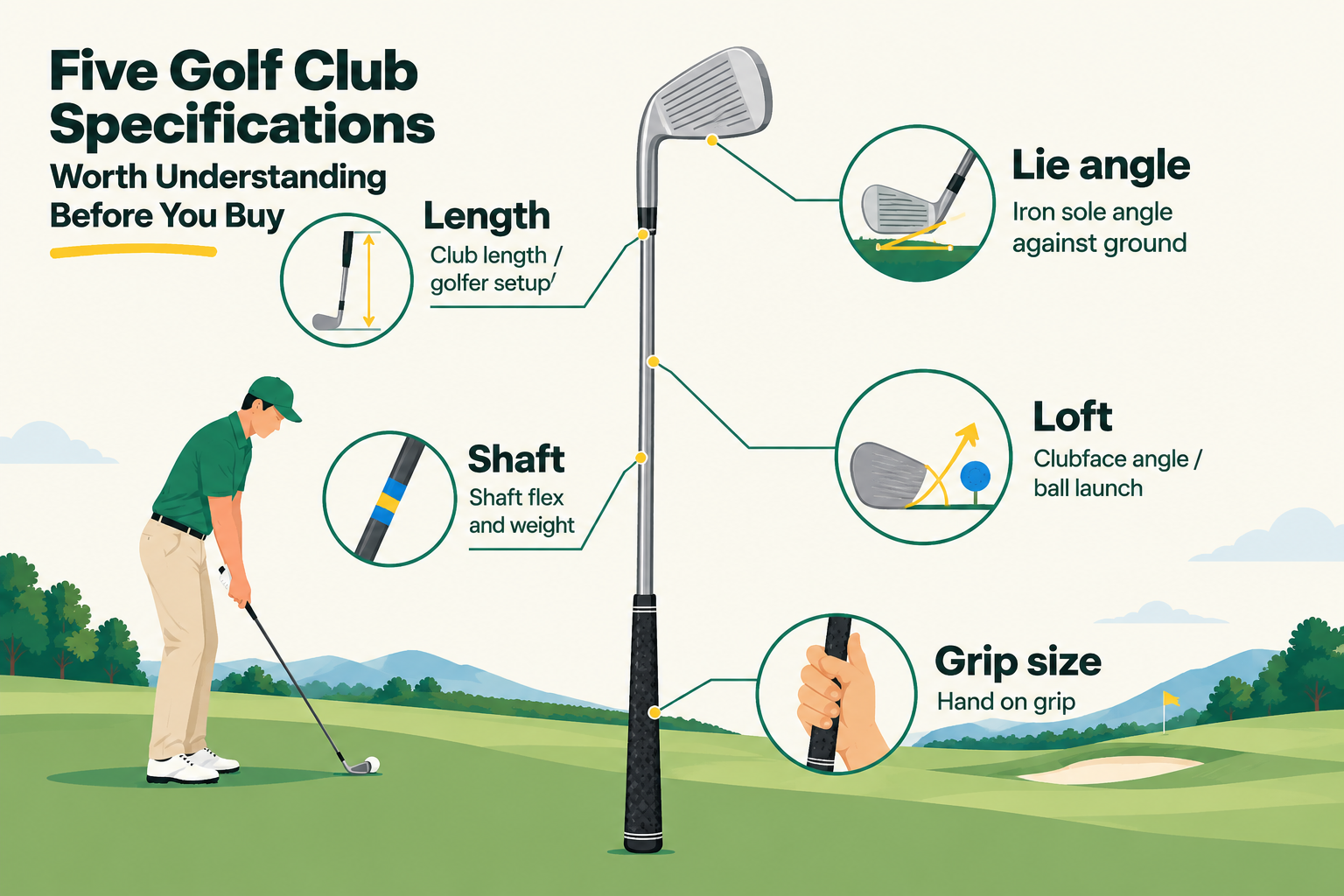
1. Club Length
What it affects: Your posture, comfort, ability to reach the ball naturally and the way you deliver the club.
A club that's too long or too short for you can make it harder to find a comfortable setup. Length can also influence strike location, consistency and control. However, height alone doesn't determine the right length: arm length, posture, club type and your delivery all matter.
What to know: If you regularly feel cramped, stretched or uncomfortable at address, or consistently struggle to find the middle of the face, length is worth checking. Don't assume that being tall or short automatically means you need non-standard clubs.
2. Lie Angle
What it affects: How the sole of the club sits relative to the ground at impact, and potentially your directional consistency.
Lie angle describes the relationship between the shaft and the sole of the club. If the lie angle is poorly matched to how you deliver an iron, it may contribute to directional problems. A club that is too upright or too flat can change how the head interacts with the ground and, depending on the club and delivery, influence where the ball starts.
What to know: Lie angle is particularly worth checking when buying irons or if your existing irons seem to produce a persistent directional pattern despite reasonably consistent contact. Your height or the marks on the sole alone cannot reliably establish the correct lie angle.
3. Shaft Flex, Weight and Profile
What it affects: How the club feels during the swing, its overall timing and the launch and spin characteristics you may produce.
Shafts come in different weights, flexes and bend profiles. These characteristics can influence how the club feels and performs, but there is no universal rule that a particular swing speed must use a particular flex.
Labels such as regular, stiff and extra stiff are not perfectly standardised across manufacturers. Two shafts with the same label can feel and perform differently. Weight, profile, length and the club head they're paired with also matter.
What to know: If you're buying a driver or a new set of irons, compare a few sensible shaft options rather than choosing solely from your age, handicap or swing speed. A shaft that feels controllable and produces a useful ball flight is a better starting point than simply choosing the stiffest option you can swing.
4. Loft
What it affects: Launch, trajectory, distance and the gaps between your clubs.
Loft is the angle of the clubface that helps determine how the ball launches. Drivers, fairway woods, hybrids, irons and wedges all use different lofts to produce different types of shots.
With a driver, loft can be important when you're trying to find a useful combination of launch, spin, carry and control. With irons, the lofts across the set affect distance gaps. Two iron sets with the same club numbers can have noticeably different lofts, so a 7-iron from one set may not travel the same distance as a 7-iron from another.
What to know: Don't choose a driver simply because it has less loft or buy irons based on how far somebody else hits their 7-iron. Look for a useful flight, predictable distances and sensible gaps between clubs. The best loft depends on the club, your delivery and the result you're trying to achieve.
5. Grip Size
What it affects: Comfort, hand feel and how naturally you can hold and control the club.
Grips come in different sizes and materials, and golfers can also change the effective size by adding extra tape beneath the grip. A grip that feels too large or too small may be uncomfortable or make it harder to hold the club in a way that feels natural.
Hand size can provide a useful starting point, but it isn't the whole story. Finger length, grip preference and the way you hold the club also matter. Nor should you assume that changing grip size will automatically cure a slice, hook or other swing problem.
What to know: Pay attention to whether your grips feel comfortable, secure and consistent across the set. If your hands feel cramped, you're struggling to hold the club comfortably or the grips are worn and slippery, it's worth investigating before replacing your clubs.
Which Specifications Should You Prioritise?
There's no single ranking that works for every golfer, but a sensible starting point is to establish that the clubs are comfortable to set up with, that their specifications are reasonable for your delivery, and that they produce useful shots.
Length and lie angle are particularly relevant when checking whether irons fit you properly. Shaft characteristics deserve attention when you're comparing new clubs, especially if you have clear preferences for weight or struggle to control the club consistently. Loft matters when choosing a driver or checking distance gaps throughout your set. Grip size is worth checking whenever the club doesn't feel comfortable in your hands.
You don't need to optimise every specification at once. Start with the one most likely to affect your comfort, contact or shot pattern.
And remember: if a club doesn't perform as you'd like, that doesn't automatically mean its specifications are wrong. Technique, strike quality, the design of the club head and the conditions you're playing in can all influence the result.
BUY BETTER · MAKING THE CALL
When is a fitting worth it?
A fitting is most useful when it can help you make a specific equipment decision. You don't need to book one simply because you've reached a certain handicap, played for a certain number of years or seen a better golfer get fitted.

You're buying a new set of irons
Often worth considering. You'll be using these clubs for years, and differences in length, lie, shaft weight and overall feel can affect how comfortably you set up and how consistently you strike the ball.
You don't necessarily need an elaborate fitting. Even comparing a few sensible options can help you avoid buying a set that feels wrong from the start.
You're replacing your driver
Potentially very worthwhile. Drivers can differ in head design, loft, shaft characteristics and adjustability. A fitting can help you compare launch, direction, strike pattern and usable distance rather than choosing by brand or headline distance alone.
If your current driver produces a persistent high fade, for example, testing alternatives may help establish whether a different setup improves your results. It won't automatically correct a swing issue, though.
You're returning to golf or buying your first decent set
Keep it simple. You may not need a full custom fitting straight away. Start with clubs that are comfortable, reasonably suited to your build and ability, and forgiving enough for where your game is now.
If you're unsure about length, struggle to make comfortable contact, or have a substantial mismatch between clubs, a basic fitting or specification check may be useful before you spend more.
Your contact is inconsistent and you suspect the clubs
Investigate before buying. If you repeatedly strike the ground, catch shots towards the heel or toe, or struggle to get comfortable at address, club specifications may be part of the picture.
But inconsistent contact is also a normal part of learning and changing your swing. A fitting is more useful when you can describe the pattern you're trying to solve, rather than expecting new clubs to fix every miss.
You're playing well with your current clubs
There may be no urgency. If your clubs feel comfortable, your contact is reliable enough and your distances work for your game, you don't need to replace them just because a fitting might find a small improvement.
You can wait until you're ready to replace a club or set, or until you have a specific reason to investigate your equipment.
The best time to get fitted is when you have a decision to make — not simply because someone tells you that you should.
BUY BETTER · START WITH WHAT YOU KNOW
What can you check yourself?
You don't need a launch monitor or a fitting bay to work out whether your clubs deserve a closer look. You can start with how they feel, how you set up and what your shots tend to do.
1. Check your setup and comfort
Address the ball as you normally would, with your usual posture and grip. Do you feel cramped, excessively stretched or as though you have to make an adjustment just to reach the ball? Do the grips feel comfortable in your hands?
These observations are clues, not proof that a club is the wrong length or grip size. A video of your normal setup, or a comparison with another club, can help you decide whether to investigate further.
2. Look for repeated patterns, not one bad shot
Pay attention to what happens across a number of swings. Are you regularly striking the same area of the face? Does one club consistently launch much lower or higher than expected? Does a particular club feel difficult to control even when you make a reasonable swing?
One poor shot doesn't tell you much. A recurring pattern is more useful, especially when you can compare it with a club that feels comfortable and performs reliably.
3. Check the distances between your clubs
When you have the opportunity, note how far your clubs carry and whether the gaps between them make sense. You may discover that two clubs go almost the same distance, or that there's a distance you regularly need but can't comfortably cover.
Don't judge the whole set from one range session. Strike quality, weather, balls and conditions all affect distance. Carry distance is particularly useful when comparing clubs because it separates flight distance from the roll after landing.
4. Inspect the clubs themselves
Look for damaged grips, loose heads, bent-looking shafts, worn grooves or obvious signs that a club has been altered. If you bought the clubs second-hand, you may not know whether the shafts, lengths or lofts match the original specifications.
A golf shop or club repairer can check specifications and condition. Don't try to bend a club or adjust its specifications yourself unless you have the right equipment and know what you're doing.
5. Write down the question before you book
- “I feel too bent over or stretched out with these clubs.”
- “My strike pattern is consistently towards the heel or toe.”
- “My driver launches too high, and I lose direction.”
- “I have a large distance gap between these two clubs.”
- “I'm buying irons and want to compare shaft weight and club length.”
A clear question gives a fitter something useful to investigate. “I want to hit it further” is understandable, but it is less specific than explaining what your current clubs do and what you want to improve.
You don't have to diagnose the equipment problem yourself. You just need to notice the pattern you're trying to solve.
BUY BETTER · YOUR NEXT STEP
Where to go from here
You don't need to turn club fitting into another complicated part of golf. Match your next step to the decision you're actually facing.
If you're buying your first set or returning to golf
Start by finding clubs that are comfortable, forgiving and suitable for your current game. You may be better off with a sensible second-hand set or standard specifications than spending heavily on a full custom build straight away.
Read next: What Type of Golf Irons Should You Buy?
If you're replacing one club
Focus on that club's job. For a driver, compare direction, strike, launch and usable distance. For a wedge, consider the shots you need it to play. For an iron, look at contact, trajectory and how it fits into your distance gaps.
Read next: Explore Buy Better
If your current clubs seem to be holding you back
Write down the recurring problem and ask a reputable fitter or club professional to help you investigate it. Take your current clubs along and ask what the evidence shows before committing to a purchase.
If your clubs work well already
Keep playing them. You can revisit fitting when you're ready to replace them, notice a persistent issue or want to make a specific improvement. There's no need to spend money just to confirm that your current setup is working.
Buy the club that helps you play better golf — not the one with the most impressive specification sheet.
A BETTER ROUND · THE TAKE
You don't need to be custom-fitted to play good golf
Club fitting can be valuable, but it isn't a compulsory step on the way to becoming a better golfer. Plenty of golfers can play enjoyable, consistent golf with standard-specification clubs that suit them reasonably well.
The value of a fitting comes from answering a question. Are your clubs comfortable? Is there a specification worth changing? Does another combination produce a more useful ball flight or a more consistent strike? Can you see a meaningful improvement over what you already own?
Consider a fitting when: you're investing in a new set, replacing an important club, or investigating a persistent equipment-related problem.
Don't rush into one when: you're still learning what you need, your current clubs work reasonably well, or you're hoping new equipment will automatically correct a swing fault.
Whatever you choose: compare the results, ask questions and make sure the recommendation makes sense for your game and budget.
Better equipment decisions don't have to be complicated. Start with the problem, understand your options, and spend when there's a good reason to believe the change will help.
BUY BETTER · FURTHER READING
Sources and further reading
This article is intended to help golfers understand the main equipment considerations and decide when a fitting may be useful. For more detail on fitting processes and manufacturer-specific specifications, these resources are useful starting points.
- PGA — Getting the Proper Fit Is Worth the Investment An overview of how club length, shaft flex, lie angle and loft can influence setup and performance.
- Titleist Australia — Golf Club Fitting Explains the fitting process, including baseline performance, testing different club and shaft combinations, and checking distance gaps.
- Mizuno Golf Australia — Custom Fitting Describes some of the measurements and swing characteristics used to help evaluate shaft options and other specifications.
- PING — Fitting Color Code Chart Background on iron lie angle, club length and grip sizing, including why a golfer's measurements are useful starting points rather than the whole fitting process.
Equipment specifications and fitting options vary by manufacturer and model. Manufacturer resources describe their own systems and should not be treated as independent proof that a particular club or fitting service will improve every golfer's results.
Looking for something else?
Search A BETTER ROUND for another golf problem, question or idea.
Can’t find what you’re looking for? Have a golf question? Ask ABR →