

How to Play Golf With Better Golfers Without Feeling Intimidated
Playing golf with people who are much better than you can change the way you experience a round. You might start worrying about your score, feel embarrassed after a poor shot or rush because you think everyone is waiting for you.
Suddenly, you're not just trying to hit a good golf shot. You're trying not to look inexperienced, slow the group down or make a mistake in front of people whose games you admire.
The result is often the opposite of what you want. You hurry, abandon your usual routine and put more pressure on every shot.
You can play comfortably with better golfers by focusing on your own game, being considerate of the group's pace and sticking to a simple routine. You don't need to match their scores or play perfect golf to be a good playing partner.
The aim isn't to stop caring about how you play. It's to enjoy the round, contribute to a smooth game and give yourself permission to play the golf that's actually in front of you.
Why Playing With Better Golfers Can Feel So Uncomfortable
Golf gives you plenty of opportunities to compare yourself with other people. You see how far they hit the ball, how often they find the fairway, how confidently they choose a club and how easily they recover from trouble.
When someone is playing well, their game can make your own mistakes feel bigger than they really are. A topped drive that you would normally shrug off can suddenly feel embarrassing. A missed putt becomes something you think you should have made because everyone else seems to hole theirs.
There are a few common reasons this pressure builds.
You start measuring every shot against theirs
Instead of asking whether you made a reasonable decision for your ability, you judge your shot against what the better player did. Their seven-iron might reach the green while yours finishes short. That doesn't automatically make your shot a failure; you may have started from a different position, chosen a sensible club and made a perfectly reasonable swing.
You feel responsible for holding everyone up
Nobody wants to be the slow player in a group. But when you're less experienced, you can mistake being considerate for needing to rush everything. You hurry your preparation, take less time to choose a shot and swing before you're ready—even when the group isn't actually waiting on you.
You assume everyone is judging your game
After a bad shot, it's easy to imagine that the others are keeping track of your mistakes. In reality, they may be thinking about their own next shot, their score or where their ball finished. Even if someone notices your mistake, that doesn't mean they're forming the harsh opinion you're imagining.
You try to prove you belong
This is where the round can really unravel. You reach for a club you don't normally hit, aim at a target beyond your comfortable range or try to hit the ball harder because you want to keep up. Instead of playing your game, you start trying to demonstrate that you're better than your score suggests.
The important distinction: playing with better golfers can reveal where your game needs work, but it doesn't mean every shot is a test you need to pass.
You can learn from the people around you without turning the round into a comparison exercise. The first step is recognising when you're playing the course—and when you're playing for approval.
What Better Golfers Actually Want From a Playing Partner
It's worth separating two things: how well you play and how you behave on the course.
Your playing partners can see the first one, but the second is what you have much more control over. You might hit several poor shots and still be a relaxed, considerate person to play with. You might also shoot a great score and make the round unpleasant by being impatient, distracted or careless around others.
If you're worried about being the weaker player in the group, concentrate on the things that help everyone enjoy the round.
Keep the group moving
Be ready when it's your turn, keep an eye on where your ball finishes and start thinking about your next shot while others are playing—provided you're safe and not distracting them.
Be sensible about pace
Walk purposefully, take a sensible number of practice swings and follow the group's approach to ready golf where permitted and safe. You don't need to sprint or rush into a shot to prove you're quick.
Show basic consideration
Be quiet when others are hitting, look after the course, watch where shots go when you can and be aware of other players' lines and routines.
Stay pleasant after mistakes
A brief laugh or a simple “that's not what I was after” is enough. You don't have to turn every bad shot into a long explanation or an apology.
Good etiquette isn't the same as perfect golf. A considerate player who shoots 110 can be a much better playing partner than a talented golfer who makes everyone uncomfortable.
If you're unsure about the pace, ask a simple question at the start: “Let me know if there's anything you want me to do differently to help keep us moving.” Then listen to the answer rather than guessing what everyone thinks of you.
5 Ways to Feel More Comfortable Playing With Better Golfers
You don't need a complicated mental strategy for the round. A few practical decisions before and during the game can help you stop managing other people's impressions and get back to playing golf.
Decide what a good round means for you
Before you tee off, choose a goal that has something to do with your own game. It might be committing to your club choices, keeping your pre-shot routine consistent or recovering calmly after a poor hole.
Avoid making your goal “keep up with them” or “don't embarrass myself”. Those goals depend on other people's performance and leave you judging every shot against a standard you may not be ready to meet.
Choose shots for your game, not theirs
If your playing partner carries a bunker with a seven-iron, that doesn't mean you should try to do the same. Choose the club and target that make sense for your own distance, consistency and lie.
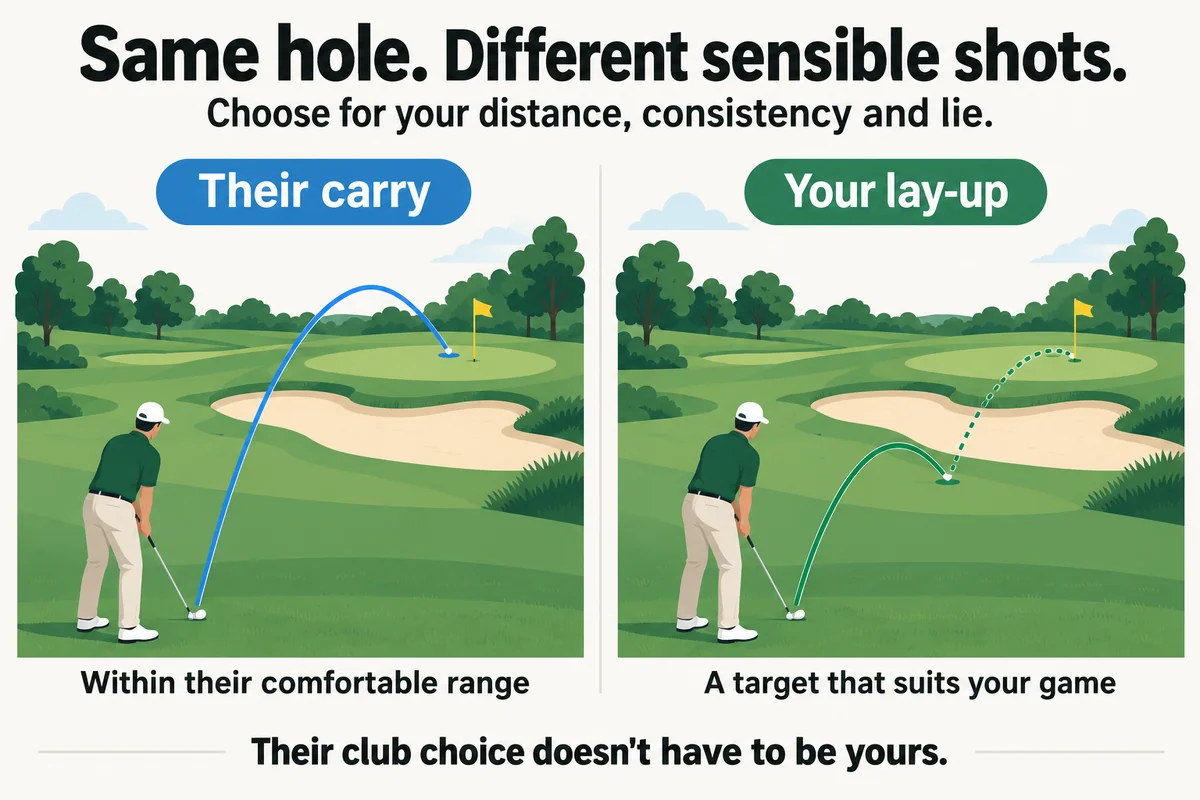
Sometimes the sensible play is to lay up, aim for the wider part of the fairway or take an extra shot to reach the green. That's not a lack of ambition. It's making a decision based on the golfer you are today.
Keep your normal pre-shot routine
When you feel watched, you may be tempted to shorten your routine or rush straight into the swing. Resist the urge to change everything just because the group is better than yours.
Use a simple, familiar sequence: choose the shot, get set, take your attention to the target and play. It doesn't need to be long. It just needs to help you arrive at the ball ready to hit.
Separate pace from pressure
You can be ready to play without hurrying your swing. Move efficiently between shots, keep your clubs organised and be aware of the group ahead. When it's safe and appropriate, play ready golf in line with the group's agreed approach and the Rules.
But never hit simply because you feel embarrassed about taking your turn. Check that the area is clear, that other players are safe and that you're genuinely ready to play.

Let a bad shot be one shot
A poor shot is uncomfortable enough without carrying it into the next one. If you top a drive or send an iron into trouble, acknowledge it and move on to the next decision.
You don't have to explain why it happened, apologise repeatedly or immediately prove you can hit a better one. Your next shot deserves your attention, not the frustration from the last one.
Set one process goal for the round
Pick just one thing you can control. For example: “I'll choose my shot, get ready and commit without comparing it to anyone else's.”
At the end of the round, judge how often you followed that intention—not whether you matched the other players' scores.
What to Do When You Hit a Bad Shot in Front of Better Golfers
The hardest moment often isn't the bad shot itself. It's what happens immediately afterwards.
You might glance at your playing partners, make a joke at your own expense or apologise for the mistake. Then you start thinking about how to avoid doing it again. By the time you reach the next ball, you're carrying embarrassment, frustration and a growing urge to prove yourself.
This is where a small reset can help.
Acknowledge what happened
“That wasn't the shot I wanted.” No drama, no lengthy explanation.
Return to the next decision
Find your ball, assess the lie and decide what the situation calls for. Don't let embarrassment choose your next club or target.
Play the shot in front of you
Use your normal preparation and make a committed attempt at the shot you've chosen. You don't need to repair your reputation with one swing.
If you feel like you're holding everyone up
First, check what's actually happening. Is the group behind waiting on you, or are you simply aware that your partners finish holes in fewer shots? Those are two different things.
If you're keeping up with the group ahead and playing at a reasonable pace, you don't need to race through every shot. If the group is falling behind, look for practical ways to save time: be ready when it's safe to play, limit unnecessary delays and follow the course's pace-of-play guidance.
If you lose a ball or take several shots to get out of trouble, use the course's local rules and lost-ball procedures. Where appropriate, pick up or move on in accordance with the format and any agreed group rules. You don't have to finish every hole at all costs just to prove you belong.
If someone makes you feel uncomfortable
Most rounds won't require a conversation about your ability. But if someone is openly impatient or makes repeated comments about your game, you don't have to treat that as a fair assessment of your worth as a golfer.
You can calmly acknowledge a useful pace-of-play suggestion without accepting personal criticism. If the group dynamic genuinely makes golf unpleasant, it's reasonable to choose playing partners who make the game more enjoyable.
Remember: you are allowed to be learning. The point of playing golf is not to convince everyone that you're already good at it.
You Don't Have to Play Their Game to Enjoy the Round
Playing with better golfers can be a great opportunity. You get to see different approaches to the game, learn from other players and experience golf in a group that might challenge you to improve.
But none of that works particularly well if you're spending the entire round trying to prove that you belong.
You don't need to hit the same clubs, take the same risks or shoot a similar score. You need to make sensible decisions for your own game, be considerate of the people around you and give each shot your attention when it's your turn.
Some days you'll play well. Other days you'll lose balls, miss short putts and wonder why you ever picked up a golf club. That is part of the game for beginners and experienced golfers alike, even if the mistakes look different.
Did you make thoughtful decisions? Did you keep a reasonable pace? Did you recover after mistakes instead of letting them define the next hole?
Those are useful measures of progress, regardless of what the scorecard says.
The more comfortable you become playing your own game around other people, the more you can enjoy what makes golf worthwhile: the challenge, the company and the possibility of getting a little better over time.
Looking for something else?
Search A BETTER ROUND for another golf problem, question or idea.
Can’t find what you’re looking for? Have a golf question? Ask ABR →