
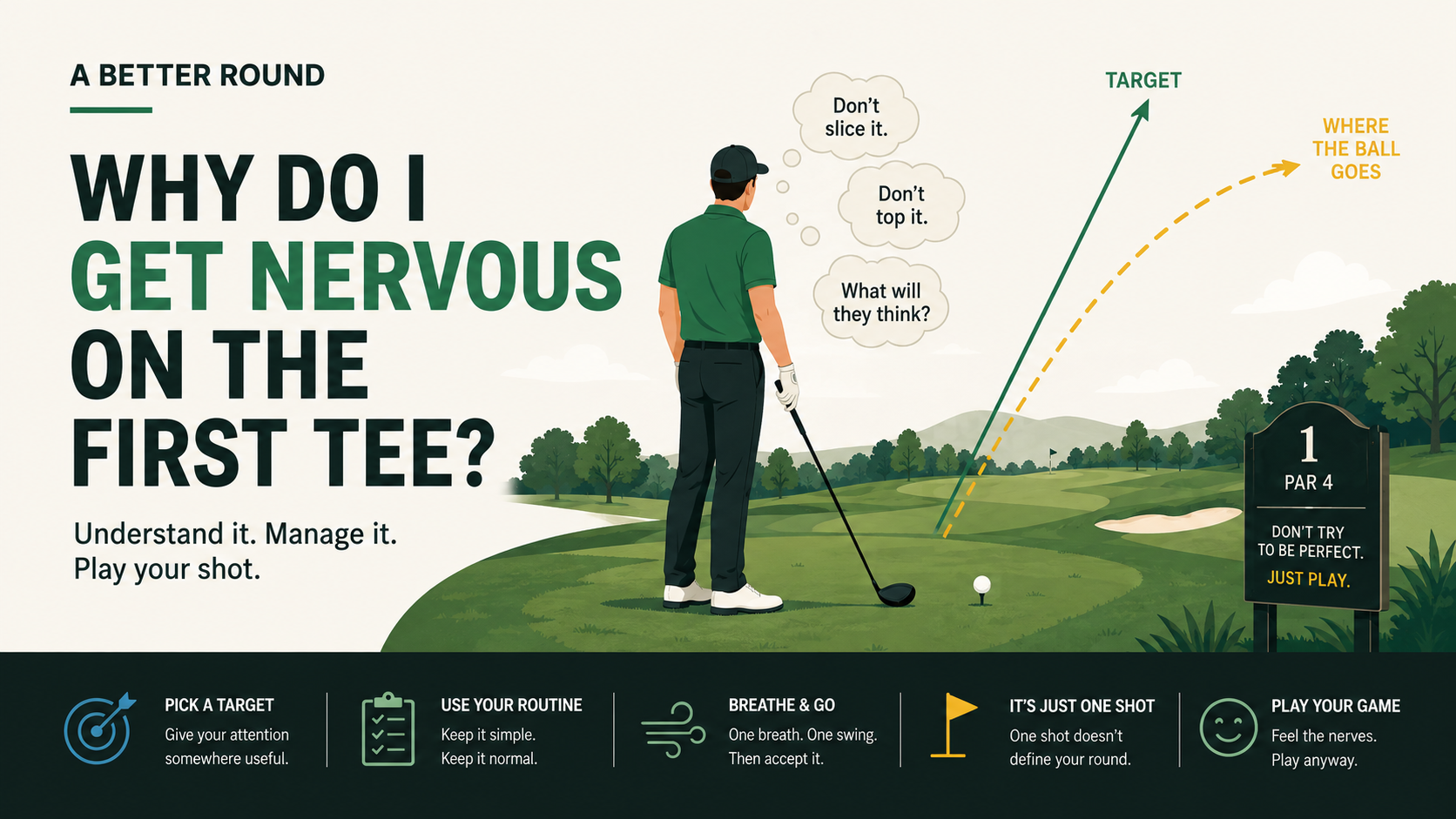
Why Do I Get Nervous on the First Tee?
Why Do I Get Nervous on the First Tee?
First-tee nerves can make a familiar golf swing suddenly feel different. But the nerves themselves aren't necessarily the problem. The more useful question is what happens to your attention when the first shot suddenly feels important.
You've hit a few balls on the range. Everything feels reasonably good.
Then you walk to the first tee and golf suddenly feels like a different sport.
The fairway looks narrower. Your grip feels tighter. You become strangely aware of the people standing nearby. And the swing that felt perfectly ordinary ten minutes ago suddenly feels like something you have to get right.
If that sounds familiar, you're not necessarily dealing with a broken swing.
The first tee combines several things that aren't present in the same way on the range: anticipation, uncertainty, other people watching, and the knowledge that this shot counts.
You can't hit another ball immediately and call the first one a warm-up.
So your attention changes.
Suddenly you're thinking about your takeaway. Your grip. Your head. Your swing path. The bunker. The trees. The people behind you.
And, most helpfully of all, exactly where you don't want the ball to go.
That last part matters.
The feeling of nerves is one thing. What you do when you feel them is another.
The ABR Rule.
You don't need to stop feeling nervous. You need to stop letting the nerves change how you play.
Understand It
What pressure does to your golf
A useful way to think about first-tee nerves is to separate the feeling from the behaviour that follows it.
Your heart rate might rise. You might feel tense. You might become more aware of the people around you.
None of that automatically means you're about to hit a bad shot.
The more interesting problem is what happens to your attention.
When a familiar skill suddenly feels important, you may start consciously monitoring parts of the movement that normally happen without much thought.
Instead of simply hitting the shot, you start supervising the swing.
Is my takeaway right?
Did I turn enough?
Are my hands in the right position?
Am I coming over the top?
Did I keep my head down?
That can be particularly unhelpful when you're already under pressure.
Research into skilled golfers has found that consciously monitoring the execution of a putting stroke can impair putting proficiency. Other research has found that competitive pressure can change golfers' psychological, physiological and movement responses, although the effect on performance is not always the same for everyone.
So the useful lesson isn't that you should never think about your golf swing.
Technical thinking has a place.
Practice is where you work on the movement.
The first tee is where you use it.
That's an important distinction.
If you're deliberately changing your swing, analysing your movement can be useful. But once you've chosen the shot, continuing to monitor every part of the swing can give your attention a job it doesn't need.
Your real task is much simpler:
Pick a target.
Make a decision.
Swing.
What actually matters when you're nervous
You don't need to control everything on the first tee.
In fact, trying to control everything is one of the quickest ways to make the moment feel even bigger.
Think about what happens when the nerves arrive.
You feel watched
Don't spend the next 30 seconds wondering what everyone thinks.
Look at the target.
You fear a bad shot
Don't try to mentally eliminate every possible miss.
Choose one realistic target.
Your swing suddenly feels uncertain
Don't respond by adding three more swing thoughts.
Use one familiar cue, if you normally use one.
You feel rushed
Don't hit the shot simply because you feel uncomfortable standing there.
Keep your normal routine.
You want a great start
Don't turn the first tee into a test you have to pass.
Play the shot you normally play.
Don't play against the bad shot
If you stand over the ball thinking, "Don't slice it," your attention is still centred on the slice.
You're giving your brain a problem rather than a target.
Give yourself something positive and specific to do instead.
Pick a tree.
A fairway edge.
A patch of grass.
A bunker to play away from.
Something you can actually aim at.
Research on attention and putting under pressure provides some support for the broader idea that useful visual attention can help performance when anxiety rises, although that doesn't mean there is one magic way to stare at a particular point during a driver swing.
Give your attention somewhere useful.
A simple first-tee routine
You don't need a complicated mental routine.
In fact, adding another elaborate process to an already nervous golfer probably isn't much of a solution.
Try this instead.
Decide before you arrive
Know which club you're likely to hit and roughly where you want the ball to go.
Don't use the first tee to have a committee meeting with yourself.
Pick one target
Choose something specific in the distance.
Your job is to send the ball there, not to think through every possible place it could end up.
Use your normal routine
If you normally make one rehearsal swing, make one.
If you don't, don't invent one because there are people watching.
The point is familiarity.
Step in and go
Don't wait for the feeling of confidence to arrive.
It might not.
Take your normal setup, look at the target, make your normal swing and let the result be the result.
You may still feel nervous.
That's fine.
The aim isn't to create a first tee where you feel nothing.
The aim is to make a normal decision and execute your normal process while feeling something.
Confidence doesn't have to come before the shot.
Sometimes it comes after you make the swing anyway.
Practise the transition, not just the swing
If first-tee nerves are a problem, hitting another 50 balls on the range isn't necessarily the answer.
You need to practise the part that changes:
going from lots of golf balls and no consequence to one ball and a target.
Next time you're practising, finish with a small first-tee simulation.
01 — Step away from the range for a minute
Create a small break between your normal practice and the simulation.
02 — Choose one club and one realistic target
Don't make the shot harder than it needs to be.
03 — Go through your normal pre-shot routine
No extra mental tricks.
04 — Hit exactly one ball
Treat it as though it is the first tee.
05 — Accept the result without immediately hitting another
A poor shot is information, not an instruction to panic.
06 — Repeat later with a different target
The point isn't to manufacture pressure. It's to become familiar with making a decision and making a swing when you don't have another ball waiting immediately afterwards.
There is some evidence that practising under mild pressure can help golfers become more resilient to later pressure, although this research is still about specific experimental conditions rather than a universal recipe for first-tee nerves.
So don't judge this practice by whether you suddenly become fearless.
Judge it by whether the first-tee situation starts to feel more familiar.
The things worth remembering
Feeling nervous doesn't mean you're going to play badly
Pressure affects golfers differently. The feeling itself isn't proof that your swing is about to disappear.
Don't turn the first tee into a swing lesson
Technical work belongs in practice. On the course, use the swing you've got.
Give your attention a useful job
A specific target is generally more useful than thinking about everything you don't want to happen.
Keep your normal routine
Familiarity matters. Don't invent a complicated routine because the first tee suddenly feels important.
You don't have to wait until you feel confident
You can feel nervous and still make a normal golf swing.
Practise the situation, not just the movement
If the problem appears when one ball suddenly matters, occasionally practise one ball suddenly mattering.
You don't need to conquer the first tee.
You don't need to conquer the first tee.
And you don't need to eliminate the nerves before you can play a good opening shot.
Feel them.
Pick the target.
Follow the routine.
Make the swing.
Then go find the ball.
The nerves can come along for the ride.
They don't have to choose the shot.
The next question is usually more interesting
You might now understand why the first tee can feel different from the range.
But there's another question underneath it:
What happens when the nerves aren't just on the first tee, but start showing up over important shots during the round?
Is the answer the same?
Should you use the same routine?
And why do some golfers seem to play better when the pressure increases?
That's the sort of question worth investigating rather than simply answering with another generic piece of golf advice.
Have a golf question you're still trying to work out? Ask ABR →
Golfers ask. ABR investigates. We figure it out together.
Looking for something else?
Search A BETTER ROUND for another golf problem, question or idea.

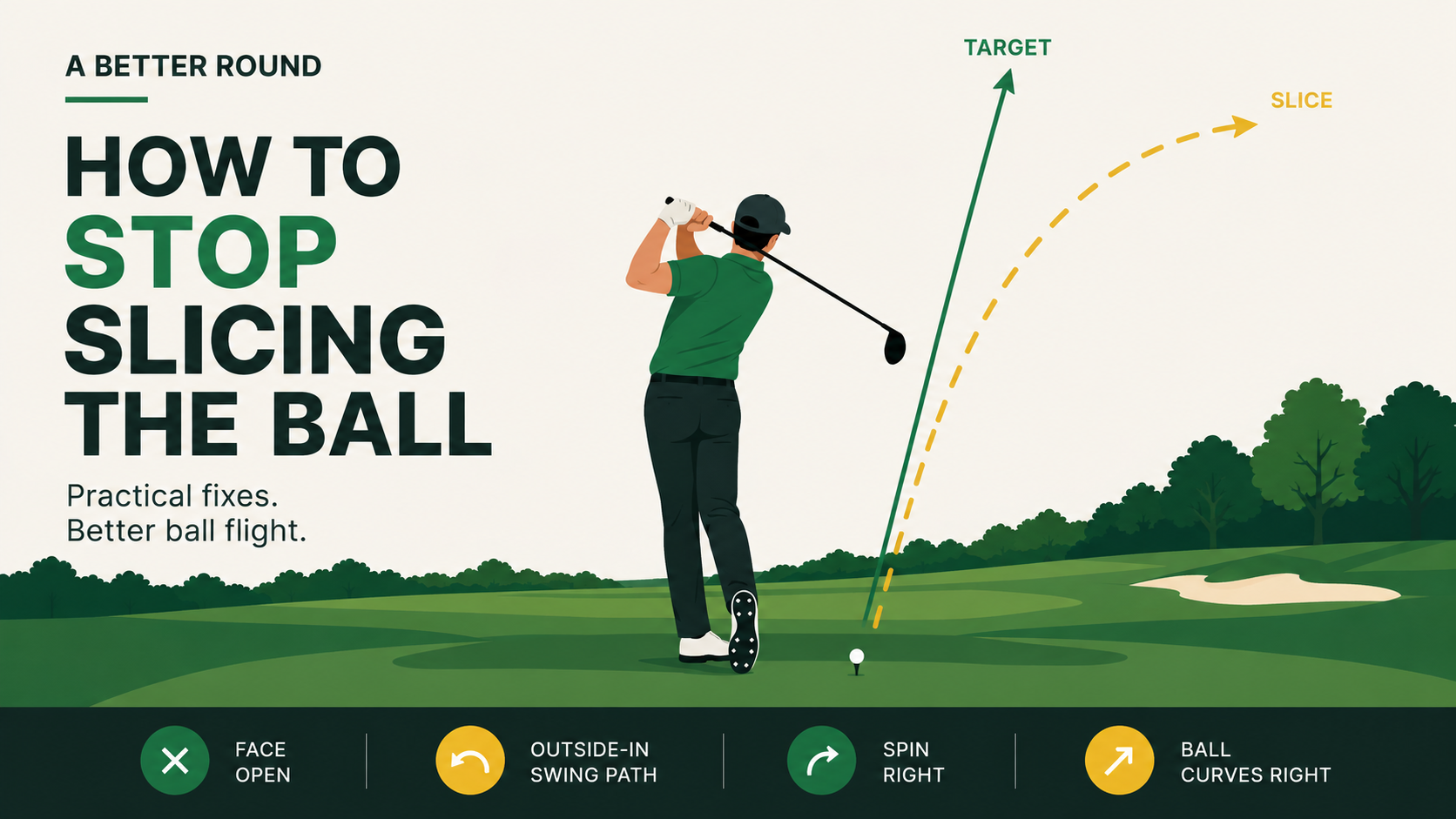
How to Stop Slicing the Ball
How to Stop Slicing the Golf Ball
If you slice the golf ball, the answer isn't necessarily another swing tip. Learn how to read the ball flight, understand what is causing the curve, and work on the variable that actually matters.
If you slice the golf ball, you've probably already tried to fix it.
Maybe you've strengthened your grip. Maybe you've tried to swing more from the inside. Maybe someone has told you to stop coming over the top, slow your backswing down, turn your hips or release the club harder.
The problem is that most slice advice starts with a swing change before you've worked out what is actually causing the ball to curve.
And that can leave you with a familiar golfing problem: six swing thoughts, three different drills and no idea which one is supposed to help.
A better place to start is the ball.
Where did it start? How much did it curve? Where did you strike it?
Those three pieces of information can tell you considerably more than simply saying, "I hit a slice."
A slice isn't one specific swing fault. It is a ball-flight result produced by the relationship between the clubface and club path at impact. Strike can also influence the result, particularly with a driver.
So rather than trying to cure your slice with the latest tip, work backwards from the shot.
Read the ball flight.
Understand the cause. Test one variable. Then practise what actually works.
You don't need a perfect swing. You need a ball flight you can understand.
First, Understand What a Slice Actually Is
For a right-handed golfer, a slice is a shot that curves significantly to the right.
But not every ball that finishes right is a slice.
A ball can start right and stay relatively straight. It can start left and curve right. It can start straight and then peel away.
Those shots may finish in a similar place, but they don't necessarily have the same cause.
That's why the first useful question isn't:
"How do I stop slicing?"
It's:
"What is my ball actually doing?"
Clubface
The clubface's direction at impact has a major influence on where the ball starts. A face pointing right generally produces a start to the right; a face pointing left generally produces a start to the left.
Club Path
Club path is the direction the clubhead is travelling through impact relative to the target line. A path travelling left is often described as out-to-in, while a path travelling right is often described as in-to-out.
Face-to-Path
Face-to-path describes the difference between where the clubface is pointing and the direction the club is travelling. If the face is open relative to the path, the ball tends to curve right for a right-handed golfer.
The greater that face-to-path difference, generally, the greater the curvature.
So imagine two shots.
Shot A: starts left and curves hard right.
Shot B: starts right and curves further right.
Both may finish in the trees, but they don't tell you exactly the same story.
The starting direction gives you information about the face. The curvature gives you information about the relationship between face and path.
You don't need a launch monitor to start learning this. You can learn a lot simply by watching the flight.
Read the Shot Before You Change Your Swing
The next time you slice a ball, don't immediately try to fix it.
Watch it.
1. Where did it start?
- Left of the target
- Roughly at the target
- Right of the target
2. How much did it curve?
- A gentle fade
- A noticeable fade
- A big curve
- A full slice into the next postcode
3. Where did you strike it?
Particularly with a driver, check whether you struck the ball towards the heel, near the centre or towards the toe.
Now you have three useful pieces of information.
That's a much better starting point than simply deciding that your swing is "over the top."
Don't Ignore Where You Strike the Ball
Strike location can be particularly important with the driver.
When the ball is struck away from the centre of the clubface, the clubhead can twist and rotate through impact. This creates gear effect, which can influence the ball's launch and curvature.
A heel strike, for example, can contribute to a right-curving shot for a right-handed golfer.
That matters because you can make what feels like the same swing twice and get noticeably different results if one strike is near the centre and the other is towards the heel.
So if your driver is consistently curving right, don't assume the answer has to be a major swing change.
Check the strike.
A little impact spray or face marking can give you useful feedback. You may discover that part of the problem is happening at the clubface before you even get to the question of what your body or hands are doing.
The ball flight is the output.
Your job is to work backwards towards the input.
So What Should You Actually Change?
Once you've read the shot, resist the temptation to change everything.
For many golfers, the clubface deserves attention before an elaborate attempt to rebuild the entire swing path.
That does not mean "just close the clubface." It means the face is worth testing before you decide that your path is the problem.
Likewise, if your strike is consistently towards the heel, that deserves attention too.
The goal isn't to force a particular swing shape. The goal is to find the variable that has the biggest influence on your particular ball flight.
A simple way to test it
Hit five normal shots
Don't try to fix anything. Hit five shots with your normal swing and pay attention to starting direction, amount of curve and strike location. You're establishing a baseline.
Slow everything down
Hit five half-swings at roughly 50–60% speed. Your only goal is to produce a ball that starts closer to your intended line and curves less. Don't worry about distance.
Test the path
If your ball flight suggests that path may be contributing to the problem, place an alignment aid or headcover outside and slightly behind the ball to give you an external reference. Make controlled swings without contacting it.
Change one variable
Don't simultaneously change your grip, takeaway, backswing, hip rotation, wrist position, release and finish. If you change six things and the ball improves, you won't know why.
Return to normal swings
Hit another five normal shots and compare them with your first five.
- Did the ball start closer to the target?
- Did it curve less?
- Did you strike the face more consistently?
- Did the ball behave differently when you added speed?
Don't judge the session by whether you hit a draw.
Judge it by whether you learned something.
And if nothing improved, that's useful information too. You've eliminated one possibility.
The point isn't to manufacture a particular swing. It's to replace speculation with information.
Make the Better Shot Repeatable
Once you've found something that improves the ball flight, don't immediately try to hit it harder.
Make it repeatable first.
10 balls — controlled
Work at 50–60% speed and reproduce the better ball flight.
10 balls — variable
Change the target between shots. This stops you from simply repeating the same movement to the same target.
10 balls — normal
Go through your normal pre-shot routine and treat each shot as though you're playing.
The goal isn't to hit 30 perfect shots. It's to discover whether the better pattern is becoming something you can actually use.
Don't Try to Turn a Slice Into a Hook
A golfer discovers that trying to swing more from the inside reduces the slice, so they immediately try to exaggerate the movement.
The next shot starts right and hooks left.
Success? Not really.
You've replaced one unpredictable shot with another.
The goal isn't to produce the opposite miss. The goal is to make the ball flight more predictable.
If a small change reduces the amount of curvature, that may be more valuable than a dramatic change that occasionally produces a perfect draw.
Golf improvement isn't about finding the most impressive shot you can hit. It's about making your common shot more playable.
What If You Still Don't Know What's Causing It?
That's normal. Golf swings are complicated, and ball flight can be influenced by more than one variable.
You may discover that your face is contributing to the slice, but that your path is also inconsistent. You may improve your path and discover that your strike is still poor.
Or you may hit five good shots in practice and immediately produce the old slice on the first tee.
None of that means the work failed. It means you're learning how your particular swing behaves.
If you can't identify the cause confidently, don't keep adding swing thoughts.
Get better information. A coach can help. A launch monitor can help. Slow-motion video can help. Even something as simple as recording your start direction and strike pattern over 20 shots can tell you more than guessing.
The point is to replace speculation with information.
Take the Better Pattern Onto the Course
Practice is useful, but the ultimate test is whether you can play golf without constantly thinking about your swing.
When you're on the course, don't stand over the ball trying to remember everything you learned. Use the information instead.
If your normal miss is a predictable fade, allow for it. If you've discovered that your driver strike tends to move towards the heel when you get quick, give yourself a simple reminder and commit to the shot.
And if one appears that looks like your old slice?
Don't panic. You don't need to rebuild your swing in the middle of the round.
You already know what the miss looks like.
That's progress.
The Six Things Worth Remembering
Read the ball before changing the swing
Start direction, curvature and strike can tell you a lot.
Don't confuse every right miss with a slice
A push, fade, push-slice and pull-fade can have different patterns.
The clubface matters
Its direction strongly influences where the ball starts, while face-to-path influences curvature.
Check your strike
Particularly with the driver, heel contact can contribute to a right-curving shot.
Change one thing at a time
If you change everything, you won't know what helped.
Judge practice by what you learn
A session that teaches you something useful is still a good session, even if you don't hit perfect shots.
Don't try to cure your slice with one magic tip.
Learn to read it. Understand the relationship between face and path. Check the strike. Identify the variable that appears to matter most. Change one thing. Test it. Then practise what actually works.
You don't need to create a perfect swing. You need a ball flight you can understand and trust.
That's a better round.
One question usually leads to another.
You might now understand what causes a slice. But knowing what is causing your slice can be harder.
Is it the clubface? The path? The strike? Or some combination of the three?
That's where the next question starts. And it's the sort of thing we're interested in figuring out with golfers, not simply telling them what to do.
Have a golf question you're still trying to work out? Ask ABR.
Golfers ask. ABR investigates. We figure it out together.
Looking for something else?
Search A BETTER ROUND for another golf problem, question or idea.