
Why Do I Keep Topping the Golf Ball?
Why Do I Keep Topping the Golf Ball?
A topped golf shot can seem like an obvious swing fault, but “lifting your head” doesn't really explain why it happened. Understand low point, identify the patterns that can contribute to a top, and test one change at a time.
A topped golf shot is one of those misses that seems to explain itself.
You look up, the ball barely gets airborne and someone nearby says the words you've probably heard a hundred times:
“You lifted your head.”
Maybe you did.
But that doesn't really tell you why you topped the ball.
A more useful question is:
Where did the bottom of your swing go?
The short answer.
For a normal iron shot, you generally want the club to strike the ball before it reaches the bottom of its swing arc. If the club's low point moves behind the ball, the club can be rising as it reaches impact, making it easier to catch the ball too high.
But topping isn't caused by one universal swing fault.
Staying back, standing up through impact, inconsistent setup and trying to help the ball into the air can all contribute to poor contact.
So rather than starting with “How do I keep my head down?”, start with:
“What is my club doing at the bottom of the swing?”
That gives you something you can actually investigate.
What actually happens when you top the ball?
Think of the clubhead travelling in an arc.
At some point, that arc reaches its Low Point before the club begins travelling upward again.
For a typical iron shot, you generally want the ball to be struck before that lowest point.
In simple terms:
Ball → impact → low point → turf
That relationship helps explain why a well-struck iron shot can produce a divot or brush the grass just after the ball. The club has reached the ball first and is still travelling towards its lowest point.
TrackMan defines Low Point in relation to where the club reaches the bottom of its swing arc relative to impact. For iron shots, a low point after impact is associated with ball-first contact.
A top can occur when that relationship is reversed:
Low point → ball → club rising
The leading edge can then catch the ball too high, often producing the familiar low, skidding shot.
That's why low point is a useful way to understand a top.
It doesn't mean every golfer who tops the ball has exactly the same underlying fault.
It means we have a useful starting point for working out what went wrong.
So should you stop lifting your head?
Not as your first solution.
“Keep your head down” is one of golf's oldest pieces of advice, but it isn't a particularly useful diagnosis on its own.
PGA instruction has specifically challenged the idea that simply keeping your head down is the answer, while distinguishing a relatively steady head from trying to freeze it in place.
Your head and body are supposed to move during a golf swing.
The more useful question is whether your movement is changing the relationship between your body, the club and the ground at the wrong time.
For example, if you rise out of posture, remain too far on your trail side or change your setup, the club may not reach the ground where you need it to.
So don't make “keep my head down” your entire swing thought.
Instead, pay attention to where the club is reaching the ground.
That gives you something you can test.
Four things that can contribute to a topped shot
There isn't one universal “topping fault”.
Two golfers can produce almost identical topped shots while getting there in different ways.
These are four useful patterns to investigate.
You are staying back through impact
This is one of the first things worth checking.
If your pressure remains too much on your trail side as you move into impact, your low point can struggle to get far enough forward.
That can leave the club reaching its lowest point behind the ball and rising by the time it reaches impact.
You might notice:
- a feeling of hanging back
- your upper body moving away from the target
- difficulty getting pressure onto your lead side
- a tendency to hit fat shots as well as tops
The connection between fat and topped shots is worth understanding.
If your low point is inconsistent, you can alternate between contacting the ground too early and reacting in a way that produces a topped strike.
TrackMan notes that low point is influenced by the body's pivot and that an inconsistent low point can contribute to fat and thin contact. PGA instruction also identifies staying back as a common contributor to topped iron shots.
That doesn't mean you should simply “throw your weight forward.”
It means investigate whether your pressure and pivot are allowing the low point to move into a more useful position.
You are standing up through the strike
Another possibility is Early Extension.
Early extension describes a move where the pelvis moves towards the ball and the golfer becomes more upright too early in the downswing.
You don't need to understand every part of the biomechanics.
Think about it from the side.
At address, you've established a certain relationship between your body and the ball.
If you suddenly stand taller as the club approaches impact, you've changed that relationship.
The club has to react.
PGA instruction identifies early extension as a move in which the belt buckle moves towards the ball before impact, causing the upper body to stand up and potentially producing topped or inconsistent contact.
This is where “stay down” can also become misleading.
You don't want to freeze yourself in your address position.
You want to avoid standing up so early that the club can no longer reach the ball and ground in the way you intended.
Your setup is making the strike harder
Sometimes the best place to investigate isn't the downswing.
It's the setup.
Ball Position changes the relationship between the ball and the bottom of your swing.
If the ball is consistently positioned somewhere that doesn't suit the club or the motion you're making, you're making the strike harder before the swing has even started.
This is particularly worth checking if your contact pattern is remarkably consistent.
If you repeatedly top the same club and the ball is consistently positioned unusually far forward or back, don't immediately start rebuilding your swing.
Make a small adjustment.
Then hit enough shots to see whether the contact pattern actually changes.
Change one variable.
If you change your ball position, posture, grip and swing thought at the same time, you won't know which change actually mattered.
You are trying to help the ball into the air
This is another common recreational-golfer trap.
The ball is sitting on the ground.
You want it to go up.
So your instinct says:
Help it up.
But an iron already has loft built into it.
You don't need to scoop underneath the ball to make it airborne.
The better objective is to make a controlled strike and allow the club's loft to do its job.
PGA instruction similarly identifies staying back and trying to lift the ball with the hands as contributors to topped shots.
This can create a frustrating cycle:
You top the ball → you think you didn't get underneath it → you try harder to lift it → contact becomes less predictable → you top another one.
The answer isn't necessarily to hit down harder.
It's to stop asking the swing to perform a job the club is already designed to do.
Don't assume every top is the same
This may be the most useful part of diagnosing the problem.
Instead of asking:
“What causes a topped golf shot?”
ask:
“What does my topped shot look and feel like?”
The pattern can give you a starting point.
If you top the ball and also hit fat shots
Look at low-point control first.
Your club may be reaching the ground in inconsistent places.
If you top the ball and feel yourself standing up
Investigate posture and early extension.
Don't simply tell yourself to “stay down”.
Film a few swings from the side if possible and look for whether your body becomes noticeably more upright before impact.
If you consistently top one club
Check setup and ball position before making a major swing change.
If you mainly top when you try to hit harder
Look at tempo, balance and sequencing.
A harder swing can expose a movement pattern that isn't obvious at half speed.
If you only top under pressure
Don't assume you've suddenly developed a completely different swing.
Your intention may have changed.
You might be swinging faster, trying to guide the ball, becoming tense or simply trying too hard to avoid the miss you're worried about.
That's useful information.
The miss may be telling you something about the way your swing changes under pressure, not just what happens in your technically perfect practice swing.
What about topping the driver?
This is where the advice needs to change.
Don't apply an iron swing description blindly to the driver.
With an iron sitting on the ground, ball-first contact followed by the club reaching its low point is a useful model.
A driver is different because the ball is teed up and the desired attack conditions are different.
TrackMan distinguishes between the typical attack-angle conditions for irons and drives: irons are generally struck with a negative attack angle, while drivers are typically struck with a positive attack angle.
So if you're topping your driver, investigate it separately.
Tee height, ball position and the way you deliver the club can all matter.
PGA instruction, for example, uses a different practice approach for topped drives that focuses on the tee rather than trying to reproduce an iron-style ground strike.
The fact that you top an iron and the fact that you top a driver do not automatically point to the same problem.
For this article, we're primarily talking about shots where the ball is sitting on the ground, particularly iron shots.
How to work out what's happening in your own swing
This is where it's tempting to give you five drills.
Don't.
You don't need five drills yet.
You need some information.
Step 1 — Hit 10–15 short iron shots
Take an 8-iron or 7-iron and make comfortable swings.
Don't try to fix the top.
Don't try to swing harder.
Just observe.
- Am I also hitting fat shots?
- Does the top happen when I speed up?
- Do I feel myself standing taller?
- Does my pressure finish on the lead side?
- Is my ball position consistent?
- Does the problem happen on every shot or only occasionally?
You're trying to find a pattern, not a perfect diagnosis.
Step 2 — Make the low point visible
Now give yourself some feedback from the ground.
Put a line on the ground — chalk, a line on the mat or another suitable reference — and use it to observe where the club is contacting the ground relative to where the ball sits.
You aren't trying to manufacture a perfect divot.
You're trying to answer one question:
Can I repeatedly get the club to the ground in roughly the right place?
That's a much better feedback loop than simply asking whether the ball flew.
TrackMan uses Low Point specifically because it provides a way to describe where the bottom of the swing occurs relative to the ball. You can use the same basic idea without owning a launch monitor: the ground itself gives you feedback.
Step 3 — Test one change
Now choose the most obvious pattern.
If you're clearly staying back, experiment with a better pressure shift.
If you're clearly standing up, experiment with maintaining your posture through the strike.
If your ball position is inconsistent, standardise it.
If you're trying to lift the ball, stop trying to lift it.
Don't change everything at once.
If you make four changes and suddenly hit three good shots, you won't know which change helped.
If you change one thing and the contact improves, you've learned something.
That is progress.
Try something else next time rather than piling another thought onto the swing.
A simple 15-minute practice test
You don't need to turn every range session into a swing laboratory.
5 balls — normal
Hit five comfortable 8-iron shots. Don't make any changes. Just observe the contact.
5 balls — ground awareness
Use your ground reference. Focus on where the club is contacting the ground relative to the ball.
5 balls — one experiment
Choose one change based on what you've observed. Then compare the contact.
The objective isn't:
“I must stop topping today.”
The objective is:
“I understand my contact a little better than I did 15 minutes ago.”
If the contact improves, you've found a useful direction.
If it doesn't, that's useful too.
You now know that particular change didn't solve the problem.
Try something else next time rather than piling another thought onto the swing.
What if I keep topping the ball?
If you're still topping shots after you've experimented with the obvious variables, don't assume you're failing to practise hard enough.
A visible miss doesn't always reveal the underlying cause.
A video from face-on and down-the-line can help you see movements you can't feel. A good coach can also help determine whether the problem is actually low point, posture, pressure movement, setup, arm structure or something else.
That's one reason not to become too attached to a diagnosis from an article.
Low point is the useful organising idea. It isn't a guarantee that you've identified the precise fault.
That distinction matters.
The goal isn't to diagnose yourself perfectly from one miss.
The goal is to turn a frustrating shot into useful information.
SOURCE & CITATION
The article uses a small number of authoritative sources where they add useful support to technical claims.
Low Point
TrackMan defines Low Point in relation to where the club reaches the bottom of its swing arc and explains its relationship to whether the golfer strikes the ball before or after the low point. TrackMan also identifies Low Point as a useful measure for understanding ground contact.
Early Extension
PGA instruction describes early extension as the pelvis moving towards the ball before impact, causing the golfer to become more upright and potentially contributing to topped or inconsistent contact.
Staying Back and Helping the Ball Into the Air
PGA instruction identifies remaining on the trail side and attempting to help the ball into the air with the hands as contributors to topped shots.
Head Movement
PGA instruction distinguishes between maintaining a relatively steady head and simply trying to keep the head down, supporting the article's recommendation not to treat “keep your head down” as a complete diagnosis.
Iron vs Driver
TrackMan distinguishes the typical attack-angle conditions of irons and drivers, supporting the article's recommendation to treat topped iron shots and topped drives as separate problems.
What is ABR analysis?
The following elements are ABR editorial synthesis, rather than claims presented as established scientific fact:
- the diagnosis-first framework
- “don't assume every top is the same”
- the pattern-based troubleshooting approach
- the one-change-at-a-time practice process
- the 15-minute practice structure
- the recommendation to use ground contact as practical feedback
These are presented as practical editorial recommendations, not universal prescriptions.
Six things worth remembering
A top isn't simply “lifting your head”
Your head may move, but that doesn't explain why the club was too high at impact.
Think about low point
For a typical iron shot, you want the club to strike the ball before reaching its lowest point.
Look for your pattern
Staying back, standing up, setup problems and trying to help the ball into the air can all contribute to poor contact.
Don't fix five things at once
Find the most obvious pattern and test one change.
Treat the driver separately
The desired strike conditions are different because the ball is teed up.
Better practice starts with better feedback
Instead of simply hitting balls and hoping the top disappears, give yourself a way to see where the club is reaching the ground.
Don't start by trying to keep your head down.
Start by understanding where your club is reaching the bottom of its swing.
Once you understand low point, a topped shot becomes much less mysterious.
You can then investigate the things that might be moving that low point — your pressure, posture, setup or intention — and test them one at a time.
You might not fix the problem in one range session.
That's fine.
The goal is to understand your miss well enough that your practice becomes more useful.
Progress, not perfection.
Once you understand that low point matters, another question naturally appears.
How do you actually practise controlling low point without filling your swing with another five things to think about?
That's a problem worth investigating too.
Have a golf question you're still trying to work out? Ask ABR.
Golfers ask. ABR investigates. We figure it out together.

How to Prepare for Your First Golf Competition
How to Prepare for Your First Golf Competition
Your first golf competition probably requires less preparation than you think. Here's what to know before you play your first competitive round — from understanding the format to handling nerves, scoring and the pressure of having every shot count.
Your first golf competition probably feels like it requires more preparation than it actually does.
Maybe you've entered your first club Stableford. Maybe you're playing in a D-grade competition. Or perhaps your regular group has decided that Saturday's round is going to have a score, a small prize and a little more pride attached to it.
Whatever the situation, you don't suddenly need to become a tournament golfer.
The course is the same. Your clubs are the same. Your swing is the same.
What changes is that the score matters a little more — and that can make familiar golf feel surprisingly unfamiliar.
The best preparation is therefore less about trying to improve your golf in the days before the competition and more about removing the things you don't need to worry about.
Your first competition isn't a deadline for fixing your golf.
It's an opportunity to find out what happens when the shots matter a little more.
Before Anything Else, Find Out What You're Actually Playing
This sounds obvious, but it's probably the most useful thing you can do before your first competition.
Don't arrive at the first tee wondering whether you're playing Stableford or stroke play, how your handicap applies or who is supposed to mark the card.
Find out beforehand.
At a minimum, know:
- What format are you playing?
- Are you playing off a handicap?
- Which tees are you playing from?
- How is the score recorded?
- Who marks whose card?
- Do you need to submit your score after the round?
- Are there any local rules or competition conditions?
If you're playing at a club, the competition notice, pro shop or competition organiser should be able to tell you.
The Rules of Golf also place specific responsibilities on players in competitions, including correctly returning a scorecard where required. The exact requirements can depend on the format and terms of the competition.
Don't be embarrassed to ask.
Knowing what is happening before you start is far more useful than trying to work it out while standing on the first tee.
If It's Your First Competition, Stableford Is Worth Understanding
If you've mostly played social golf, Stableford may be the competition format you encounter first.
The basic idea is simple: instead of adding up every stroke for the final result, you earn points on each hole based on your score relative to the fixed score for that hole.
Net double bogey or worse
0 points
Net bogey
1 point
Net par
2 points
Net birdie
3 points
Net eagle
4 points
The exact competition conditions can vary, but the important thing for a first-timer is this:
One terrible hole doesn't necessarily ruin your competition.
The next hole starts fresh.
Once you can't score any more points on a hole, there is no reason to keep grinding away trying to rescue it. In Stableford, the Rules allow the player to pick up once no further points can be scored, subject to the competition's requirements.
That makes Stableford quite a good introduction to competitive golf.
You can have a disaster, take your zero and move on.
The next hole starts fresh.
What If You Don't Have a Handicap?
Don't assume you can't play competitive golf.
But don't assume you can either.
Formal competitions can have handicap requirements and competition-specific conditions. Informal events, social competitions and games among friends may handle handicaps very differently.
So if you don't have one, ask the organiser:
“Can I play in this competition without an official handicap?”
They'll tell you what applies to that particular event.
If you're intending to play competitions regularly, establishing an official handicap is obviously useful. It gives you a consistent way of competing against golfers of different abilities rather than relying on everyone agreeing on what is “fair”.
But there is an important distinction here:
Not having a handicap doesn't mean you're not ready for competitive golf. It means you need to understand the rules of the particular competition you're entering.
Your First Tee Shot Might Feel Much More Important Than It Is
This is probably the strangest part of a first competition.
You can hit a perfectly ordinary tee shot in a social round without giving it much thought.
Then someone says:
“Good luck, mate.”
And suddenly you're acutely aware that this shot counts.
You might feel nervous.
You might become conscious of people watching.
You might start thinking about where the ball is going before you've even made your backswing.
That's normal.
The trick isn't to eliminate the nerves.
It's to give yourself something more useful to think about.
Pick the target. Choose the shot. Make the normal swing.
That's your job.
Not the next 17 holes.
Not your final score.
Just this shot.
Prepare for the Round, Not a New Golf Swing
Your first competition isn't the day to discover whether you can survive without a 17-step warm-up routine.
The goal is simply to remove avoidable stress and make your golf as familiar as possible.
Arrive Early — But Don't Turn Your Warm-Up Into a Training Session
You don't need to arrive two hours early and hit 100 balls.
You do need enough time that you're not sprinting from the car park to the first tee.
Arrive and get organised
Check in, organise your bag, find the first tee and make sure you understand where you're supposed to be.
Warm up normally
Hit a few balls using clubs and swings you already know. The objective is to feel ready, not to discover a new swing thought.
Put some time into putting
Get a feel for the greens and hit a few short putts. You don't need an elaborate putting session.
Get to the first tee without rushing
Give yourself enough time to settle in before your tee time. A relaxed start is more useful than squeezing in another 20 range balls.
Stick With the Golf You Already Know
If your normal 7-iron is your reliable club, hit your normal 7-iron.
If you normally take three-quarter swings with your wedges, do that.
If your driver has been unreliable for months, don't suddenly decide that competition day is when you're going to start hitting it 20 yards further.
You're not trying to manufacture your best-ever golf.
You're trying to access the golf you already have.
Keep Your Pre-Shot Routine Simple
You don't need a complicated routine. In fact, complicated routines can give your brain even more things to think about.
Target → club → practice look → address → swing
The important part is consistency. If you normally stand over the ball for five seconds, don't suddenly stand there for 20. If you normally take one practice swing, take one. If you normally pick your target from behind the ball, keep doing it.
The routine gives you somewhere to put your attention when your brain starts offering unhelpful thoughts.
You don't have to feel calm.
You just need to know what you're doing next.
Practise the Golf You're About to Play
If you have a week before your competition, don't turn it into a crash course in fixing your golf swing.
Instead, make your practice resemble the golf you're about to play.
Your normal tee shot
Practise the shot you are most likely to use on the course rather than trying to manufacture extra distance.
Your most reliable approach club
Spend time with the clubs you trust rather than chasing technical changes.
Short putts and basic chips
Give yourself some confidence around the green, where simple execution can save shots.
A few awkward lies
Practise the sorts of situations you might actually encounter rather than only hitting perfect range shots.
Your pre-shot routine
Spend some time playing rather than practising so you have to make decisions, accept poor shots and continue when the result matters.
Don't Chase Your Score
This is particularly relevant in Stableford.
You might have a number in your head that you think you should score. Then you're six holes in and behind your imaginary target.
The temptation is to start forcing things.
You see a risky shortcut.
You think:
I need the points.
But the golf course doesn't know you're behind.
The shot still has the same risk.
If you normally lay up, lay up. If you normally aim at the middle of the green, aim at the middle of the green. If you normally hit 7-iron rather than trying to carry the bunker, hit 7-iron.
Don't let the score turn sensible golf into desperate golf.
A competition score is the result of your decisions. It isn't something you can directly control.
Let Your First Competition Teach You Something
You probably think you're preparing to see whether you can play good golf under pressure.
But your first competition can tell you something much more useful:
What changes about your decision-making when the golf matters?
Do you rush?
You may discover that your normal routine disappears as soon as you feel pressure.
Do you become overly cautious?
You may start avoiding shots you normally trust because you're afraid of making a mistake.
Do you chase the score?
You may start taking risks because you're trying to recover points rather than simply playing the hole.
Do you get stuck on bad shots?
You may discover that one poor hole affects the next several decisions.
Those observations are much more valuable than simply deciding:
I need to get better under pressure.
What If You Play Badly?
You might.
In fact, your first competition may be one of your less impressive rounds.
That's okay.
Don't judge the experience entirely by your score.
1. What felt different?
Did you feel nervous? Rushed? Overly cautious?
2. What decisions changed?
Did you attack pins you normally wouldn't? Take different clubs? Try to recover lost points?
3. What would I do differently next time?
Pick one thing. Not seven.
Maybe next time you want to stick more closely to your normal pre-shot routine.
Maybe you want to stop looking at your Stableford total until the end.
Maybe you need to learn the format better before you play.
Maybe you simply need to play another competition so the whole experience feels less unfamiliar.
Don't wait until you're “good enough”
There is no magical point where your golf suddenly becomes competition ready. Handicaps exist so golfers of different abilities can compete against each other.
Lower the stakes in your own head
You don't need to win your grade, beat your handicap, impress your playing partners or shoot your best score. You need to find out what competitive golf feels like.
What About Playing With Golfers You Don't Know?
This can be more intimidating than the competition itself.
You might worry that everyone else is better than you, that you'll slow the group down or that they'll judge you when you hit a terrible shot.
Here's the good news:
Your playing partners probably care much less about your golf than you think they do.
What they will notice is whether you're considerate. Be ready when it's your turn, keep track of your ball, watch where other players hit theirs, keep up with the group in front and be aware of safety.
You don't need to apologise every time you hit a bad shot.
A bunker shot that flies over the green isn't a social offence.
It's just a bad golf shot.
One Piece of Competition Etiquette Worth Knowing
Don't assume there are “gimmes”.
In a casual round, your group might routinely pick up a two-footer.
In a competition, you need to play according to the format and the Rules of Golf.
In stroke play, for example, players are required to hole out unless a specific rule or format changes that requirement.
The same goes for things such as provisional balls, taking relief and playing from the wrong place.
You don't need to memorise the entire Rules of Golf.
When you're unsure, ask.
If something happens on the course and you don't know what the rule is, ask your playing partners or the committee rather than guessing.
What If You Start Badly?
Probably less than you think.
Imagine your first three holes go:
Double bogey. Bogey. Three-putt.
Your brain will probably tell you the competition is already over.
It isn't.
This is one of the biggest traps of competitive golf: starting to play the score rather than the hole.
Bad hole → accept it → reset → play the next hole.
You don't need to win the next hole. You don't need to recover the entire round. You just need to play the next shot sensibly.
What If Your Competition Is Just Your Mates?
Competitive golf is broader than club competitions.
Maybe six friends have decided to put $10 each into a prize pool. Maybe you've joined a group where nobody takes the game particularly seriously — until someone announces the score. Maybe you're playing Ambrose and suddenly everyone cares very deeply about whose tee shot gets chosen.
That's still useful competitive experience.
The stakes don't have to be high for your brain to start treating the shots differently.
You can use these rounds to learn what competition does to your golf.
That's often more useful than whether you happened to win.
The first competition doesn't need to be your best round. It needs to be useful.
Sources & Further Reading
For competition-specific rules and scoring, the strongest references are the Rules of Golf and Rules of Handicapping rather than generic golf advice. Stableford scoring and competition procedures can vary according to the specific Terms of Competition, so the event organiser remains the final authority for a particular event.
For Australian golfers, practical competition details can also vary between clubs, which is why checking the competition notice or asking the organiser is preferable to assuming every event works the same way.
The Six Things Worth Remembering
Know what you're playing
Understand the format, tees, handicap requirements, scoring procedure and local rules before you arrive at the first tee.
Don't rebuild your swing
Competition day isn't the time to introduce a new grip, takeaway or swing thought you've never tested.
Keep your routine familiar
Use the same clubs, decisions and pre-shot routine you already trust.
Don't chase the score
A bad hole doesn't need to become a bad round. Accept it, reset and play the next shot sensibly.
Ask when you're unsure
You don't need to know every Rule of Golf. You do need to avoid guessing when something happens on the course.
Let the first competition teach you something
Your first competitive round doesn't need to be your best round. Pay attention to what changes about your decisions when the shots matter.
Your first competition doesn't need to prove anything.
It's an introduction to what happens to your golf when the shots matter a little more.
Prepare for the things you can control: understand the format, know how your handicap works, arrive without rushing and stick with the golf you already know.
Then let the round teach you something.
You might discover that pressure barely affects you. You might discover that you make terrible decisions when you're chasing a score. You might discover that your swing isn't the problem at all.
The first competition doesn't need to be your best round. It needs to be useful.
That's how you get better at competitive golf.
The official sources behind this article
Competition rules and handicapping can vary according to the format and Terms of Competition. For the rules and scoring information discussed above, we have used the primary governing sources.
Competition conditions can vary between events. If you're unsure about a rule, handicap requirement or scoring procedure, check the Terms of Competition or ask the competition organiser before you play.
One competition usually leads to a better question.
You might finish the round thinking:
Why did I suddenly feel nervous over a three-foot putt?
Or:
Why did I start making completely different decisions once I knew my score?
Or perhaps:
How am I actually supposed to use my handicap in a competition?
Those are the questions that make golf interesting.
You don't need to solve everything before you play. Sometimes you need to play the round first, see what happens and then work out what it means.
Have a golf question you're still trying to work out? Ask ABR.
Golfers ask. ABR investigates. We figure it out together.
Looking for something else?
Search A BETTER ROUND for another golf problem, question or idea.
What Is a Stock Shot in Golf? How to Find Yours and Use It
What Is a Stock Shot in Golf? How to Find Yours and Use It
Your stock shot isn't your best-ever shot. It's the shot you can reasonably expect to hit with your normal swing — and knowing it can help you choose better clubs, targets and strategies.
A stock shot in golf is the predictable shot you normally hit with a particular club when you make your normal swing.
It includes more than whether the ball draws or fades. Your stock shot can include how far the ball normally carries, where it starts, how much it curves, how high it flies, where it typically finishes and where your common miss tends to go.
A stock shot doesn't have to be perfect.
You can have a stock fade. You can have a stock draw. You can even have a stock shot that isn't particularly pretty.
The important thing is that you know what to expect.
That gives you a useful baseline for choosing clubs, targets and strategies.
Your stock shot is your expected reasonably good outcome.
Your stock miss tells you what you need to protect against when things don't go quite right.
What Actually Is a Stock Shot?
The simplest definition is:
A stock shot is the shot you can reasonably expect to hit when you make your normal swing with a particular club.
Imagine you hit 20 seven-irons.
You don't care about the one that you absolutely flushed 160 metres. You also don't care much about the one you caught thin and sent 125.
You're looking for the pattern produced by your reasonably good, normal swings.
Perhaps most of them carry around 145 metres, start slightly left, fade a few metres, fly medium-high and finish somewhere around your intended target.
That's your stock 7-iron.
Notice what isn't required.
- It doesn't have to fly perfectly straight.
- It doesn't have to finish beside the flag.
- It doesn't have to be the shot you'd choose if you were trying to impress someone.
It just needs to be predictable enough to plan around.
Your Stock Shot Isn't Your Best Shot
This is probably the most important distinction.
Golfers are remarkably good at remembering their best shots.
You hit your 7-iron 155 metres once and suddenly 155 becomes "my 7-iron distance".
You hit a perfect draw around a tree and start believing you can call on that shot whenever you need it.
You hit one beautiful driver straight down the middle and forget that your normal ball flight is actually a fade.
That's a problem when you're making decisions on the course.
Your stock shot should be based on what normally happens, not what is theoretically possible.
If your 7-iron carries 145 metres most of the time, that's a more useful number than the 158 metres you managed once.
If your driver normally fades 10 metres, that's more useful information than knowing you can occasionally hit one straight.
Your stock shot is essentially your expected outcome.
And expected outcomes are much more useful for decision-making than your best-case scenario.
What Makes Up Your Stock Shot?
When golfers talk about a stock shot, they often focus only on shape.
"I'm a fader."
"I'm a drawer."
That's useful, but it isn't the whole picture.
A stock shot has several parts.
Distance
How far does the club normally carry? This is more useful than your longest-ever shot when you're choosing a club for an approach.
Starting direction
Does the ball normally start left, right or roughly where you're aiming?
Curvature
Does it stay fairly straight, or does it normally move one way? And how much?
Trajectory
Does your normal shot fly high, medium or low? This can become particularly important when dealing with wind, trees and greens.
Typical finish
Where does the ball normally finish relative to where you aimed?
Stock miss
Where does the ball tend to go when you don't quite make the swing you wanted?
Your stock shot tells you what you expect when things go reasonably well.
Your stock miss tells you what you need to protect against when they don't.
You Might Have a Different Stock Shot With Every Club
You don't necessarily have one stock shot for your entire golf game.
Your driver might have a slight fade. Your fairway wood might be relatively straight. Your irons might have a small draw. Your wedges might fly fairly straight.
That's completely fine.
In fact, it's probably more useful to think of your stock shot club by club.
You don't need to develop one perfect ball flight that works throughout the bag.
You need to understand what each important club tends to do when you make your normal swing.
A simple stock-shot profile
- Driver: slight fade
- 5-wood: straight
- 7-iron: slight draw
- 9-iron: straight
- Sand wedge: slightly lower, straight flight
That information gives you something to work with.
And you don't need a launch monitor to start figuring it out.
Use Your Stock Shot to Make Better Decisions
Because golf is a target game.
You're not rewarded for making the prettiest swing. You're rewarded for getting the ball to the right place.
Knowing your stock shot lets you make decisions based on what you're actually likely to produce.
Imagine you've got 145 metres to the pin.
You know your stock 7-iron carries around 145 metres and normally fades five metres. The flag is on the right side of the green, with trouble beyond it.
You now have a decision.
You could aim directly at the flag and hope your fade doesn't move too far.
Or you could start the ball further left, allowing your normal shot shape to bring it towards the target.
What club?
What distance can I realistically expect?
What target?
Where should I aim to give my normal shot room to work?
What miss?
Where is the ball most likely to finish if I don't quite get it right?
What shot should I avoid?
Is there a situation where trying something outside my normal pattern creates more risk than reward?
The swing hasn't changed.
The decision has.
Your Stock Shot Can Change Where You Aim
Let's say your normal 7-iron fades.
There's a flag in the middle of the green.
You don't necessarily need to aim at the flag.
You can aim slightly left and allow your normal ball flight to move towards it.
That's not trying to hit a special shot.
It's doing the opposite.
You're planning around the shot you already have.
Your Stock Shot Can Help You Choose the Right Club
Distance is another area where golfers often get themselves into trouble.
Suppose your 7-iron can occasionally carry 155 metres. But your normal carry is closer to 145.
You have 150 metres to the front of the green.
If you plan around your best-ever 7-iron, you might choose the 7.
If you plan around your stock shot, you might choose the 6.
Your stock distance should be based on what you normally carry, not how far you can hit the club when everything goes right.
Wind, elevation, lie, temperature and the situation still matter.
Your stock distance simply gives you a more realistic starting point.
Build Your Stock Shot Profile
You don't need a complicated launch-monitor session to start building this information.
Pick one club — a 7-iron is a good place to begin — and work out five things.
Carry
How far does it normally carry?
Start
Where does it normally start?
Shape
Does it draw, fade or fly relatively straight?
Finish
Where does it normally finish relative to your target?
Miss
Where does the common poor-but-normal shot go?
You don't need precise numbers for everything.
"Usually fades a little" is useful. "Normally carries around 145 metres" is useful. "Most misses finish right" is useful.
How Do You Find Your Stock Shot?
Hit enough shots to see a pattern
Don't base your stock shot on three swings. Hit enough balls to see what happens repeatedly. And don't count obvious mishits as evidence of your normal shot. You're trying to understand what happens when you make a reasonably normal swing.
Look at the starting direction
Where does the ball generally start? Left? Right? Straight? This can tell you something different from where it eventually finishes.
Look at the curve
Does it stay relatively straight? Does it fade? Does it draw? And how much? You don't need precise numbers to start.
Work out your realistic carry distance
Don't use your longest shot. Look at what you normally carry with a decent strike. If you have access to a launch monitor, great. If you don't, you can still build a useful estimate over time.
Look at the pattern
Don't ask, "What was my best shot?" Ask, "What happened most often?" That's your starting point.
You Can Do This on the Course, Too
Your stock shot isn't something you need to discover in a single practice session.
You can start noticing it during normal rounds.
After a few rounds, you may realise:
- "Most of my 7-irons start left and fade back."
- "My driver isn't really a slice. It's a small fade unless I get quick."
- "I keep choosing clubs based on how far I can hit them, rather than how far they normally carry."
Those observations are useful.
You don't need perfect data.
You need better information than you had before.
Six Things Worth Remembering
Your stock shot isn't your best shot
It's the shot you can reasonably expect when you make your normal swing.
Think beyond draw or fade
Distance, start direction, curvature, trajectory, finish and miss all form part of your stock-shot profile.
You can have a different stock shot with every club
Your driver doesn't need to behave like your irons. Understand each important club on its own terms.
Your stock miss matters too
Knowing where the poor-but-normal shot goes helps you protect against trouble.
Use your stock shot to choose targets and clubs
Aim around your normal shape and choose clubs around your realistic carry distance.
Start with the shot you already have
You don't need five impressive shots. One dependable shot you understand can be far more useful.
Your stock shot isn't your perfect shot. It's your predictable one.
And that's exactly why it's useful.
You don't need to eliminate every tendency from your golf swing before you can make better decisions.
First, understand what your normal swing produces. Know the typical distance. Know the usual shape. Know the common miss.
Then use that information to choose better targets, clubs and strategies.
Stop planning around the shot you hope to hit. Start planning around the shot you're most likely to hit.
That's a much more useful way to play golf.
Knowing your stock shot creates another question.
Once you know where your ball is likely to go, where should you actually aim?
Because the best target isn't always the flag.
Sometimes it's the part of the course that gives your normal shot the most room to succeed.
That's where course management starts to get really interesting.
Have a golf question you're still trying to work out? Ask ABR.
Golfers ask. ABR investigates. We figure it out together.
Looking for something else?
Search A BETTER ROUND for another golf problem, question or idea.

Should You Buy Golf Clubs From Temu?
Should You Buy Golf Clubs From Temu?
A new set of golf clubs can cost a lot of money. So when Temu starts offering irons, drivers, wedges and even complete sets for a fraction of what you might pay from a major golf brand, the obvious question is: what's the catch?
The answer isn't as simple as “they're rubbish”.
There are golfers who say they've bought cheap clubs from Temu and been pleasantly surprised. There are also plenty of examples of obvious replicas and counterfeit versions of major brands.
And even when a cheap club performs perfectly well, there are questions you can't answer as easily: who made it, how consistent is it, are the specifications accurate, how long will it last and what happens if it breaks?
So should you buy golf clubs from Temu?
Sometimes, perhaps.
But the cheaper the club, the more important it becomes to understand what you're actually buying.
A Quick Answer
Temu isn't a golf club manufacturer. It's a marketplace where different sellers offer different products.
That matters because “Temu golf clubs” aren't one thing. You can find inexpensive clubs sold under unfamiliar brands, clubs designed to resemble established models and products carrying the names and appearance of major manufacturers.
Those are very different propositions.
Recent golfers' experiences reflect that. Some report getting perfectly usable clubs for a fraction of the price of mainstream equipment. Others point to poor grips, questionable shafts, inconsistent specifications or concerns about durability.
One recent discussion included golfers using Temu clubs as perfectly serviceable second sets, while others recommended buying legitimate second-hand clubs instead.
There are also plenty of counterfeit products in the wider marketplace. TaylorMade, Titleist, Ping, Callaway and Scotty Cameron products are among the brands commonly identified in discussions of counterfeit golf equipment.
So the real question isn't whether a Temu golf club can hit a golf ball.
Of course it can.
The better question is what are you giving up by paying so little?
What Are You Actually Buying?
The first thing to understand is that a cheap club isn't automatically a bad club.
Golf clubs aren't magic objects. A driver head doesn't need to cost $800 to make contact with a golf ball, and an iron doesn't stop working because it doesn't have a famous logo on the back.
In fact, recent independent-style testing has shown why the subject is more complicated than it first appears. Golfers have bought highly rated Temu clubs and put them into full sets, while other testers have compared inexpensive replicas with much more expensive clubs.
Some of those tests produce surprisingly respectable results.
But a few good shots don't tell us everything about a club.
A golf club is a combination of:
- the clubhead
- the shaft
- the grip
- the loft and lie
- the length
- the swing weight
- the manufacturing tolerances
- and the consistency from one club to the next.
That last part is easy to overlook.
You might buy an iron that happens to work very well for you. That doesn't necessarily tell you whether the next one produced by the same seller will have exactly the same characteristics.
The USGA's own equipment guidelines recognise the importance of manufacturing consistency: a club model submitted for conformance is expected to have samples that are designed and manufactured to be identical within reasonable manufacturing tolerances.
That's one of the less visible things you're paying for with established equipment.
Why Are the Clubs So Cheap?
It's tempting to assume that the difference between a $100 club and a $500 club is simply a giant brand markup.
There is certainly a branding component to the price of premium golf equipment. But that's not the whole story.
Established manufacturers spend money on product development, testing, tooling, materials, quality control, distribution, customer service and warranty support.
They also produce clubs to specific performance and manufacturing tolerances.
And, importantly, they have to stand behind them.
That doesn't mean an expensive club is automatically better for your golf game. A $1,000 set fitted badly can be a worse choice for you than a $400 set that fits reasonably well.
But it does mean that the price difference isn't necessarily paying for nothing.
You're buying a degree of certainty.
You generally have more confidence about what the club is, what its specifications are supposed to be, how it was produced and who you can contact if something goes wrong.
That's difficult to see in a product photograph.
But Can Cheap Clubs Actually Perform?
This is where things get uncomfortable for anyone wanting a simple answer.
Yes, some appear to.
There are golfers reporting that inexpensive Temu clubs perform well enough that they struggle to notice a meaningful difference during normal play. One 2026 Reddit discussion included a golfer using Temu irons as a second set and reporting that, after several months, they remained perfectly usable, although the finish showed wear and the grips were replaced.
Another golfer described buying a Temu putter and being surprised by its weight and feel compared with an older mainstream putter.
That's useful information.
But it's also anecdotal.
A golfer saying “I hit these just as well” doesn't establish that the club has the same manufacturing consistency, durability or specifications as the established alternative.
Nor does it mean that a cheap club will perform the same way for every golfer.
This is particularly important with irons.
A putter is relatively simple in terms of what the golfer is asking it to do. With irons, the shaft, loft, lie, length and consistency become much more relevant.
If the advertised “stiff” shaft isn't really behaving like the stiff shaft you expected, you've got a very different problem from simply deciding whether you like the look of the club.
One golfer in a 2026 discussion put the issue particularly well: the problem isn't necessarily that the clubs are terrible, but that you may not have a reliable baseline for what you're actually getting, particularly with shaft flex and specifications.
The Counterfeit Problem Is Different
This is where we'd draw a firm line.
There is a big difference between buying a cheap golf club from an unknown manufacturer and buying a fake TaylorMade, Titleist, Ping or Callaway.
The first might be a cheap golf club.
The second is pretending to be something it isn't.
Counterfeit golf clubs are not a new phenomenon, but they are part of the marketplace surrounding ultra-cheap equipment. Golfers regularly report encountering replicas of major models, with P790-style irons and Scotty Cameron-style putters among the products frequently discussed.
And sometimes the replicas can look remarkably convincing.
That's actually part of the problem.
A club can look almost identical to the real thing without having the same materials, construction or manufacturing process.
There is also no good reason to assume that a product is genuine simply because the listing uses the same photographs or model name as the genuine product.
A suspiciously cheap premium club is a warning sign.
If you're paying a suspiciously small amount for a supposedly new premium club, that's not a clever golf bargain. It's a warning sign.
So What Does the Extra Money Buy?
This is probably the most useful way to think about the whole Temu question.
You're not necessarily paying hundreds of dollars more simply to hit the ball farther.
Consistency
The confidence that one 7-iron is built to the same specification as the next.
Known specifications
Loft, lie, length, shaft and swing weight are meaningful when you're trying to build a consistent set.
Shaft choice
Established manufacturers and club fitters give you considerably more options for matching the club to your swing.
Research and development
Major manufacturers invest heavily in testing designs and materials. That doesn't guarantee that their newest technology will improve your score, but it does mean there is a development process behind the product.
Quality control
You are buying a higher level of confidence that the club you received is the club that was intended to be produced.
Warranty and support
If an established club fails, there is normally a manufacturer or retailer standing behind it.
Resale value
A recognisable golf brand is much easier to sell second-hand.
Conformity
Golf equipment used in competition is subject to equipment rules. The USGA and R&A maintain detailed equipment specifications and conformance procedures.
None of this means every premium club is worth its price.
It means there are things in a golf club that you can't judge from a few swings on a range.
The Comparison That Matters: Temu vs Used Clubs
This is where we'd be more cautious about recommending Temu.
If you have $300 to spend on golf clubs, don't compare a $300 Temu set with a $1,500 premium set.
That's not a fair comparison.
Compare it with what else $300 can buy.
And one of the most obvious alternatives is legitimate second-hand equipment.
A five-year-old set from a reputable manufacturer might not have the latest technology, but you know what it is. You can check its specifications, research reviews, find replacement components and potentially sell it later.
The second-hand market also lets you buy individual clubs rather than committing to an entire set.
You might spend $300 building a mixed bag of older Callaway, TaylorMade, Cobra, Ping, Titleist or Mizuno clubs that have already lost much of their original retail value.
For a golfer who actually intends to play regularly, we'd generally prefer that proposition to gambling the same money on an unknown complete set.
The equation changes if the second-hand market in your area is particularly expensive or limited. Some golfers report exactly that, saying Temu gives them access to new clubs for less than the used clubs available locally.
That's a legitimate reason to consider it.
When Might Buying From Temu Actually Make Sense?
There are situations where the risk is relatively low.
Say you've just started playing golf.
You're not sure whether you'll still be playing in 12 months.
You don't want to spend $1,500 on a set before you know whether golf is going to become a hobby.
In that situation, spending a modest amount on a basic set isn't necessarily irrational.
You're effectively buying an inexpensive way into the game.
The same could apply if you're:
- an occasional golfer
- buying a spare set
- buying clubs for someone who is just starting
- experimenting with a particular type of club
- looking for a low-cost travel or backup club
- comfortable accepting some uncertainty.
The important word is uncertainty.
You're not necessarily getting a terrible club.
You're accepting that you know less about what you're getting.
For some golfers, that's a perfectly reasonable trade-off.
When Would We Look Elsewhere?
The calculation changes as you become more serious about golf.
If you're playing every week and actively trying to improve, equipment consistency becomes more useful.
If you're getting fitted, there's little point spending money on a fitting and then buying a club whose actual specifications you're uncertain about.
If you play competitions, you have another reason to care about conformity.
And if you're spending several hundred dollars on a complete set, the second-hand market starts to look increasingly attractive.
The same is true if you're hoping the clubs will last for many years.
A cheap purchase isn't necessarily cheap if you have to replace it twice.
Don't Confuse Price With Value
This is perhaps the biggest lesson from the Temu question.
Cheap and good value aren't the same thing.
A $100 club that performs reasonably well might be fantastic value. It might also be a poor purchase if it breaks six months later, has an unsuitable shaft or can't be resold.
Conversely, a $700 driver isn't automatically good value simply because it's made by a famous manufacturer.
The question we should ask about any golf equipment is:
What am I getting for the money, and does that matter to my golf?
That's a much better question than simply asking what's the cheapest one I can find.
So, Should You Buy Golf Clubs From Temu?
If you want our simple answer:
We wouldn't make Temu our first choice for a serious golfer building a long-term set.
We'd look first at reputable brands, good-value direct-to-consumer equipment and the legitimate second-hand market.
But we also wouldn't tell a casual golfer that buying an inexpensive, non-counterfeit Temu club is automatically a terrible idea.
Some cheap clubs clearly can be playable.
The issue is that you're taking on more uncertainty about the product, the specifications, the manufacturing consistency, durability and support.
And that's the trade-off.
If you're a beginner who wants to spend $200–$300 getting into golf, that trade-off might be acceptable.
If you're a regular golfer trying to build a dependable set around your swing, we'd rather spend that money on something we know more about.
And we'd draw a hard line at counterfeit branded clubs.
Don't buy a fake TaylorMade, Titleist, Ping or Callaway because you think you've found the bargain of the century. If you want to save money, buy a legitimate cheaper club or a genuine used one.
That's where the real value usually lies.
You don't need expensive golf clubs to play good golf. But you do need to know what you're buying.
A cheap Temu club may turn out to be perfectly playable. The problem is that the low price can also mean less certainty about the club's specifications, consistency, durability and support.
For a casual golfer, that gamble might be worth taking.
For someone building a serious set, we'd spend the same money on something with a clearer history — particularly a genuine second-hand club from an established manufacturer.
Don't pay for a logo you don't need. But don't confuse paying less with getting more.
How much do you actually need to spend on golf clubs?
Because if the answer isn't “as much as possible”, there has to be a sensible middle ground between bargain-bin equipment and a $2,000 bag.
That's the part worth working out.
Have a golf question you're still trying to work out? Ask ABR.
Golfers ask. ABR investigates. We figure it out together.
Looking for something else?
Search A BETTER ROUND for another golf problem, question or idea.

Why Do I Go Through Performance Slumps?
Why Do I Go Through Performance Slumps?
A golf slump can feel like you've forgotten how to play. But old habits can return when fatigue, pressure, timing, practice or attention change — and understanding why can help you reset without rebuilding everything.
One of the easiest traps in golf is assuming that a run of poor shots means you've lost an ability you previously had.
You hit a few pulls, so you start working on your path.
Then you hit a push, so you change something else.
Then you top one.
Now you're thinking about your head, your arms, your grip and your takeaway before you've even reached the ball.
The problem isn't necessarily that you need more things to work on.
It may be that you're reacting to the symptoms of a disrupted movement pattern rather than identifying what caused the disruption in the first place.
Your golf swing isn't a collection of independent movements that you consciously assemble every time you play.
It's a coordinated movement you've built through repetition.
That matters when things go wrong.
Your body tends to prefer what it already knows
If you've spent years making a particular movement, your nervous system has become very good at producing it.
That doesn't mean the movement is technically perfect.
It means it's familiar.
So when you're tired, rushed, distracted or under pressure, there is a good chance you'll rely more heavily on established movement patterns.
This is one reason an old miss can suddenly return.
You may not have consciously decided to go back to your old swing.
Your body may simply have returned to a movement it knows extremely well.
Don't immediately assume you need a new swing.
First ask what allowed the old pattern to reappear.
There isn't one cause of a performance slump.
Sometimes it's mechanical. Sometimes it's mental. Often it's a combination.
The important thing is to recognise that your performance is produced by a system. Change one part of that system and something else may compensate.
Your body has learned a pattern
Imagine you've been working on staying more stable through your backswing.
For a few weeks, you practise it deliberately. Your contact improves. Your ball flight becomes more predictable.
Then you stop thinking about it.
You play several rounds without practising.
Eventually, your old movement starts creeping back.
That's not necessarily a failure of your new technique.
It's simply what happens when a newer pattern has not yet become as automatic as the older one.
The old movement has had more repetitions behind it.
The answer may not be more technical information.
It may be enough quality repetition to make the better movement easier to access again.
Fatigue can change your movement
This one is easy to underestimate.
Your golf swing happens quickly, but it still requires coordination, balance and force production.
When you're physically tired, you may not reproduce the same movement as you do when you're fresh.
You might lose some stability.
You might stand up through impact.
You might become quicker in transition.
You might struggle to maintain the same sequence of movements.
And because the changes can be subtle, the result can feel like you've suddenly forgotten how to swing.
Sometimes the more useful question is simply:
Was I actually moving like I normally do?
If your poor golf consistently appears late in a round, after a long week at work or when you're playing several days in a row, fatigue deserves some attention before you start rebuilding your technique.
Your timing can drift without your swing completely changing
Golfers often describe a swing as feeling "off" without being able to identify exactly what has changed.
Timing is one reason.
The individual parts of your swing might still be broadly where you expect them to be, but the relationships between them can change.
Your backswing might become slightly quicker.
Your transition might become more abrupt.
Your lower body might move differently.
Your arms might catch up or fall behind.
A small timing change can produce a very different strike.
That's why trying to fix the visible result can sometimes make things worse.
If you're suddenly hitting pulls, for example, you don't necessarily need to spend the next 30 balls trying to manufacture a completely different club path.
You might first need to restore the tempo and sequence that allowed your normal delivery to happen.
If the swing feels unusually fast, slow or disconnected, investigate timing before assuming you've developed a completely new technical fault.
Pressure Changes What You Pay Attention To
There is another reason old patterns can return: what you're thinking about changes.
When you're playing freely, you may simply see the shot and hit it.
Then you hit a few bad shots.
You become concerned about the next one.
You start monitoring your grip.
Then your takeaway.
Then whether your head is moving.
Now you're trying to consciously control movements that normally happen without much conscious supervision.
This can interfere with the very movement you're trying to improve.
The more important the shot feels, the more you may try to control it
This is particularly noticeable when a golfer is playing well.
You're one over after 12 holes.
You start thinking about the score.
You don't want to ruin the round.
The next tee shot suddenly feels important.
Instead of making the swing you've been making all day, you start trying to make sure you don't make a mistake.
That can produce tension, hesitation or a change in tempo.
And then the bad shot reinforces the thought:
"See? I knew I couldn't keep it going."
But the sequence may actually be:
importance → more conscious control → altered movement → poor shot → increased concern.
Understanding that sequence is useful because it gives you somewhere to intervene.
You don't necessarily need to "think positively."
You may simply need to reduce the number of things you're trying to control.
Sometimes You've Practised The Wrong Thing
A slump can also come from practice.
This sounds counterintuitive, but more practice isn't automatically better practice.
If you repeatedly hit balls while making a compensating movement, you can become very good at reproducing that compensation.
Or you might spend an hour working on one technical change without ever testing whether it transfers to an actual golf shot.
Then you arrive on the course and discover that the movement you practised doesn't appear when you have a target, a club and a consequence.
That's not necessarily because the practice was useless.
It may simply mean you haven't bridged the gap between learning a movement and using it.
A Better Practice Question
Instead of asking:
"How many balls did I hit?"
ask:
"What did I actually learn from those balls?"
If you're working on a technical change, give yourself enough repetition to understand it.
Then introduce targets.
Change clubs.
Change distances.
Hit one ball rather than ten identical balls.
Create situations where you have to make a decision.
The objective is gradually moving from:
"Can I perform this movement?"
to
"Can I use this movement when I'm actually playing golf?"
That distinction can explain why something works beautifully on the range but seems to disappear on the course.
Slow down the diagnosis.
The instinct when your game goes bad is often to do more.
More practice. More swing thoughts. More YouTube videos. More technical changes.
Try the opposite first.
You don't need to know exactly what is wrong after three bad shots.
Identify the pattern
Don't treat every bad shot as a separate problem. Look for repetition.
- Are you consistently starting the ball left?
- Are you striking the ground inconsistently?
- Are you losing balance?
- Are you becoming quicker?
- Are you struggling late in the round?
- Are you making worse decisions?
- Are you becoming more defensive over certain shots?
- Are you playing better on the range than on the course?
A pattern is useful. One bad shot usually isn't.
Ask what changed
This is probably the most useful question in the entire process.
What was different when I was playing well?
Maybe you were practising regularly, using one simple swing cue, taking more club, playing within yourself, sleeping better, walking instead of rushing, accepting your normal miss, or focusing on the target rather than the mechanics.
You don't need to recreate everything. You're looking for the variable that might matter.
Test one meaningful variable
If your ball striking deteriorated after you stopped practising your tempo, for example, that is a much more useful clue than deciding you suddenly need to rebuild your entire backswing.
Change one meaningful thing and observe what happens.
Don't chase every miss
Your swing will never be perfectly repeatable. Even very good golfers hit poor shots.
Ask:
Is this an isolated shot, or is this a repeatable pattern?
If it's a pattern, investigate it. If it isn't, you may simply have hit a bad shot.
Don't diagnose the whole swing from one bad shot.
Look for a pattern, identify what changed, then test one meaningful variable.
There is also a physical side to this that golfers sometimes overlook.
If your body doesn't move comfortably in a particular direction, your swing has to work around that limitation.
That doesn't mean every swing problem is caused by poor mobility.
It means movement is constrained by the body producing it.
If you've developed a new habit of standing up through impact, for example, there could be several explanations.
It could be technical.
It could be a balance issue.
It could be related to how you're using your hips.
It could be a reaction to something happening earlier in the swing.
Or it could simply be the way your body has learned to organise the movement.
That's why trying to diagnose physical causes from a single ball flight is difficult.
But you can still pay attention to useful clues.
Notice when the problem appears
Does it happen:
- only with the driver?
- only with longer clubs?
- late in the round?
- when you try to hit harder?
- when the lie is uneven?
- when you're tired?
- when you're under pressure?
Those details matter.
They can help distinguish between a general movement problem and a situation-specific pattern.
And if you suspect a physical limitation rather than a technical issue, that's a good point to get qualified help rather than trying to diagnose your body from golf videos.
The Reset Doesn't Have To Be A Rebuild
One of the most useful things you can learn about slumps is that a reset doesn't have to mean starting again.
Sometimes you just need to reconnect with something you already know.
That might mean going back to your most reliable club.
It might mean hitting half swings.
It might mean slowing your tempo.
It might mean returning to a simple setup routine.
It might mean spending 20 minutes hitting shots without changing anything, simply observing what the ball is doing.
The point is to give your system a chance to settle.
Try changing one meaningful variable
If your swing has gone sideways, pick one thing to investigate.
For example:
"I'm going to focus on tempo for this session."
Then observe the result.
If your strike improves, you've learned something.
If it doesn't, you haven't failed.
You've ruled out one possibility.
That is a much healthier way to work through a slump than changing five things and having no idea which one mattered.
What a good reset actually looks like.
A useful reset might be surprisingly boring.
Start with a club you trust
Hit some easy shots. Don't chase distance. Pay attention to contact and notice the starting direction.
Find a tempo that feels repeatable
Don't try to manufacture your best swing immediately. Find a movement you can reproduce comfortably.
Gradually increase the difficulty
Move from comfortable → normal → challenging.
If the problem reappears at a particular point, that's useful information.
Find the condition that changes the result
Maybe everything looks fine at 70% speed but falls apart when you try to hit harder. Maybe your contact is good until you use the driver. Maybe your swing works on the range but changes as soon as you introduce a target.
Now you've got something to investigate.
"My swing changes when I add speed."
That's a much better problem to have than simply thinking, "My swing has disappeared."
You May Not Need To Get Back To Your Best
There's another trap in the language we use around slumps.
We talk about "getting your swing back."
But which swing?
The one you had three weeks ago?
Last year?
Your best round ever?
Golf doesn't work like a saved computer file that you can simply restore.
Your body changes.
Your confidence changes.
Your technique develops.
Your circumstances change.
Your game will move around.
The goal isn't necessarily to recreate a previous version of yourself.
It's to understand what's happening now and find a version of your movement that you can repeat.
That is a much more useful definition of progress.
A slump doesn't always mean you've lost your swing.
Often, something has changed — your movement, timing, fatigue, attention, practice or the amount of pressure you're putting on the shot — and your body has responded by returning to something more familiar.
Instead of immediately rebuilding your swing, look for the pattern. Ask what changed. Then change one meaningful thing and see what happens.
You don't always need a new solution. Sometimes you need to reconnect with the one that was already working.
How do you know whether you've actually got a problem?
Once you start looking at slumps this way, another question naturally appears: how do you tell whether you're dealing with a genuine technical problem or simply a temporary run of poor shots?
Golfers rarely have perfectly repeatable swings, and a few bad shots can make almost any part of your technique look suspicious. The useful skill is learning when to investigate and when to leave something alone.
That's part of getting better at golf too — not just finding things to fix, but learning which things actually need fixing.
Have a golf question you're still trying to work out? Ask ABR.
Golfers ask. ABR investigates. We figure it out together.
Looking for something else?
Search A BETTER ROUND for another golf problem, question or idea.
How to Structure a Golf Range Session That Actually Helps Your Game
What Should You Actually Do at the Golf Range?
A bucket of balls isn't automatically a practice session. Here's how to make your range time more useful without turning it into a complicated training programme.
This article started with a question from Gavin in New Zealand.
Have a question? Ask ABR →
First, decide what you're there to do.
Before you hit your first ball, give the session a purpose.
That purpose doesn't have to be complicated. You might be warming up before a round, learning how far your clubs actually go, working on your contact, practising a particular swing change, becoming more comfortable with your driver, learning to control different shots, preparing for a course you're about to play or simply having a hit.
These are all legitimate reasons to go to the range.
The important thing is that they aren't the same thing.
If you're working with a coach on a specific swing change, for example, you may deliberately hit the same club repeatedly so you can concentrate on that movement.
Technical practice
You're deliberately working on a movement or swing change.
Skill practice
You're learning to control the ball in different situations, with different clubs, targets or shot requirements.
Performance practice
You're practising the decisions and execution that happen when you actually play.
A useful range session can contain all three.
You don't have to choose one forever.
The point isn't to make every range session complicated.
It's to know what you're trying to get from the balls you're hitting.
If you don't know what you're trying to accomplish, it's very easy for the session to become 60 or 100 unrelated swings.
Start simple. Then make the shots more like golf.
01 — Warm up
Your first golf swing of the day probably isn't going to be your best one.
There's no particular reason to expect it to be.
Start with a short iron or wedge and make some comfortable swings. You might begin with a few easy half-swings before gradually increasing the length and speed of the swing.
The objective isn't to hit the ball as hard as possible.
Get your body moving, find some rhythm and establish reasonable contact.
Don't turn your warm-up into a performance test.
Give yourself a few balls to settle in before deciding whether anything needs fixing.
02 — Change clubs
There is a good reason golfers like hitting the same club repeatedly.
It feels productive.
You hit a 7-iron. Then another 7-iron. Then another.
Eventually you hit three or four good ones in a row and think, “I've got it.”
Maybe you have. But on the golf course, you don't normally hit 15 consecutive 7-irons.
You hit a driver. Then perhaps a 7-iron. Then a wedge. Then another 7-iron. Then a hybrid.
Every shot requires you to reset. The club changes. The distance changes. The target changes. Your visual picture changes.
A simple club ladder
PW
→
8-IRON
→
6-IRON
→
HYBRID
→
DRIVER
You don't need to follow that exact sequence. The point is simply to introduce change.
If you're trying to learn a new movement, repetition can be useful. But once you're trying to make a skill usable on the course, changing the situation is valuable.
03 — Aim with purpose
A driving range is full of targets. Flags. Posts. Distance markers. Trees. Signs. The edges of the range.
Use them.
Instead of thinking, “I'm hitting a 7-iron,” start thinking, “I'm hitting a 7-iron to that target.”
That small change gives the shot a job.
Pick a target before you hit. Then make your normal setup and pre-shot routine.
You're beginning to practise aiming and executing, rather than simply making swings.
Don't just practise different clubs. Practise different decisions.
Learn your actual distances
The range is also a good place to learn something very practical: what your clubs actually do.
Not what the number on the club says. Not how far you hit one particularly good shot. And not how far your friend says you should hit a 7-iron.
How far does your normal shot go?
Your useful distance is the one you can reasonably expect.
Over time, start building a picture of your normal distances. Your numbers don't need to match anybody else's.
Once you know them, club selection on the course becomes much easier.
Explore different shots
Golf isn't simply a collection of clubs. It's a collection of shots.
Sometimes you need to hit a normal full shot. Sometimes you need to take something off. Sometimes you have more room and can be aggressive. Sometimes you need to keep the ball lower.
You don't need to become a shot-shaping expert to benefit from this.
Just experiment.
Take a 7-iron and try hitting one normal shot. Then try one with a slightly lower flight. Then perhaps one where you deliberately take some speed off.
The objective isn't to manufacture perfect golf shots.
Ask a better question:
What can I actually do with this club?
Play golf
There is a point where you can stop working on your swing and start working on playing.
Imagine a par 4 you know.
You hit your imaginary tee shot. Where did it finish?
Now you're playing your second shot. What club would you choose? Where is your target? What kind of shot would you try to hit?
Hit it.
Then imagine where that finished and play the next shot.
You're no longer simply asking, “Can I hit this club?” You're asking, “What shot do I need here?”
That's much closer to the decisions you actually make on the course.
Make some of the range work like the course.
One of the biggest differences between range golf and course golf is what happens after a bad shot.
On the range, you can immediately hit another.
On the course, you can't.
Try a one-ball mindset
Pick a target. Choose your club. Go through your normal pre-shot routine. Hit one ball.
Then stop.
Don't immediately try to correct it. Instead, ask:
- Was that the shot I intended to hit?
- Was the contact what I expected?
- Did the ball start where I expected?
- What would I do differently if I had to hit it again?
Then move to a completely different shot.
Don't turn every bad shot into a swing problem.
Sometimes the useful information is simply: “That's my miss.”
Finish with a little pressure
Five balls. Five targets. One shot each.
Before every shot: pick the target, choose the shot, go through your routine and hit it.
No second attempt. No mulligan.
You could score yourself in a very simple way: did the ball finish inside the intended area?
Yes or no.
That's enough.
The ABR 60-Ball Range Session
10 balls
Find rhythm and establish contact.
15 balls
Change clubs and reset between shots.
15 balls
Practise aiming and execution.
15 balls
Introduce decisions and shot selection.
5 balls
Test your execution.
But don't treat 60 as a magic number.
If you have 30 balls, halve it. If you've got 90, spend the extra balls on whatever you're actually trying to improve.
The framework is more important than the number.
The objective isn't to finish a bucket. It's to finish a useful practice session.
You don't need an elaborate practice plan.
If you're brand new to golf, you don't need to jump straight into elaborate practice games.
Your early range sessions can be much simpler.
Learn contact
Learn how to make reasonable contact and start the ball roughly where you're intending.
Learn your clubs
Get comfortable with what different clubs feel like and begin learning your normal distances.
Build your routine
Get comfortable with your setup, target selection and pre-shot routine.
Then gradually introduce more targets, different clubs and simulated holes.
The range isn't an exam. It's a place where you can discover what your golf currently looks like.
You also don't need to be embarrassed about hitting poor shots.
You're learning.
There is nothing wrong with just hitting balls.
Structured practice can become its own kind of golf-industry nonsense.
Sometimes you just want to hit balls. That's fine.
You don't need a spreadsheet for every bucket. You don't need a practice objective for every Tuesday afternoon.
Golf is supposed to be enjoyable.
If you want to stand on the range and hit your driver because you enjoy watching it fly, go for it.
The problem isn't unstructured practice.
It's expecting unstructured ball hitting to produce structured improvement.
The more deliberate you are about what you're trying to learn, the more useful the range becomes.
The range is not there to help you hit more golf balls.
It's there to help you learn what to do with them.
Use repetition when you're deliberately learning something. Use changing clubs and targets when you're trying to develop adaptable skills. And spend at least some of your time practising the thing you're ultimately trying to get better at: playing golf.
You don't need a perfect swing. You don't need a complicated practice plan.
You just need to make your practice a little more useful.
Six things worth remembering.
Don't confuse hitting balls with practising.
A bucket of balls isn't automatically a practice session. Decide what you're trying to accomplish before you start.
Use repetition when it has a purpose.
If you're learning a technical change, repeating the same shot can be useful. Don't introduce variety just because you think you're supposed to.
Change clubs and targets.
Once you're developing skills, make the shots less predictable. Golf rarely asks you to hit the same club to the same target repeatedly.
Learn your normal distances.
Your reliable carry distance is more useful than the longest shot you've ever hit.
Practise playing, not just swinging.
Play imaginary holes. Choose targets. Make decisions. Use your routine. Give yourself one-ball challenges.
More balls aren't necessarily more useful.
A shorter, purposeful session can teach you more than a long session where you're simply trying to empty the bucket.
Knowing you should practise is one thing. Knowing what to practise is another.
That's what makes Gavin's question a useful one.
The range can help you learn your swing, your clubs and your shots. But the more you practise, the more questions tend to appear.
How much should you practise? How do you know whether a swing change is actually working? And when should you stop working on technique and simply play?
Those are the sorts of questions we're interested in figuring out with golfers, not simply telling them what to do.
Have a golf question you're still trying to work out? Ask ABR.
Golfers ask. ABR investigates. We figure it out together.
Looking for something else?
Search A BETTER ROUND for another golf problem, question or idea.
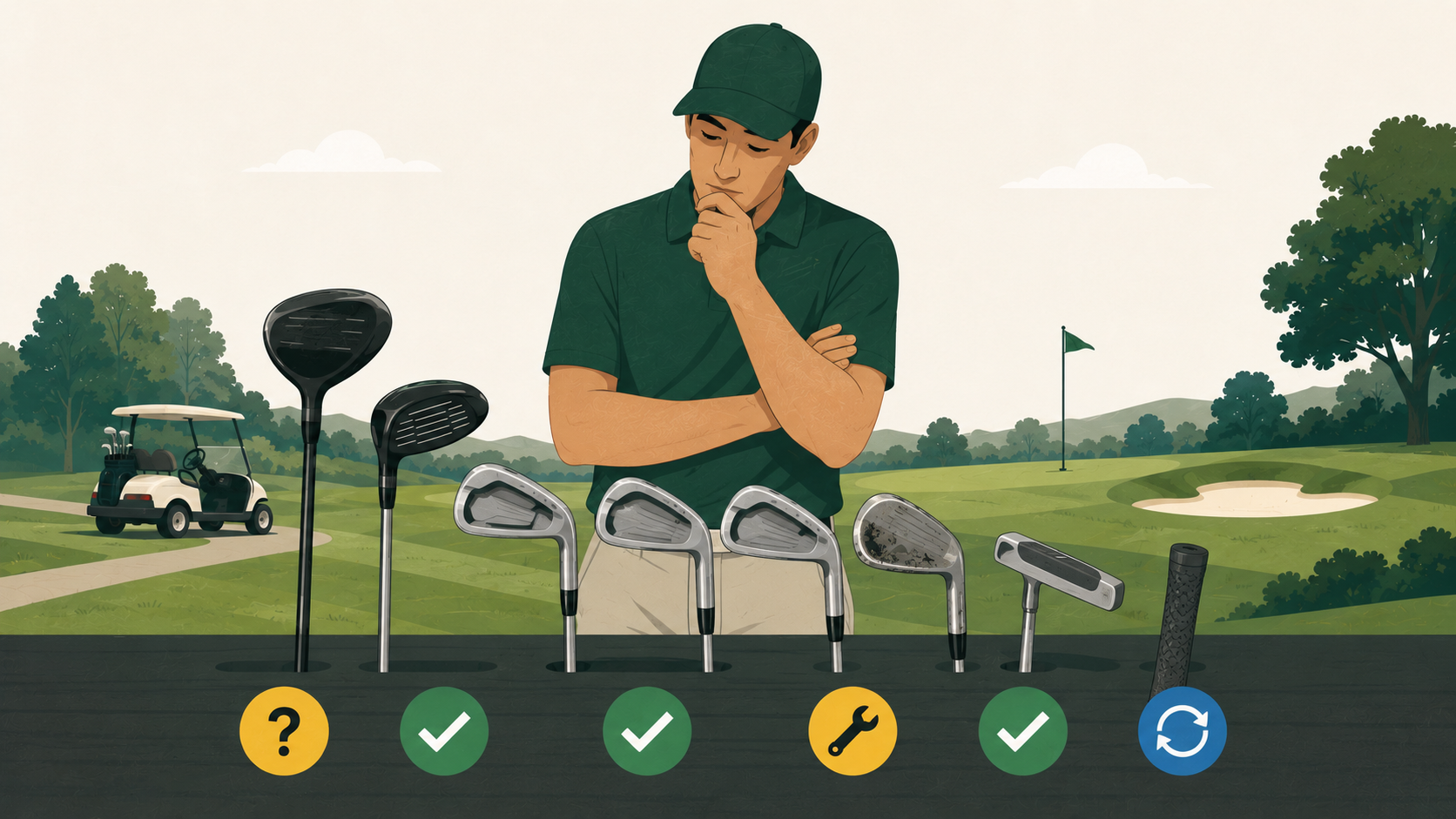
When Should I Replace My Golf Clubs?
When Should I Replace My Golf Clubs?
How long do golf clubs really last? Learn when to replace, repair or keep your clubs — and how to tell if new equipment will actually improve your game.
Some Parts of Your Golf Bag Wear Out Much Faster Than Others
The first mistake golfers make when thinking about club replacement is treating the entire bag as though it ages at the same rate.
It doesn't.
A driver, a set of irons, a sand wedge and a set of grips have very different jobs — and very different exposure to wear.
Grips
Grips are usually the easiest place to start.
You don't necessarily need new clubs because your grips are hard, shiny or slippery. You may simply need new grips.
Golf Digest's equipment guidance commonly uses once a year or roughly every 40 rounds as a regripping guideline, although playing frequency, storage conditions and personal preference matter.
This is a particularly good ABR example of the difference between:
new equipment
and
maintaining existing equipment.
Wedges
Wedges deserve more attention than most golfers give them.
Their grooves are repeatedly exposed to high-friction shots, sand, practice and impact with abrasive surfaces.
Golf Digest has reported research and expert guidance suggesting that wedge performance can decline noticeably with groove wear, with one recent assessment putting peak performance around 65–75 rounds depending on use. Recreational golfers may therefore go considerably longer, particularly if they play infrequently.
The important point isn't the number.
It's the performance.
If your wedge is producing inconsistent launch, spin or distance on shots you normally control, wear deserves investigation.
Irons
Irons are different.
A set of irons can remain perfectly playable for many years.
That doesn't mean newer irons can't be better. New designs can offer different launch, forgiveness, speed and fitting options.
But the fact that your irons are six or eight years old isn't enough information to conclude that they need replacing.
Golf Digest has previously noted that irons can remain playable well beyond five years, while also arguing that newer technology can offer meaningful benefits compared with much older designs.
Both things can be true.
Driver, fairway woods and hybrids
These clubs deserve a slightly different question:
Does the club still give me the launch, speed, forgiveness and consistency I need?
A driver can remain physically usable for years.
But because the driver is often one of the most technology-sensitive clubs in the bag, a fitting or launch-monitor comparison can reveal whether a newer model genuinely performs better for you.
That is a much better test than looking at the release date.
The important distinction
Wear is one reason to replace a club.
Age is not.
And new technology is only a reason when the technology actually produces a meaningful benefit for your swing.
The USGA's Equipment Rules explicitly recognise normal wear to things such as grips and grooves, while distinguishing wear from physical damage.
That's a useful way to think about your own bag.
Don't ask:
"How old is this?"
Ask:
"What has actually changed?"
Four Good Reasons to Replace a Golf Club
Instead of asking whether your clubs are "old enough", use four tests.
If a club fails one of these tests, it may be time to replace it.
If it doesn't?
Keep playing.
1. The club is physically damaged
This is the easiest one.
Cracks, dents, loose components, damaged shafts or other structural problems are legitimate reasons to stop using a club and have it assessed.
Don't confuse cosmetic wear with structural damage.
A few scratches aren't a performance diagnosis.
A cracked driver face is.
2. The club is genuinely worn
This is where wedges, grooves and grips become important.
A worn grip is usually a repair problem, not a club replacement problem.
A worn wedge face may be a replacement problem.
The distinction matters because replacing an entire iron set because the grips are finished is rather like buying a new car because the tyres are bald.
The car may be fine.
3. Your needs have changed
This is one of the strongest reasons to replace clubs — and it has nothing to do with age.
Perhaps your swing has changed.
Perhaps you've become faster.
Perhaps you've slowed down.
Perhaps your handicap has moved substantially.
Perhaps you're struggling to launch a particular iron.
Perhaps the gap between two clubs has become useless.
Perhaps you've realised that you never hit your 3-iron and would rather have a hybrid.
Those are legitimate equipment questions.
The club may not be "bad".
It may simply no longer be the right tool for the golfer you are now.
4. A replacement demonstrably performs better
This is the most interesting test.
New technology can be useful.
But the question is whether you benefit.
A fitting can help answer that.
Golf.com and Golf Digest both point to professional fitting and launch-monitor testing as useful ways of comparing current equipment with potential replacements.
And you don't necessarily need to buy an entire set.
You might discover that your irons are fine but your driver isn't.
Or that your wedges are the weak point.
Or that your current shaft isn't a great fit.
Or that the new club is only marginally better.
That last result is useful too.
It means you can keep your money.
The ABR Decision Table
| What you find | Best next step |
|---|---|
| Worn grip | REPAIR |
| Worn wedge grooves | REPLACE WEDGE |
| Cosmetic scratches | KEEP |
| Structural damage | REPLACE / REPAIR |
| Club no longer suits your swing | TEST |
| Poor distance or launch | TEST |
| New model looks better online | DO NOTHING YET |
| New club performs meaningfully better | CONSIDER REPLACING |
The point isn't to avoid buying golf equipment.
It's to make sure the equipment earns its place in your budget.
Before You Buy Anything, Test the Problem
This is where a lot of golfers get the process backwards.
They decide they need new clubs first.
Then they go looking for evidence.
ABR would reverse that.
Start with the club you already own
If you're considering a new driver, hit your current driver first.
Establish what it actually does.
Look at:
- carry distance
- total distance
- launch
- spin
- dispersion
- strike location
- consistency
Then compare a potential replacement.
You don't need to become a launch-monitor scientist.
You simply need enough information to answer:
Is the new club solving something?
If it isn't, that's useful information.
Don't assume a bad shot means bad equipment
Golfers are remarkably good at blaming clubs for problems that originate elsewhere.
A pull-hook might be a swing issue.
A short drive might be poor strike.
Inconsistent iron distance might be contact.
A driver that feels difficult might be badly fitted — but it might also simply expose a swing problem.
This is why fitting should be about diagnosis, not validation of a purchase you've already decided to make.
Consider a partial upgrade
There is no rule saying that a golfer needs to replace 14 clubs simultaneously.
Golf Digest has even highlighted the fact that many golfers don't necessarily need a full 14-club setup.
Your bag might be perfectly healthy with:
- old irons
- a newer driver
- one replacement wedge
- an older putter
- a recently regripped set
That's not a mismatched bag.
That's a bag that has been maintained according to need.
Don't shop for a new club until you can explain what you want the new club to do better.
If you can't answer that, you're probably not ready to buy.
Give Your Bag a 15-Minute Reality Check
Before you spend any money, give your clubs a quick inspection.
You don't need a launch monitor.
You don't need a spreadsheet.
You don't need to know the exact manufacturing year of every club in your bag.
Just work through these five questions.
1. Is anything physically damaged?
Look for:
- cracks
- dents
- loose heads
- damaged shafts
- anything that doesn't look or feel structurally right
If yes, have it assessed.
2. Are the grips still doing their job?
If they're hard, shiny, slick or visibly worn, start with regripping.
Don't replace perfectly good clubs because their handles are tired.
3. Are your wedges still performing?
Look at the grooves and think about your short-game results.
If shots that used to stop are now releasing unpredictably, investigate groove wear.
4. Does every club still have a useful job?
If you never hit your 4-iron, the question isn't necessarily whether your 4-iron is bad.
The question is whether something else would be more useful.
5. Can you identify a genuine performance problem?
If you can, test it.
If you can't, keep playing.
That's the whole point.
Keep. Repair. Test. Replace.
Your final decision should usually fall into one of four categories:
KEEP
The club works. Keep it.
REPAIR
The club is fine but needs maintenance.
TEST
You suspect a better option exists. Compare before buying.
REPLACE
The club is worn, damaged, unsuitable or demonstrably outperformed.
That is a much better equipment strategy than replacing everything whenever the manufacturers release something shiny.
Because sometimes the best golf equipment purchase is a new club.
Sometimes it's a new grip.
And sometimes it's absolutely nothing.
Your Golf Clubs Don't Know What Year It Is.
If they fit you, perform properly and aren't worn out, their age is mostly irrelevant.
Replace equipment when it gives you a reason to — not because the golf industry has given you a new release calendar.
Your next step: take your bag out this week and classify every club:
KEEP / REPAIR / TEST / REPLACE
You may discover you need new equipment.
You may discover you need new grips.
Or you may discover that your clubs are perfectly fine and the problem is the golfer holding them.
That last possibility is inconvenient.
It's also free.

What Golf Clubs Do You Actually Need?
What Golf Clubs Do You Actually Need?
You don't need to fill every available slot in your golf bag. The better question is which clubs will actually help you play the shots you need to play — and how many clubs you really need to do that.
START WITH THE JOB
Think About Shots, Not Clubs
Before deciding whether you need a 5-wood, 4-hybrid or 5-iron, think about what the bag actually has to accomplish.
Across an ordinary round, you need clubs that can cover a handful of different jobs.
Get the ball away from the tee
You need something you can reliably use when a hole gives you a tee shot where distance matters. That might be a driver. It might be a fairway wood. For some golfers, it might even be a hybrid on tighter holes.
Cover longer shots
You need one or more clubs capable of covering the distance between your tee club and your longest comfortable iron or wedge.
Hit approach shots
This is where your irons, hybrids or other fairway clubs fill in the distances between your longest clubs and your scoring clubs.
Handle shots around the green
You need at least one club you can use confidently for pitches, chips and other short shots. You don’t necessarily need three specialist wedges to do this.
Get the ball in the hole
You need a putter.
That’s basically the job description.
Everything else is a question of how you want to cover those jobs.
This is where golf equipment gets interesting. There isn’t one correct combination.
- A hybrid can replace a long iron.
- A 5-wood can replace a hybrid for some golfers.
- A pitching wedge can cover some shots that another golfer might play with a gap wedge.
- A sand wedge can do considerably more than bunker shots.
The best bag isn’t the one that looks most complete.
It’s the one where every club has a reason for being there.
BUILD YOUR BAG
Build the Bag Around Your Game
Instead of copying someone else’s 14-club setup, start with the clubs you know you can use.
A sensible progression might look something like this.
6–7 clubs
Driver or fairway wood, hybrid, 7-iron, 9-iron, wedge, sand wedge and putter. A simple option for a minimalist or casual golfer.
8–10 clubs
Driver, hybrid or wood, several irons, wedges and putter. A practical starting point for a new or returning golfer.
11–12 clubs
Driver, wood or hybrid, a fuller iron range, two or three wedges and a putter. Useful for a regular golfer who is still developing their game.
13–14 clubs
Full distance coverage with more specialised options. Useful for golfers who benefit from tighter gaps and additional shot options.
These are examples, not prescriptions.
There is no magic number at which a golfer suddenly becomes entitled to another wedge.
The more useful framework is to look at your actual distances.
Before buying a club, ask:
01 — What distance am I trying to cover?
If you can’t identify a useful distance or shot, you probably don’t need the club.
02 — What club currently covers that distance?
You may already have the answer.
03 — Is there a meaningful gap?
A small difference you never encounter isn’t necessarily a problem. A meaningful distance gap that leaves you constantly between clubs probably is.
04 — Can I actually hit the new club?
A club that exists on paper but produces worse results than the one it replaces isn’t improving your bag.
05 — Does it give me another useful shot?
Sometimes the value isn’t distance. It might be trajectory, lie versatility or confidence.
06 — Am I buying it because I need it?
Or because a complete set looks incomplete without it?
A sensible starting bag
For someone starting or returning to golf, a simple setup might be:
- Driver
- Hybrid or fairway wood
- 6- or 7-iron
- 8-iron
- 9-iron
- Pitching wedge
- Sand wedge
- Putter
That’s eight clubs.
You could play golf with that.
As you develop, you can identify where the genuine gaps are and add clubs accordingly.
A different golfer might prefer a 5-wood instead of a hybrid, a 5-iron instead of a 6-iron, or another wedge instead of a long club.
That’s the point.
The bag should adapt to the golfer, not the other way around.
ABR INSIGHT
You Don’t Need a Full Bag to Play Better Golf
Golf equipment can make it feel as though there’s always another club you should own. But more clubs don’t automatically mean more options, better scores or a better experience.
What matters is whether the clubs in your bag give you useful coverage, create sensible distance gaps and give you confidence when you need them.
If you’re carrying a club because you think you’re supposed to, rather than because it helps you play a shot, it might be worth asking whether it belongs there.
THE ABR TAKE
Build your bag around the shots you actually play. You can always add clubs later when your game gives you a reason to.
Looking for something else?
Search A BETTER ROUND for another golf problem, question or idea.
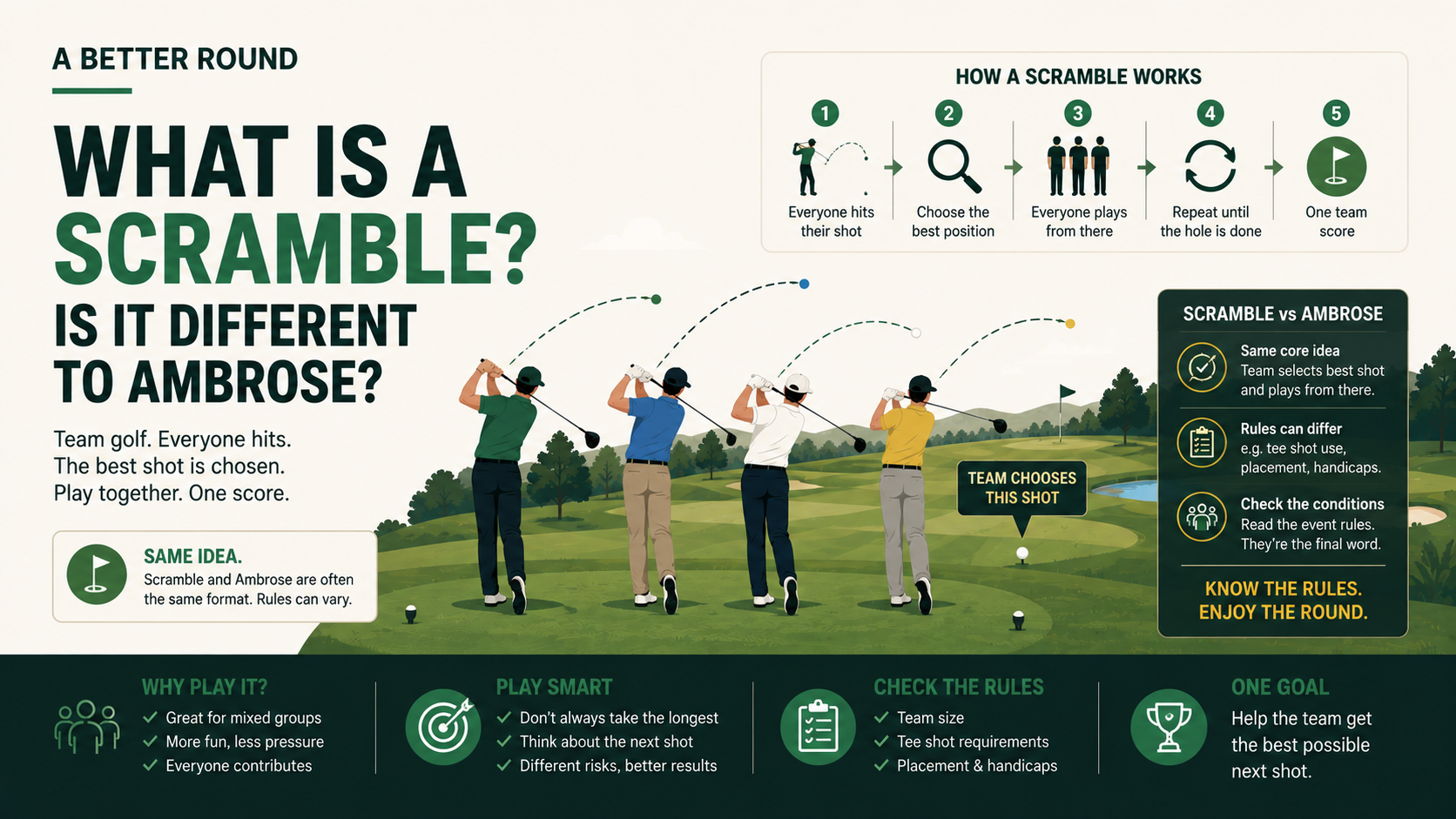
What Is a Scramble? Is It Different From Ambrose?
What Is a Scramble or Ambrose Golf Format?
Scramble and Ambrose are popular team formats that make golf more social, more forgiving and often more fun. But the terminology can be confusing. Different competitions can use the same name with slightly different rules, so it helps to understand the basic idea — and check the conditions of play for the event you're actually playing.
Is Ambrose Actually Different to a Scramble?
Sometimes. And sometimes, not really.
This is one of those areas of golf where the terminology is less consistent than you might expect.
“Scramble” is a widely used name for a format in which a team selects its best ball or position after each shot, with the players then continuing from there.
“Ambrose” is also used for that same basic format, particularly in organised team competitions.
But don't assume the name tells you exactly how the competition works.
An Ambrose competition might specify a minimum number of tee shots that each player has to contribute. It might use a particular team handicap calculation or have specific rules about where the selected ball can be placed.
Another event using the word “scramble” may have its own variations.
The underlying idea is often the same. The details are what you need to check.
Why Does the Terminology Get Confusing?
Golf formats have developed through clubs, competitions, charity events and social golf in different parts of the world. Names have travelled, adapted and sometimes become shorthand for slightly different versions of the same basic game.
Even within one named format, the rules can vary.
A four-person Ambrose event might require every player to have a certain number of drives selected, while another event may use a different requirement. Handicap allowances can also differ between competitions.
So if someone tells you, “We're playing Ambrose on Saturday,” the useful follow-up question isn't necessarily:
“What's Ambrose?”
It's: “What are the rules for this one?”
When Is a Scramble or Ambrose a Good Choice?
The beauty of these formats is that they change what matters about a round of golf.
Your worst shot can disappear. Your best player doesn't have to carry the whole group. And a golfer who might normally feel uncomfortable standing over a shot gets several chances to contribute without feeling that one mistake has ruined the hole.
You're Playing With a Mixed Group
A team format can work brilliantly when handicaps and experience levels are all over the place. Everyone gets a chance to contribute, and the stronger golfers can help the group without simply playing their own game.
You're Organising a Charity or Golf Day
Scramble-style golf is particularly well suited to events where the priority is participation and social interaction rather than four hours of individual competition. It gives people a reason to talk, make decisions together and celebrate each other's good shots.
You Want a More Relaxed Round
The format removes some of the pressure that comes with knowing every shot counts toward your own score. You can take a risk because somebody else may already have a safe option. That can make the game feel noticeably different from ordinary stroke play.
You Want the Group to Work Together
Strategy becomes a team discussion. Do you take the long drive, the ball in the fairway or the angle that leaves the easiest next shot? A good team can quickly discover that “best” doesn't always mean “furthest.”
That's also what makes the format surprisingly fun for experienced golfers. You're not just trying to hit good shots. You're trying to help create the best possible next shot for the team.
The Format Is Simple. The Strategy Isn't Quite.
Once everyone understands the basic rules, the next question becomes more interesting:
How do you actually play a scramble well?
The obvious temptation is to choose the ball that travelled furthest. Sometimes that's exactly right.
But the best position is often the one that gives the team the easiest next shot.
Don't Automatically Choose the Longest Drive
A slightly shorter ball in the middle of the fairway may be more useful than a longer one sitting behind a tree or leaving an awkward angle into the green.
Distance matters. So does position.
Let Different Players Take Different Risks
If the team already has a safe ball, another player can afford to be aggressive.
That might mean trying to carry a bunker, taking on a pin or hitting a more ambitious tee shot.
The team doesn't need every player to hit the same kind of shot. It can use the situation to its advantage.
Think About the Next Shot
The best selected ball isn't always the one that looks best right now.
Consider the lie, the angle, the distance and what club the team will have next.
A ball that leaves a simple approach from the fairway may be more valuable than one that is five metres closer but leaves an awkward shot.
Know the Event Rules Before You Start
This is the least exciting part of the format, but probably the most useful.
- how many players are allowed on a team
- which tees are being used
- how many tee shots each player must contribute
- how the selected ball is played
- where the ball can be placed
- how the team handicap is calculated
- whether there are any special local conditions
The format name alone doesn't tell you all of that.
Once those details are clear, the rest becomes much easier.
Next Time You're Invited, Just Ask One Question
If someone invites you to a scramble or Ambrose, don't worry too much about which word they've used.
Ask for the rules.
Find out how many players are on a team. Ask how the selected ball is played. Check whether every player's drive has to be used a certain number of times. Find out how the team handicap is calculated and whether there are any special local rules.
Once you've got that sorted, the rest is pretty simple:
Hit your shot, help the team find the best position, and try to give the next player the easiest possible opportunity.
You don't need to be the best golfer in the group.
You just need to contribute when you can.
Don't get hung up on the label.
Scramble and Ambrose are often two names for much the same idea: team golf where everyone gets a chance to contribute and the group plays from its best position.
The important thing isn't what the format is called. It's understanding the rules for the competition you're actually playing, then making decisions that give your team the best next shot.
Understand the rules, choose the position that gives the team the best next shot, and enjoy a format where one bad shot doesn't have to ruin the hole.
So how do you know what you're actually supposed to do?
Once you know that the rules can vary between competitions, another question naturally follows:
That's where the conditions of play matter more than the name on the event poster.
Golf has plenty of formats, rules and local variations that can seem obvious to the people who play them regularly but surprisingly confusing when you're encountering them for the first time.
Sometimes the best way to understand them is simply to ask.
Have a golf question you're still trying to work out? Ask ABR.
Golfers ask. ABR investigates. We figure it out together.
Looking for something else?
Search A BETTER ROUND for another golf problem, question or idea.

Which Tees Should I Play From?
Which Tees Should I Play From?
Choosing which tees to play isn't really about the colour of the marker or what your handicap says. It's about finding a course length that matches the shots you can actually play — while still giving you enough challenge to make the round interesting.
Standing on the first tee and choosing between red, yellow, white, blue and black can feel like golf's version of a personality test.
Pick the wrong set and the course can suddenly feel either strangely short or much harder than it needs to be.
You might spend the day hitting hybrids and fairway woods into par fours. Or you might find yourself hitting driver and wedge into almost everything, wondering why half the clubs in your bag came along.
The problem is that golfers are often given some fairly poor ways to think about the decision.
Maybe you play the whites because that's what you've always played.
Maybe you move back because the better players in your group are doing it.
Maybe your handicap seems to suggest a particular set of tees.
Or perhaps you've arrived at a new course and have no idea what the colours actually mean.
None of those is a particularly useful starting point.
Don't choose your tee by colour.
Choose it by the golf it asks you to play.
Tee colours aren't a universal distance system. Australian courses use different combinations of colours and, increasingly, skill- or distance-based tee systems rather than traditional assumptions about who should play which tee.
So instead of trying to remember what red, yellow, white, blue or black is supposed to mean, look at something much more useful:
How far do you hit your clubs, and what will this tee leave you?
That's the real decision.
Start with your 7-iron
One of the most useful pieces of research on tee selection comes from the USGA's Best Tees work.
The idea is surprisingly simple: use your 7-iron distance as a reference for the overall length of course that is likely to suit you.
Why the 7-iron?
The USGA found that golfers tend to have a more reliable understanding of how far they hit a 7-iron than they do with a driver. The research then used 7-iron distance to develop recommended course lengths based on the configuration of the course.
It isn't a magic formula.
And it doesn't mean your 7-iron distance tells you exactly which coloured tee to play.
It's simply a useful starting point.
The USGA's research found, for example, that a golfer hitting a 7-iron around 140 yards would generally fit a course around 5,900–6,100 yards, while golfers with shorter or longer 7-iron distances would generally fit shorter or longer courses.
For Australian golfers, that means thinking in metres rather than becoming too attached to an American yardage table.
The principle matters more than the exact number:
The longer you hit your normal clubs, the longer the course you can reasonably play.
And the reverse is also true.
Look at the shots, not just the scorecard
Course length gives you a starting point.
The actual shots you're being asked to play tell you whether that starting point makes sense.
What club are you hitting?
One long par three is part of golf. But if several par threes regularly require the longest clubs in your bag just to reach the green, that's useful information.
Moving forward can turn those holes from survival exercises into genuine decisions.
What are your approach shots?
This is probably the most revealing question.
A well-matched tee should give you a mixture of approach clubs.
You shouldn't expect every par four to leave you with a comfortable mid-iron. But if your typical second shot is a hybrid or fairway wood, the course may simply be too long for your current game.
The USGA's Best Tees research defines a good tee fit partly by whether golfers can comfortably reach fairways and the vicinity of greens while using a variety of approach clubs.
Are there decisions to make?
The best tee isn't necessarily the one that makes every par five reachable in two.
A good tee can create options.
One par five might give you a realistic chance to attack. Another might require a lay-up. Another might reward a good drive with a manageable approach.
That variety is part of what makes the course interesting.
If every par five becomes driver, longest club, longest club, you're probably playing a version of the course that doesn't suit your current distance.
Yardage isn't the whole story
Two courses of the same length can feel completely different.
A course with forced carries, narrow landing areas, hazards and difficult greens can demand considerably more from you than an open course with the same total yardage.
The USGA's research specifically recognises course playability as another factor in tee selection. A particularly difficult course may justify moving forward even when its total length looks appropriate on paper.
So don't ask only:
“How long is this tee?”
Also ask:
“What does this tee actually ask me to do?”
A simple way to choose your tees
You don't need a complicated formula before every round.
Start with three things:
Your 7-iron distance.
The total length of the tees.
The shots those tees are likely to leave you.
Then adjust for the course itself.
01 — START WITH YOUR 7-IRON
Use your normal 7-iron distance rather than your best-ever strike.
The USGA's system uses average 7-iron hitting distance as its starting reference for recommended course length.
You don't need laboratory-level accuracy.
You just need a realistic number.
02 — CHECK THE TOTAL LENGTH
Look at the scorecard.
Is the tee set broadly in the right range for your 7-iron distance?
If you're unsure, the USGA's Best Course Length Calculator is built around exactly this principle: 7-iron distance plus the course's par and hole configuration.
03 — LOOK AT THE PAR 4s
Ask yourself:
What will I normally be hitting for my second shot?
If the answer is mostly irons you can comfortably control, you're probably in the right area.
If the answer is repeatedly hybrid, fairway wood or a long iron simply to reach the green, consider moving forward.
04 — CHECK THE PAR 3s
Look at the whole group of par threes.
If several require the longest clubs in your bag, that's another signal that the tee may be too far back.
05 — CONSIDER THE COURSE ITSELF
If the course has forced carries, narrow landing areas, significant elevation changes or particularly difficult greens, don't assume the same tee distance will suit you everywhere.
Course difficulty matters too.
THE SIMPLE TEST
The right tees should challenge you without repeatedly asking you to hit shots that are outside your normal game.
That's a much better test than the colour of the marker.
So which tee should you actually choose?
Think in terms of too long, about right, or too short.
Move forward if the course keeps asking for your longest clubs
If you regularly need a hybrid or fairway wood to reach par fours, several par threes require uncomfortable long shots, and par fives feel like a sequence of maximum-effort swings, that's useful evidence.
You aren't failing to play the course properly.
The course may simply be asking for more distance than your current game can comfortably provide.
Stay where you get a mixture of shots
This is the sweet spot.
You should still have difficult holes.
You should still have uncomfortable shots.
But across the round, you should also get plenty of opportunities to use clubs you trust.
That variety is important.
Research from the USGA found golfers generally prefer holes where the approach shot is proportional to their own hitting distance, rather than simply choosing the longest course they can survive.
Consider moving back if the course removes too much of the challenge
Playing forward isn't automatically better.
If you're hitting driver and wedge into almost every par four and rarely using the longer half of your bag, you may have gone too far forward.
The point isn't to make the course as easy as possible.
It's to make the challenge appropriate.
Use handicap as context, not as the rule
Handicap still tells you something useful about your scoring ability.
But two golfers with the same handicap can have completely different games.
One might hit the ball a long way but struggle around the greens.
Another might be shorter but extremely consistent.
Their ideal tee choice doesn't have to be identical.
Your handicap can help provide context.
Your actual golf tells you what you need.
Treat the colour as an identifier, not a recommendation
Red, yellow, white, blue and black don't carry a universal meaning from one course to another.
Some Australian clubs have moved toward skill- or distance-based tee systems specifically to make tee selection less about traditional categories and more about the course length a golfer wants to play.
So when you arrive at a new course, don't ask:
“Which colour should I play?”
Ask:
“Which tee length makes sense for my game?”
Try the One-Tee Experiment
If you're still unsure, don't turn tee selection into another thing to overthink.
Test it.
Golf gives you a useful opportunity to answer this question simply by playing the same course from different starting points.
ROUND 1 — YOUR NORMAL TEES
Establish the baseline
Note the clubs you're hitting into par fours.
Notice which clubs you're using on par threes.
Pay attention to how often you're forced into long shots simply to reach the green.
Don't worry about the score yet.
You're collecting information.
ROUND 2 — ONE SET FORWARD
Change the tees, not your entire game
Play normally and see what changes.
Do you have more approach shots with clubs you trust?
Do the par threes become more playable?
Do the par fives create more interesting decisions?
ROUND 3 — ONE SET BACK
Only if you're curious
Try the opposite direction on another day.
Again, don't change your entire strategy.
You're testing the starting point, not trying to prove that one tee is better than another.
Then compare the rounds.
Which version gave you more approach shots with clubs you trust?
Which gave you more realistic chances to reach greens?
Which produced better decisions on par fives?
And perhaps most importantly:
Which version gave you the best combination of challenge, strategy and enjoyment?
That's the tee you should probably be playing.
Choose the course, not the colour.
Your handicap matters.
Your distance matters.
The course matters.
The colour of the tee marker matters much less than golf has sometimes made it seem.
Start with your 7-iron distance.
Look at the length of the course.
Then look at the shots it leaves you.
If you're constantly being asked to hit shots you have little chance of executing, move forward.
If you're rarely using the longer half of your bag, consider moving back.
You're not choosing the tee that says something about how good a golfer you are.
You're choosing the version of the course that gives you the right challenge.
The next question is usually more interesting
Choosing the right tees can make the course feel completely different.
But it raises another question:
What about your handicap?
If two golfers play the same course from different tees, how should their handicaps be adjusted?
And what do Course Rating and Slope actually mean when you're choosing where to play from?
That's a useful question because tee selection isn't just about distance. It's also about how the handicap system accounts for the course you're choosing to play.
That's the sort of thing worth investigating rather than simply accepting because that's how golf has always done it.
Have a golf question you're still trying to work out? Ask ABR →
Golfers ask. ABR investigates. We figure it out together.
Looking for something else?
Search A BETTER ROUND for another golf problem, question or idea.