
Why Do I Keep Topping the Golf Ball?
Why Do I Keep Topping the Golf Ball?
A topped golf shot can seem like an obvious swing fault, but “lifting your head” doesn't really explain why it happened. Understand low point, identify the patterns that can contribute to a top, and test one change at a time.
A topped golf shot is one of those misses that seems to explain itself.
You look up, the ball barely gets airborne and someone nearby says the words you've probably heard a hundred times:
“You lifted your head.”
Maybe you did.
But that doesn't really tell you why you topped the ball.
A more useful question is:
Where did the bottom of your swing go?
The short answer.
For a normal iron shot, you generally want the club to strike the ball before it reaches the bottom of its swing arc. If the club's low point moves behind the ball, the club can be rising as it reaches impact, making it easier to catch the ball too high.
But topping isn't caused by one universal swing fault.
Staying back, standing up through impact, inconsistent setup and trying to help the ball into the air can all contribute to poor contact.
So rather than starting with “How do I keep my head down?”, start with:
“What is my club doing at the bottom of the swing?”
That gives you something you can actually investigate.
What actually happens when you top the ball?
Think of the clubhead travelling in an arc.
At some point, that arc reaches its Low Point before the club begins travelling upward again.
For a typical iron shot, you generally want the ball to be struck before that lowest point.
In simple terms:
Ball → impact → low point → turf
That relationship helps explain why a well-struck iron shot can produce a divot or brush the grass just after the ball. The club has reached the ball first and is still travelling towards its lowest point.
TrackMan defines Low Point in relation to where the club reaches the bottom of its swing arc relative to impact. For iron shots, a low point after impact is associated with ball-first contact.
A top can occur when that relationship is reversed:
Low point → ball → club rising
The leading edge can then catch the ball too high, often producing the familiar low, skidding shot.
That's why low point is a useful way to understand a top.
It doesn't mean every golfer who tops the ball has exactly the same underlying fault.
It means we have a useful starting point for working out what went wrong.
So should you stop lifting your head?
Not as your first solution.
“Keep your head down” is one of golf's oldest pieces of advice, but it isn't a particularly useful diagnosis on its own.
PGA instruction has specifically challenged the idea that simply keeping your head down is the answer, while distinguishing a relatively steady head from trying to freeze it in place.
Your head and body are supposed to move during a golf swing.
The more useful question is whether your movement is changing the relationship between your body, the club and the ground at the wrong time.
For example, if you rise out of posture, remain too far on your trail side or change your setup, the club may not reach the ground where you need it to.
So don't make “keep my head down” your entire swing thought.
Instead, pay attention to where the club is reaching the ground.
That gives you something you can test.
Four things that can contribute to a topped shot
There isn't one universal “topping fault”.
Two golfers can produce almost identical topped shots while getting there in different ways.
These are four useful patterns to investigate.
You are staying back through impact
This is one of the first things worth checking.
If your pressure remains too much on your trail side as you move into impact, your low point can struggle to get far enough forward.
That can leave the club reaching its lowest point behind the ball and rising by the time it reaches impact.
You might notice:
- a feeling of hanging back
- your upper body moving away from the target
- difficulty getting pressure onto your lead side
- a tendency to hit fat shots as well as tops
The connection between fat and topped shots is worth understanding.
If your low point is inconsistent, you can alternate between contacting the ground too early and reacting in a way that produces a topped strike.
TrackMan notes that low point is influenced by the body's pivot and that an inconsistent low point can contribute to fat and thin contact. PGA instruction also identifies staying back as a common contributor to topped iron shots.
That doesn't mean you should simply “throw your weight forward.”
It means investigate whether your pressure and pivot are allowing the low point to move into a more useful position.
You are standing up through the strike
Another possibility is Early Extension.
Early extension describes a move where the pelvis moves towards the ball and the golfer becomes more upright too early in the downswing.
You don't need to understand every part of the biomechanics.
Think about it from the side.
At address, you've established a certain relationship between your body and the ball.
If you suddenly stand taller as the club approaches impact, you've changed that relationship.
The club has to react.
PGA instruction identifies early extension as a move in which the belt buckle moves towards the ball before impact, causing the upper body to stand up and potentially producing topped or inconsistent contact.
This is where “stay down” can also become misleading.
You don't want to freeze yourself in your address position.
You want to avoid standing up so early that the club can no longer reach the ball and ground in the way you intended.
Your setup is making the strike harder
Sometimes the best place to investigate isn't the downswing.
It's the setup.
Ball Position changes the relationship between the ball and the bottom of your swing.
If the ball is consistently positioned somewhere that doesn't suit the club or the motion you're making, you're making the strike harder before the swing has even started.
This is particularly worth checking if your contact pattern is remarkably consistent.
If you repeatedly top the same club and the ball is consistently positioned unusually far forward or back, don't immediately start rebuilding your swing.
Make a small adjustment.
Then hit enough shots to see whether the contact pattern actually changes.
Change one variable.
If you change your ball position, posture, grip and swing thought at the same time, you won't know which change actually mattered.
You are trying to help the ball into the air
This is another common recreational-golfer trap.
The ball is sitting on the ground.
You want it to go up.
So your instinct says:
Help it up.
But an iron already has loft built into it.
You don't need to scoop underneath the ball to make it airborne.
The better objective is to make a controlled strike and allow the club's loft to do its job.
PGA instruction similarly identifies staying back and trying to lift the ball with the hands as contributors to topped shots.
This can create a frustrating cycle:
You top the ball → you think you didn't get underneath it → you try harder to lift it → contact becomes less predictable → you top another one.
The answer isn't necessarily to hit down harder.
It's to stop asking the swing to perform a job the club is already designed to do.
Don't assume every top is the same
This may be the most useful part of diagnosing the problem.
Instead of asking:
“What causes a topped golf shot?”
ask:
“What does my topped shot look and feel like?”
The pattern can give you a starting point.
If you top the ball and also hit fat shots
Look at low-point control first.
Your club may be reaching the ground in inconsistent places.
If you top the ball and feel yourself standing up
Investigate posture and early extension.
Don't simply tell yourself to “stay down”.
Film a few swings from the side if possible and look for whether your body becomes noticeably more upright before impact.
If you consistently top one club
Check setup and ball position before making a major swing change.
If you mainly top when you try to hit harder
Look at tempo, balance and sequencing.
A harder swing can expose a movement pattern that isn't obvious at half speed.
If you only top under pressure
Don't assume you've suddenly developed a completely different swing.
Your intention may have changed.
You might be swinging faster, trying to guide the ball, becoming tense or simply trying too hard to avoid the miss you're worried about.
That's useful information.
The miss may be telling you something about the way your swing changes under pressure, not just what happens in your technically perfect practice swing.
What about topping the driver?
This is where the advice needs to change.
Don't apply an iron swing description blindly to the driver.
With an iron sitting on the ground, ball-first contact followed by the club reaching its low point is a useful model.
A driver is different because the ball is teed up and the desired attack conditions are different.
TrackMan distinguishes between the typical attack-angle conditions for irons and drives: irons are generally struck with a negative attack angle, while drivers are typically struck with a positive attack angle.
So if you're topping your driver, investigate it separately.
Tee height, ball position and the way you deliver the club can all matter.
PGA instruction, for example, uses a different practice approach for topped drives that focuses on the tee rather than trying to reproduce an iron-style ground strike.
The fact that you top an iron and the fact that you top a driver do not automatically point to the same problem.
For this article, we're primarily talking about shots where the ball is sitting on the ground, particularly iron shots.
How to work out what's happening in your own swing
This is where it's tempting to give you five drills.
Don't.
You don't need five drills yet.
You need some information.
Step 1 — Hit 10–15 short iron shots
Take an 8-iron or 7-iron and make comfortable swings.
Don't try to fix the top.
Don't try to swing harder.
Just observe.
- Am I also hitting fat shots?
- Does the top happen when I speed up?
- Do I feel myself standing taller?
- Does my pressure finish on the lead side?
- Is my ball position consistent?
- Does the problem happen on every shot or only occasionally?
You're trying to find a pattern, not a perfect diagnosis.
Step 2 — Make the low point visible
Now give yourself some feedback from the ground.
Put a line on the ground — chalk, a line on the mat or another suitable reference — and use it to observe where the club is contacting the ground relative to where the ball sits.
You aren't trying to manufacture a perfect divot.
You're trying to answer one question:
Can I repeatedly get the club to the ground in roughly the right place?
That's a much better feedback loop than simply asking whether the ball flew.
TrackMan uses Low Point specifically because it provides a way to describe where the bottom of the swing occurs relative to the ball. You can use the same basic idea without owning a launch monitor: the ground itself gives you feedback.
Step 3 — Test one change
Now choose the most obvious pattern.
If you're clearly staying back, experiment with a better pressure shift.
If you're clearly standing up, experiment with maintaining your posture through the strike.
If your ball position is inconsistent, standardise it.
If you're trying to lift the ball, stop trying to lift it.
Don't change everything at once.
If you make four changes and suddenly hit three good shots, you won't know which change helped.
If you change one thing and the contact improves, you've learned something.
That is progress.
Try something else next time rather than piling another thought onto the swing.
A simple 15-minute practice test
You don't need to turn every range session into a swing laboratory.
5 balls — normal
Hit five comfortable 8-iron shots. Don't make any changes. Just observe the contact.
5 balls — ground awareness
Use your ground reference. Focus on where the club is contacting the ground relative to the ball.
5 balls — one experiment
Choose one change based on what you've observed. Then compare the contact.
The objective isn't:
“I must stop topping today.”
The objective is:
“I understand my contact a little better than I did 15 minutes ago.”
If the contact improves, you've found a useful direction.
If it doesn't, that's useful too.
You now know that particular change didn't solve the problem.
Try something else next time rather than piling another thought onto the swing.
What if I keep topping the ball?
If you're still topping shots after you've experimented with the obvious variables, don't assume you're failing to practise hard enough.
A visible miss doesn't always reveal the underlying cause.
A video from face-on and down-the-line can help you see movements you can't feel. A good coach can also help determine whether the problem is actually low point, posture, pressure movement, setup, arm structure or something else.
That's one reason not to become too attached to a diagnosis from an article.
Low point is the useful organising idea. It isn't a guarantee that you've identified the precise fault.
That distinction matters.
The goal isn't to diagnose yourself perfectly from one miss.
The goal is to turn a frustrating shot into useful information.
SOURCE & CITATION
The article uses a small number of authoritative sources where they add useful support to technical claims.
Low Point
TrackMan defines Low Point in relation to where the club reaches the bottom of its swing arc and explains its relationship to whether the golfer strikes the ball before or after the low point. TrackMan also identifies Low Point as a useful measure for understanding ground contact.
Early Extension
PGA instruction describes early extension as the pelvis moving towards the ball before impact, causing the golfer to become more upright and potentially contributing to topped or inconsistent contact.
Staying Back and Helping the Ball Into the Air
PGA instruction identifies remaining on the trail side and attempting to help the ball into the air with the hands as contributors to topped shots.
Head Movement
PGA instruction distinguishes between maintaining a relatively steady head and simply trying to keep the head down, supporting the article's recommendation not to treat “keep your head down” as a complete diagnosis.
Iron vs Driver
TrackMan distinguishes the typical attack-angle conditions of irons and drivers, supporting the article's recommendation to treat topped iron shots and topped drives as separate problems.
What is ABR analysis?
The following elements are ABR editorial synthesis, rather than claims presented as established scientific fact:
- the diagnosis-first framework
- “don't assume every top is the same”
- the pattern-based troubleshooting approach
- the one-change-at-a-time practice process
- the 15-minute practice structure
- the recommendation to use ground contact as practical feedback
These are presented as practical editorial recommendations, not universal prescriptions.
Six things worth remembering
A top isn't simply “lifting your head”
Your head may move, but that doesn't explain why the club was too high at impact.
Think about low point
For a typical iron shot, you want the club to strike the ball before reaching its lowest point.
Look for your pattern
Staying back, standing up, setup problems and trying to help the ball into the air can all contribute to poor contact.
Don't fix five things at once
Find the most obvious pattern and test one change.
Treat the driver separately
The desired strike conditions are different because the ball is teed up.
Better practice starts with better feedback
Instead of simply hitting balls and hoping the top disappears, give yourself a way to see where the club is reaching the ground.
Don't start by trying to keep your head down.
Start by understanding where your club is reaching the bottom of its swing.
Once you understand low point, a topped shot becomes much less mysterious.
You can then investigate the things that might be moving that low point — your pressure, posture, setup or intention — and test them one at a time.
You might not fix the problem in one range session.
That's fine.
The goal is to understand your miss well enough that your practice becomes more useful.
Progress, not perfection.
Once you understand that low point matters, another question naturally appears.
How do you actually practise controlling low point without filling your swing with another five things to think about?
That's a problem worth investigating too.
Have a golf question you're still trying to work out? Ask ABR.
Golfers ask. ABR investigates. We figure it out together.

When Should I Replace My Golf Clubs?
When Should I Replace My Golf Clubs?
How long do golf clubs really last? Learn when to replace, repair or keep your clubs — and how to tell if new equipment will actually improve your game.
Some Parts of Your Golf Bag Wear Out Much Faster Than Others
The first mistake golfers make when thinking about club replacement is treating the entire bag as though it ages at the same rate.
It doesn't.
A driver, a set of irons, a sand wedge and a set of grips have very different jobs — and very different exposure to wear.
Grips
Grips are usually the easiest place to start.
You don't necessarily need new clubs because your grips are hard, shiny or slippery. You may simply need new grips.
Golf Digest's equipment guidance commonly uses once a year or roughly every 40 rounds as a regripping guideline, although playing frequency, storage conditions and personal preference matter.
This is a particularly good ABR example of the difference between:
new equipment
and
maintaining existing equipment.
Wedges
Wedges deserve more attention than most golfers give them.
Their grooves are repeatedly exposed to high-friction shots, sand, practice and impact with abrasive surfaces.
Golf Digest has reported research and expert guidance suggesting that wedge performance can decline noticeably with groove wear, with one recent assessment putting peak performance around 65–75 rounds depending on use. Recreational golfers may therefore go considerably longer, particularly if they play infrequently.
The important point isn't the number.
It's the performance.
If your wedge is producing inconsistent launch, spin or distance on shots you normally control, wear deserves investigation.
Irons
Irons are different.
A set of irons can remain perfectly playable for many years.
That doesn't mean newer irons can't be better. New designs can offer different launch, forgiveness, speed and fitting options.
But the fact that your irons are six or eight years old isn't enough information to conclude that they need replacing.
Golf Digest has previously noted that irons can remain playable well beyond five years, while also arguing that newer technology can offer meaningful benefits compared with much older designs.
Both things can be true.
Driver, fairway woods and hybrids
These clubs deserve a slightly different question:
Does the club still give me the launch, speed, forgiveness and consistency I need?
A driver can remain physically usable for years.
But because the driver is often one of the most technology-sensitive clubs in the bag, a fitting or launch-monitor comparison can reveal whether a newer model genuinely performs better for you.
That is a much better test than looking at the release date.
The important distinction
Wear is one reason to replace a club.
Age is not.
And new technology is only a reason when the technology actually produces a meaningful benefit for your swing.
The USGA's Equipment Rules explicitly recognise normal wear to things such as grips and grooves, while distinguishing wear from physical damage.
That's a useful way to think about your own bag.
Don't ask:
"How old is this?"
Ask:
"What has actually changed?"
Four Good Reasons to Replace a Golf Club
Instead of asking whether your clubs are "old enough", use four tests.
If a club fails one of these tests, it may be time to replace it.
If it doesn't?
Keep playing.
1. The club is physically damaged
This is the easiest one.
Cracks, dents, loose components, damaged shafts or other structural problems are legitimate reasons to stop using a club and have it assessed.
Don't confuse cosmetic wear with structural damage.
A few scratches aren't a performance diagnosis.
A cracked driver face is.
2. The club is genuinely worn
This is where wedges, grooves and grips become important.
A worn grip is usually a repair problem, not a club replacement problem.
A worn wedge face may be a replacement problem.
The distinction matters because replacing an entire iron set because the grips are finished is rather like buying a new car because the tyres are bald.
The car may be fine.
3. Your needs have changed
This is one of the strongest reasons to replace clubs — and it has nothing to do with age.
Perhaps your swing has changed.
Perhaps you've become faster.
Perhaps you've slowed down.
Perhaps your handicap has moved substantially.
Perhaps you're struggling to launch a particular iron.
Perhaps the gap between two clubs has become useless.
Perhaps you've realised that you never hit your 3-iron and would rather have a hybrid.
Those are legitimate equipment questions.
The club may not be "bad".
It may simply no longer be the right tool for the golfer you are now.
4. A replacement demonstrably performs better
This is the most interesting test.
New technology can be useful.
But the question is whether you benefit.
A fitting can help answer that.
Golf.com and Golf Digest both point to professional fitting and launch-monitor testing as useful ways of comparing current equipment with potential replacements.
And you don't necessarily need to buy an entire set.
You might discover that your irons are fine but your driver isn't.
Or that your wedges are the weak point.
Or that your current shaft isn't a great fit.
Or that the new club is only marginally better.
That last result is useful too.
It means you can keep your money.
The ABR Decision Table
| What you find | Best next step |
|---|---|
| Worn grip | REPAIR |
| Worn wedge grooves | REPLACE WEDGE |
| Cosmetic scratches | KEEP |
| Structural damage | REPLACE / REPAIR |
| Club no longer suits your swing | TEST |
| Poor distance or launch | TEST |
| New model looks better online | DO NOTHING YET |
| New club performs meaningfully better | CONSIDER REPLACING |
The point isn't to avoid buying golf equipment.
It's to make sure the equipment earns its place in your budget.
Before You Buy Anything, Test the Problem
This is where a lot of golfers get the process backwards.
They decide they need new clubs first.
Then they go looking for evidence.
ABR would reverse that.
Start with the club you already own
If you're considering a new driver, hit your current driver first.
Establish what it actually does.
Look at:
- carry distance
- total distance
- launch
- spin
- dispersion
- strike location
- consistency
Then compare a potential replacement.
You don't need to become a launch-monitor scientist.
You simply need enough information to answer:
Is the new club solving something?
If it isn't, that's useful information.
Don't assume a bad shot means bad equipment
Golfers are remarkably good at blaming clubs for problems that originate elsewhere.
A pull-hook might be a swing issue.
A short drive might be poor strike.
Inconsistent iron distance might be contact.
A driver that feels difficult might be badly fitted — but it might also simply expose a swing problem.
This is why fitting should be about diagnosis, not validation of a purchase you've already decided to make.
Consider a partial upgrade
There is no rule saying that a golfer needs to replace 14 clubs simultaneously.
Golf Digest has even highlighted the fact that many golfers don't necessarily need a full 14-club setup.
Your bag might be perfectly healthy with:
- old irons
- a newer driver
- one replacement wedge
- an older putter
- a recently regripped set
That's not a mismatched bag.
That's a bag that has been maintained according to need.
Don't shop for a new club until you can explain what you want the new club to do better.
If you can't answer that, you're probably not ready to buy.
Give Your Bag a 15-Minute Reality Check
Before you spend any money, give your clubs a quick inspection.
You don't need a launch monitor.
You don't need a spreadsheet.
You don't need to know the exact manufacturing year of every club in your bag.
Just work through these five questions.
1. Is anything physically damaged?
Look for:
- cracks
- dents
- loose heads
- damaged shafts
- anything that doesn't look or feel structurally right
If yes, have it assessed.
2. Are the grips still doing their job?
If they're hard, shiny, slick or visibly worn, start with regripping.
Don't replace perfectly good clubs because their handles are tired.
3. Are your wedges still performing?
Look at the grooves and think about your short-game results.
If shots that used to stop are now releasing unpredictably, investigate groove wear.
4. Does every club still have a useful job?
If you never hit your 4-iron, the question isn't necessarily whether your 4-iron is bad.
The question is whether something else would be more useful.
5. Can you identify a genuine performance problem?
If you can, test it.
If you can't, keep playing.
That's the whole point.
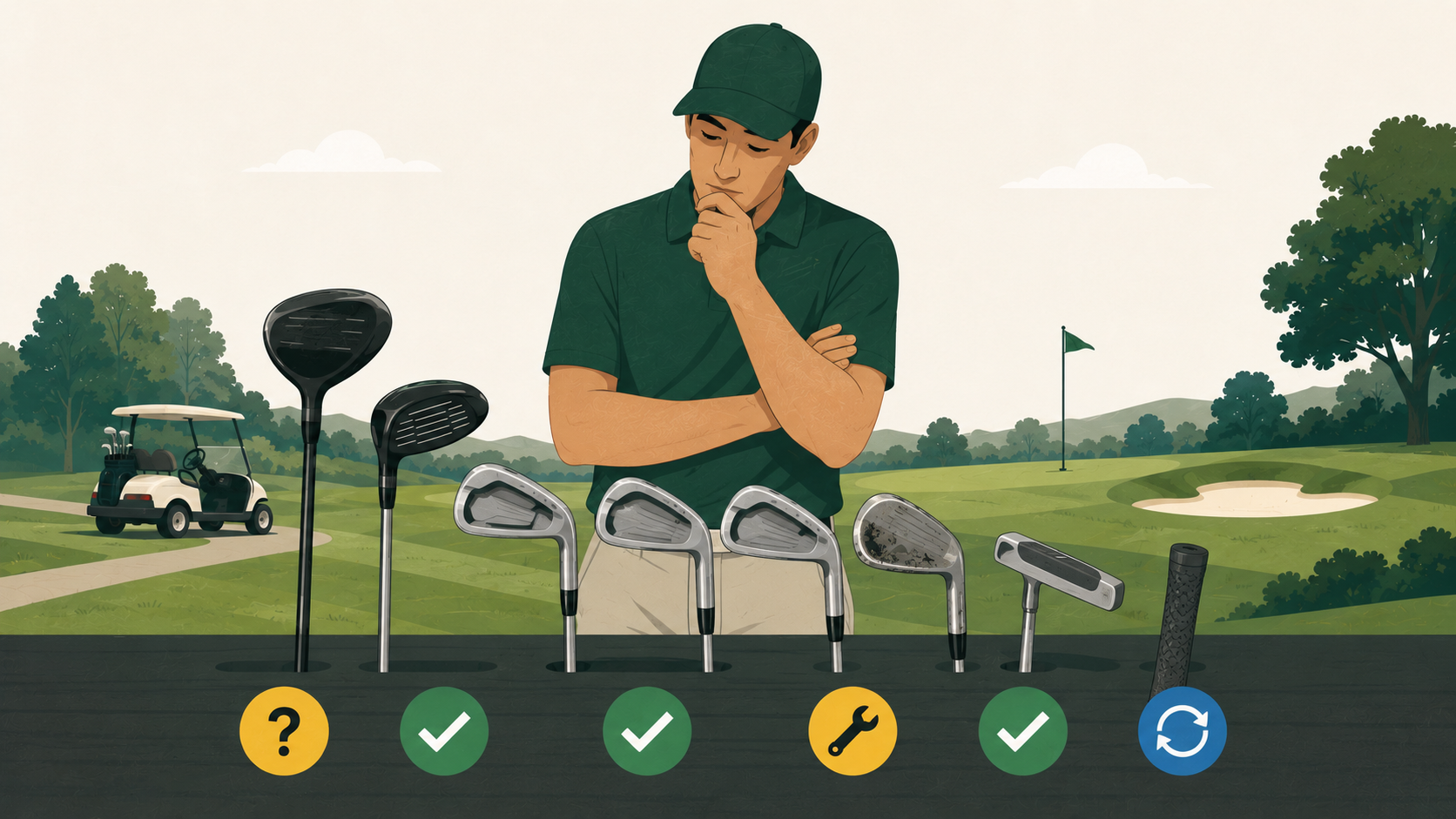
Keep. Repair. Test. Replace.
Your final decision should usually fall into one of four categories:
KEEP
The club works. Keep it.
REPAIR
The club is fine but needs maintenance.
TEST
You suspect a better option exists. Compare before buying.
REPLACE
The club is worn, damaged, unsuitable or demonstrably outperformed.
That is a much better equipment strategy than replacing everything whenever the manufacturers release something shiny.
Because sometimes the best golf equipment purchase is a new club.
Sometimes it's a new grip.
And sometimes it's absolutely nothing.
Your Golf Clubs Don't Know What Year It Is.
If they fit you, perform properly and aren't worn out, their age is mostly irrelevant.
Replace equipment when it gives you a reason to — not because the golf industry has given you a new release calendar.
Your next step: take your bag out this week and classify every club:
KEEP / REPAIR / TEST / REPLACE
You may discover you need new equipment.
You may discover you need new grips.
Or you may discover that your clubs are perfectly fine and the problem is the golfer holding them.
That last possibility is inconvenient.
It's also free.
How to Stop Slicing the Ball
How to Stop Slicing the Golf Ball
If you slice the golf ball, the answer isn't necessarily another swing tip. Learn how to read the ball flight, understand what is causing the curve, and work on the variable that actually matters.
If you slice the golf ball, you've probably already tried to fix it.
Maybe you've strengthened your grip. Maybe you've tried to swing more from the inside. Maybe someone has told you to stop coming over the top, slow your backswing down, turn your hips or release the club harder.
The problem is that most slice advice starts with a swing change before you've worked out what is actually causing the ball to curve.
And that can leave you with a familiar golfing problem: six swing thoughts, three different drills and no idea which one is supposed to help.
A better place to start is the ball.
Where did it start? How much did it curve? Where did you strike it?
Those three pieces of information can tell you considerably more than simply saying, "I hit a slice."
A slice isn't one specific swing fault. It is a ball-flight result produced by the relationship between the clubface and club path at impact. Strike can also influence the result, particularly with a driver.
So rather than trying to cure your slice with the latest tip, work backwards from the shot.
Read the ball flight.
Understand the cause. Test one variable. Then practise what actually works.
You don't need a perfect swing. You need a ball flight you can understand.
First, Understand What a Slice Actually Is
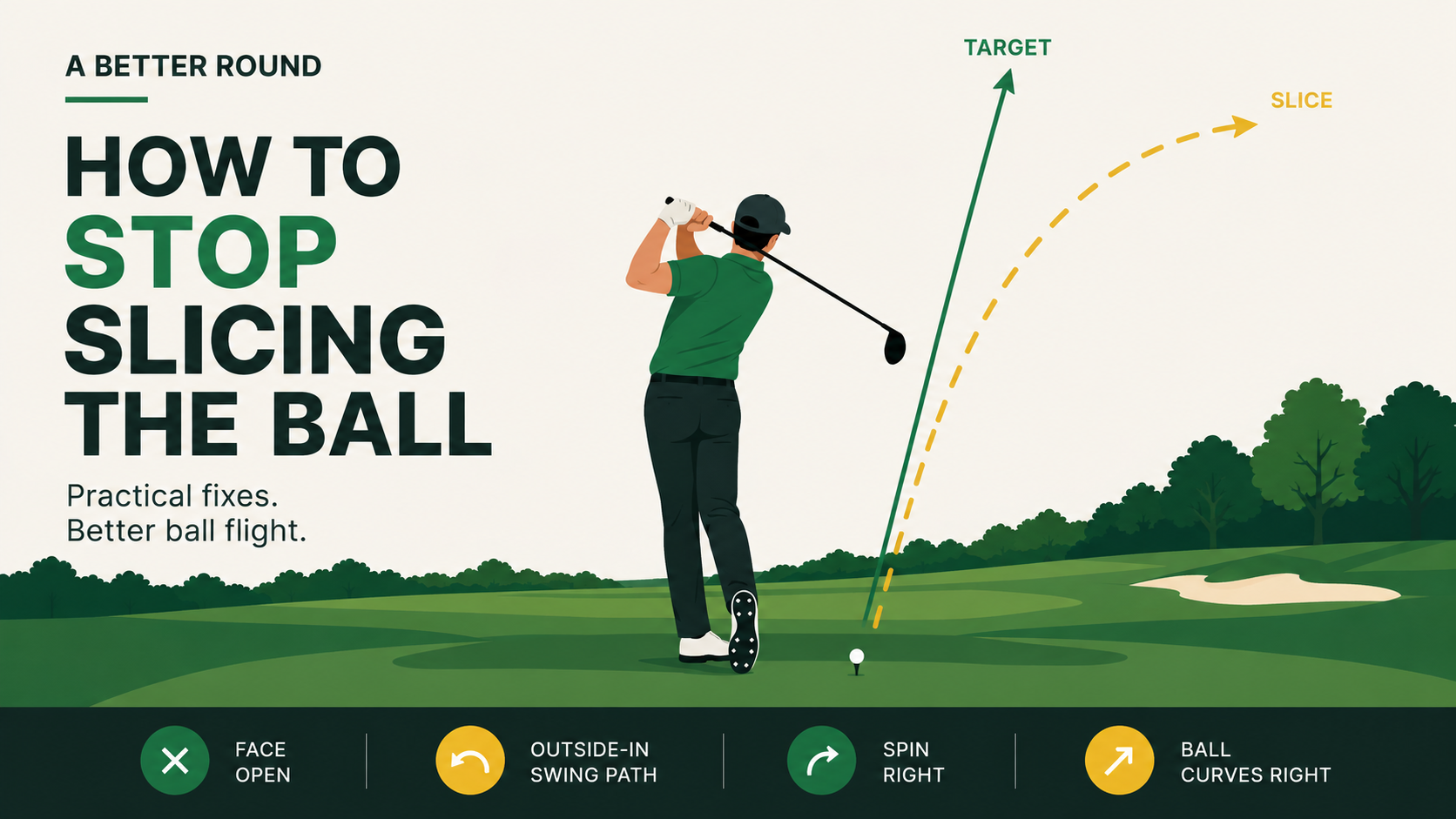
For a right-handed golfer, a slice is a shot that curves significantly to the right.
But not every ball that finishes right is a slice.
A ball can start right and stay relatively straight. It can start left and curve right. It can start straight and then peel away.
Those shots may finish in a similar place, but they don't necessarily have the same cause.
That's why the first useful question isn't:
"How do I stop slicing?"
It's:
"What is my ball actually doing?"
Clubface
The clubface's direction at impact has a major influence on where the ball starts. A face pointing right generally produces a start to the right; a face pointing left generally produces a start to the left.
Club Path
Club path is the direction the clubhead is travelling through impact relative to the target line. A path travelling left is often described as out-to-in, while a path travelling right is often described as in-to-out.
Face-to-Path
Face-to-path describes the difference between where the clubface is pointing and the direction the club is travelling. If the face is open relative to the path, the ball tends to curve right for a right-handed golfer.
The greater that face-to-path difference, generally, the greater the curvature.
So imagine two shots.
Shot A: starts left and curves hard right.
Shot B: starts right and curves further right.
Both may finish in the trees, but they don't tell you exactly the same story.
The starting direction gives you information about the face. The curvature gives you information about the relationship between face and path.
You don't need a launch monitor to start learning this. You can learn a lot simply by watching the flight.
Read the Shot Before You Change Your Swing
The next time you slice a ball, don't immediately try to fix it.
Watch it.
1. Where did it start?
- Left of the target
- Roughly at the target
- Right of the target
2. How much did it curve?
- A gentle fade
- A noticeable fade
- A big curve
- A full slice into the next postcode
3. Where did you strike it?
Particularly with a driver, check whether you struck the ball towards the heel, near the centre or towards the toe.
Now you have three useful pieces of information.
That's a much better starting point than simply deciding that your swing is "over the top."
Don't Ignore Where You Strike the Ball
Strike location can be particularly important with the driver.
When the ball is struck away from the centre of the clubface, the clubhead can twist and rotate through impact. This creates gear effect, which can influence the ball's launch and curvature.
A heel strike, for example, can contribute to a right-curving shot for a right-handed golfer.
That matters because you can make what feels like the same swing twice and get noticeably different results if one strike is near the centre and the other is towards the heel.
So if your driver is consistently curving right, don't assume the answer has to be a major swing change.
Check the strike.
A little impact spray or face marking can give you useful feedback. You may discover that part of the problem is happening at the clubface before you even get to the question of what your body or hands are doing.
The ball flight is the output.
Your job is to work backwards towards the input.
So What Should You Actually Change?
Once you've read the shot, resist the temptation to change everything.
For many golfers, the clubface deserves attention before an elaborate attempt to rebuild the entire swing path.
That does not mean "just close the clubface." It means the face is worth testing before you decide that your path is the problem.
Likewise, if your strike is consistently towards the heel, that deserves attention too.
The goal isn't to force a particular swing shape. The goal is to find the variable that has the biggest influence on your particular ball flight.
A simple way to test it
Hit five normal shots
Don't try to fix anything. Hit five shots with your normal swing and pay attention to starting direction, amount of curve and strike location. You're establishing a baseline.
Slow everything down
Hit five half-swings at roughly 50–60% speed. Your only goal is to produce a ball that starts closer to your intended line and curves less. Don't worry about distance.
Test the path
If your ball flight suggests that path may be contributing to the problem, place an alignment aid or headcover outside and slightly behind the ball to give you an external reference. Make controlled swings without contacting it.
Change one variable
Don't simultaneously change your grip, takeaway, backswing, hip rotation, wrist position, release and finish. If you change six things and the ball improves, you won't know why.
Return to normal swings
Hit another five normal shots and compare them with your first five.
- Did the ball start closer to the target?
- Did it curve less?
- Did you strike the face more consistently?
- Did the ball behave differently when you added speed?
Don't judge the session by whether you hit a draw.
Judge it by whether you learned something.
And if nothing improved, that's useful information too. You've eliminated one possibility.
The point isn't to manufacture a particular swing. It's to replace speculation with information.
Make the Better Shot Repeatable
Once you've found something that improves the ball flight, don't immediately try to hit it harder.
Make it repeatable first.
10 balls — controlled
Work at 50–60% speed and reproduce the better ball flight.
10 balls — variable
Change the target between shots. This stops you from simply repeating the same movement to the same target.
10 balls — normal
Go through your normal pre-shot routine and treat each shot as though you're playing.
The goal isn't to hit 30 perfect shots. It's to discover whether the better pattern is becoming something you can actually use.
Don't Try to Turn a Slice Into a Hook
A golfer discovers that trying to swing more from the inside reduces the slice, so they immediately try to exaggerate the movement.
The next shot starts right and hooks left.
Success? Not really.
You've replaced one unpredictable shot with another.
The goal isn't to produce the opposite miss. The goal is to make the ball flight more predictable.
If a small change reduces the amount of curvature, that may be more valuable than a dramatic change that occasionally produces a perfect draw.
Golf improvement isn't about finding the most impressive shot you can hit. It's about making your common shot more playable.
What If You Still Don't Know What's Causing It?
That's normal. Golf swings are complicated, and ball flight can be influenced by more than one variable.
You may discover that your face is contributing to the slice, but that your path is also inconsistent. You may improve your path and discover that your strike is still poor.
Or you may hit five good shots in practice and immediately produce the old slice on the first tee.
None of that means the work failed. It means you're learning how your particular swing behaves.
If you can't identify the cause confidently, don't keep adding swing thoughts.
Get better information. A coach can help. A launch monitor can help. Slow-motion video can help. Even something as simple as recording your start direction and strike pattern over 20 shots can tell you more than guessing.
The point is to replace speculation with information.
Take the Better Pattern Onto the Course
Practice is useful, but the ultimate test is whether you can play golf without constantly thinking about your swing.
When you're on the course, don't stand over the ball trying to remember everything you learned. Use the information instead.
If your normal miss is a predictable fade, allow for it. If you've discovered that your driver strike tends to move towards the heel when you get quick, give yourself a simple reminder and commit to the shot.
And if one appears that looks like your old slice?
Don't panic. You don't need to rebuild your swing in the middle of the round.
You already know what the miss looks like.
That's progress.
The Six Things Worth Remembering
Read the ball before changing the swing
Start direction, curvature and strike can tell you a lot.
Don't confuse every right miss with a slice
A push, fade, push-slice and pull-fade can have different patterns.
The clubface matters
Its direction strongly influences where the ball starts, while face-to-path influences curvature.
Check your strike
Particularly with the driver, heel contact can contribute to a right-curving shot.
Change one thing at a time
If you change everything, you won't know what helped.
Judge practice by what you learn
A session that teaches you something useful is still a good session, even if you don't hit perfect shots.
Don't try to cure your slice with one magic tip.
Learn to read it. Understand the relationship between face and path. Check the strike. Identify the variable that appears to matter most. Change one thing. Test it. Then practise what actually works.
You don't need to create a perfect swing. You need a ball flight you can understand and trust.
That's a better round.
One question usually leads to another.
You might now understand what causes a slice. But knowing what is causing your slice can be harder.
Is it the clubface? The path? The strike? Or some combination of the three?
That's where the next question starts. And it's the sort of thing we're interested in figuring out with golfers, not simply telling them what to do.
Have a golf question you're still trying to work out? Ask ABR.
Golfers ask. ABR investigates. We figure it out together.
Looking for something else?
Search A BETTER ROUND for another golf problem, question or idea.