

How to Play a Golf Hole That Doesn't Suit Your Game
Some golf holes seem to demand a shot you don't trust. Maybe there's a forced carry, a narrow fairway, a dogleg that favours a shot shape you rarely hit, or a green that looks impossible to approach from the wrong side. The temptation is to try to play the hole as it was designed to be played. But that isn't always the smartest option. Sometimes the better decision is to change the plan, use the shot you know you can hit and find a less demanding route to the same result.
What's the Best Way to Play a Hole That Doesn't Suit You?
The best approach is to stop trying to force a shot that doesn't suit your game. Instead, identify the part of the hole that creates the problem, choose a target that gives you more room for error, and build your strategy around a club and shot you trust.
That might mean aiming away from the ideal line, laying up short of a hazard, using a different club off the tee or accepting that you'll need an extra shot to reach the green.
The important thing: You don't have to play the hole perfectly. You need to give yourself the best chance of keeping the ball in play and making a score you're happy with.
Not Every Golf Hole Is Designed for Your Game
Golf courses are designed to challenge players in different ways. One hole might reward distance, another might favour accuracy, while the next asks you to shape the ball around a corner or carry a hazard.
That's part of what makes golf interesting. But it also means you'll regularly come across holes that don't play to your strengths.
Perhaps you're comfortable hitting a straight ball but the fairway bends around a corner. Maybe you naturally hit a fade when the hole appears to favour a draw. Or perhaps the only obvious route to the green involves carrying a bunker or water hazard that you don't normally attempt.
These situations can create a particular kind of pressure. You start thinking about the shot the hole seems to require rather than the shot you're actually capable of playing.
A hole doesn't have to suit your game for you to play it well.
The Trap: Trying to Hit a Shot You Don't Trust
Imagine a dogleg that turns sharply to the right. The ideal tee shot might be a controlled fade that follows the shape of the fairway.
If you don't regularly hit a fade, trying to manufacture one on the tee can introduce unnecessary uncertainty. You might leave the clubface open, overcompensate with your swing or simply lose confidence before you've even started.
The same thing happens in the opposite direction. A golfer who normally plays a fade might see a hole that appears to demand a draw and decide to try something different.
Neither shot is necessarily wrong. The problem is choosing a shot because the hole seems to demand it, rather than because it's something you can reasonably execute.
Your Reliable Shot Is More Valuable Than Your Ideal Shot
Most golfers have a natural pattern. It might be a fairly straight ball, a gentle fade or a draw. You might occasionally produce a pull, hook or slice when things go wrong.
Understanding the difference between your normal shot and your occasional miss is important. You want to plan around the shot you can repeat, while allowing enough space for the miss you know can happen.
That doesn't mean you should never challenge yourself or try a different shot. It simply means the middle of a round, with a scorecard in your hand, isn't always the best time to experiment.
Play the shot you have, not the shot you wish you had.
The Course Gives You Options. You Don't Have to Take the Obvious Route.
A designer might have a particular route in mind. Perhaps the ideal tee shot follows a dogleg, or the shortest approach requires carrying a bunker. But the intended route isn't necessarily the only route.
You might be able to play short of the corner, take a wider line, use a different club or approach the green from another angle.
The question changes from:
"How am I supposed to play this hole?"
To something much more useful:
"What's the best way for me to play this hole?"
That small change in thinking can make a significant difference to how you approach difficult holes.
Change the Plan, Not Your Whole Game
When a hole doesn't suit you, the first instinct is often to think about changing the shot. But there are usually other decisions you can make before you get to that point.
You can change where you aim, which club you use, how much distance you try to cover or which part of the hole you want to play from.
These might sound like small adjustments, but they can completely change the difficulty of a hole.
Change Your Target
You don't always need to aim down the middle or follow the apparent line of the hole. If one side gives you more room to miss, or takes a hazard out of play, make that your target instead. A wider, safer area can be much more valuable than a perfect line you struggle to hit.
Change Your Club
A driver might be the obvious choice from the tee, but that doesn't mean it's the right choice for you on every hole. A fairway wood, hybrid or iron might leave you with a shorter distance but a much better chance of finding the fairway.
Change Your Route
You don't necessarily need to reach the green in the fewest possible shots. If a direct route requires a difficult carry or an awkward angle, consider playing to a comfortable position first and approaching the green from there.
Change Your Expectations
Some holes are simply harder for your particular game. Accepting that a par might be difficult, or that a bogey is a perfectly reasonable result, can help you make calmer decisions rather than taking risks to chase a score that isn't realistically available.
A Longer Route Can Be the Better Route
Consider a par four with a narrow landing area and a fairway bunker positioned where your driver normally finishes.
The obvious play might be to hit driver and try to carry the bunker. But if that's a shot you don't trust, you have another option.
Hit a shorter club to a wider part of the fairway. You might have an extra 40 or 50 metres into the green, but you'll have a much better chance of playing your next shot from the short grass.
From there, you can hit a comfortable approach, find the green and give yourself a chance to make par or two-putt for bogey.
The best route isn't always the shortest one. It's the route that gives you the best chance of completing the hole.
Don't Confuse Playing Safely With Giving Up
Choosing a wider target or laying up doesn't mean you're being overly cautious. It means you're recognising where the difficulty lies and making a decision that gives you a better chance of handling it.
There's a difference between avoiding every challenge and choosing not to take on a shot that offers very little reward for the risk involved.
Good course management isn't about playing every hole defensively. It's about knowing when to be aggressive and when another option makes more sense.
How to Make a Difficult Hole Easier
You don't need a complicated strategy for every hole. In most cases, a few simple decisions can help you find a more comfortable way to play.
Before you choose your club, decide what part of the hole you actually want to avoid.
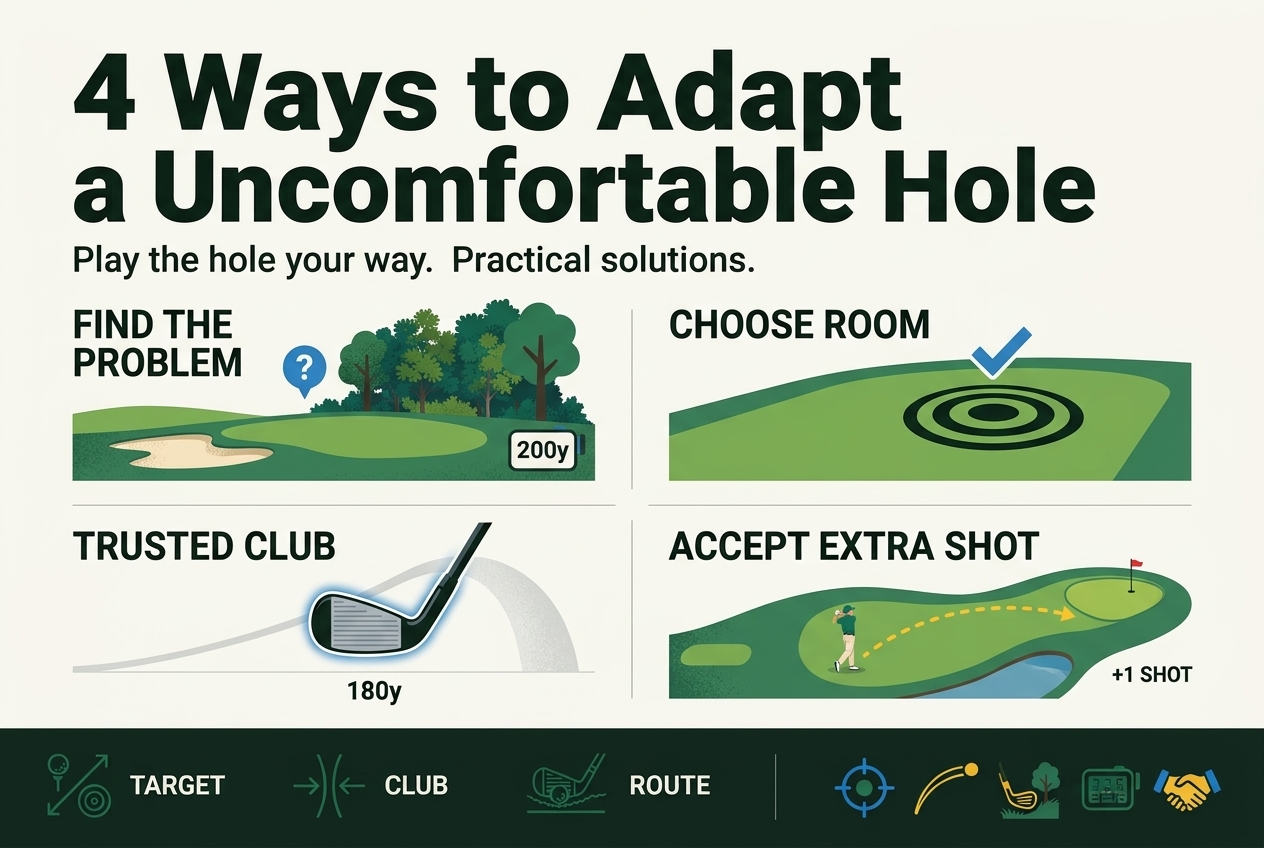
Find the Problem Before Choosing Your Shot
Take a moment to look at the hole and work out what makes it uncomfortable for your game.
Is it the narrow landing area? A hazard you need to carry? A dogleg that seems to favour a shot shape you don't have? Or is it the approach shot that worries you?
Try to identify the actual problem rather than treating the entire hole as difficult.
If the problem is a fairway bunker, you might simply need to choose a club that finishes short of it. If the problem is a narrow fairway, you might need to aim at a wider section rather than trying to find the perfect line.
Start by solving the problem, not by trying to hit a better shot.
Choose a Target That Gives You Room
Once you understand the problem, look for a target that gives you a little more margin for error.
You might not be able to hit the ideal landing area consistently, but perhaps there's a wider section of fairway that still leaves you in a reasonable position.
For example, if the fairway bends to the right, you don't necessarily have to follow the inside of the dogleg. You could play towards the wider outside section and accept a longer approach.
Likewise, if a green is protected by a bunker on the left, you might prefer to aim towards the right-hand side rather than trying to attack a flag that leaves very little room for error.
Give yourself somewhere to miss.
Use a Club and Shot You Trust
This is where you need to be honest about your own game.
If you normally hit your hybrid well but struggle to control your driver, there's nothing wrong with choosing the hybrid. If your natural shot is a fade, there's no need to manufacture a draw just because the hole appears to favour one.
Think about the shot you would be comfortable hitting on an ordinary day, without trying to do anything special.
That doesn't mean you should automatically choose the safest club in your bag. It means choosing the club that gives you a realistic combination of distance, accuracy and confidence.
Your best club for the hole might not be your longest club.
Accept the Extra Shot if It Makes Sense
Sometimes the easiest way to play a difficult hole is to stop trying to reach the green in regulation.
If a long approach requires a difficult carry, or you're sitting behind a hazard with a club you don't trust, consider laying up to a comfortable distance instead.
From there, you can play a shorter approach, give yourself a chance to hit the green and try to make your putt.
An extra shot isn't automatically a bad result. Trying to save that shot with a low-percentage attempt can sometimes turn a manageable hole into a much bigger number.
Don't risk two shots trying to save one.
A good decision doesn't guarantee a good shot. It gives you a better chance of recovering when the shot isn't perfect.
What Does This Look Like on the Course?
It's easier to understand the idea when you put it into a real golf situation.
Imagine you're standing on a par four. The hole turns left, the fairway narrows near the corner and a bunker sits in the landing area for your normal driver distance.
The ideal shot might be a controlled draw that follows the fairway around the corner. But that's not a shot you regularly hit.
You have a choice. You can try to hit the shot the hole appears to demand, or you can find another way to play it.

Option A: Try to Play the Hole as Designed
You take driver and attempt to shape the ball around the corner. If you pull it, you could run through the fairway. If you leave the face open, you might find trouble on the other side.
Even if you make good contact, you're relying on a shot that isn't part of your normal game.
Option B: Play to Your Strengths
You choose a club that you can hit comfortably and aim towards the wider part of the fairway, even if that means staying short of the corner.
You haven't gained the same distance, but you've taken the most difficult part of the tee shot out of the equation.
Your next shot might be longer, but it's from a position where you can play a normal shot towards the green.
You haven't beaten the hole by hitting a better shot. You've made the hole easier by making a better decision.
A Simple Check Before You Hit
Before playing a hole that doesn't suit you, run through four questions:
- What part of this hole creates the biggest problem for my game?
- Is there a wider or safer target I can use?
- Which club gives me the best chance of hitting a shot I trust?
- Am I trying to save a shot that isn't worth the risk?
You don't need to spend several minutes working through every possibility. A quick look at the hole and a sensible decision are usually enough.
Give Yourself Permission to Play It Differently
One of the biggest challenges is accepting that your route might look different from the route other golfers take.
Someone with a longer, more reliable drive might be able to take on the corner. A player who naturally shapes the ball might be able to follow the dogleg. A lower-handicap golfer might have the confidence to carry a hazard that you would rather avoid.
That's their game. You don't have to copy it.
Your objective is to put yourself in a position where you can play the next shot comfortably. If that means taking a different line, using a shorter club or accepting a longer approach, that's absolutely fine.
The best strategy is the one that works with your game, not against it.
Play the hole your way.
Not every golf hole is going to suit your game. Some will favour a different shot shape, demand more distance or ask you to take on a challenge you're not particularly comfortable with.
That's okay. You don't need to change your swing or suddenly become a different golfer to get around the course.
Look for a wider target. Choose a club you trust. Use your natural shot. Take the longer route if it gives you a better chance of keeping the ball in play.
And don't be afraid to accept an extra shot when the alternative is a risky attempt that could cost you more.
Good golf isn't about playing every hole the way it was designed. It's about finding the best way to play it with the game you actually have.
Looking for something else?
Search A BETTER ROUND for another golf problem, question or idea.
Can’t find what you’re looking for? Have a golf question? Ask ABR →