

Which Golf Club Should You Hit? Make the Decision Before You Swing
Choosing a golf club is about more than matching a number to the distance on your GPS. The shot in front of you, your lie, the space around the target and how far you reliably hit each club all matter. A better decision often starts before you take the club out of the bag.
How Do You Choose the Right Golf Club?
Start with the shot you need to play, not the club you hope to hit perfectly. Look at the distance, your lie, the trouble around the target and how far you normally hit your clubs.
Then choose the club that gives you the best chance of producing the result you need.
The key thing to remember: the right club isn't always the one that can reach the target on your best strike. It's the one that gives you the most useful result most often.
Start With the Shot, Not the Number
It's easy to stand over a ball, check the distance and immediately think about which club usually goes that far.
But the number on its own doesn't tell you what shot you need to play.
A 140-metre shot into the middle of a wide green is different from a 140-metre shot over water to a tucked pin. The distance might be identical. The decision doesn't have to be.
Before choosing a club, decide what you're actually trying to do with the ball.
What Does the Shot Require?
Start by looking at the target and the space around it.
Do you need the ball to carry something? Is there room short of the green? Is the safest miss to the left or right? Are you trying to land the ball softly, or is there plenty of space for it to run?
Those questions can change the club you choose before you even think about your normal distance.
The same applies when you're shaping the ball. If you normally play a fade or draw, that pattern can affect where you aim and how much space you need. A pull, hook or slice can create a different problem again.
You don't need to predict every possible miss. You just need to choose a club and target that leave some room for the shot you normally produce.
Four Things Should Influence Your Choice
You don't need a complicated formula every time you reach your ball. But a good club decision usually considers more than just the distance to the flag.
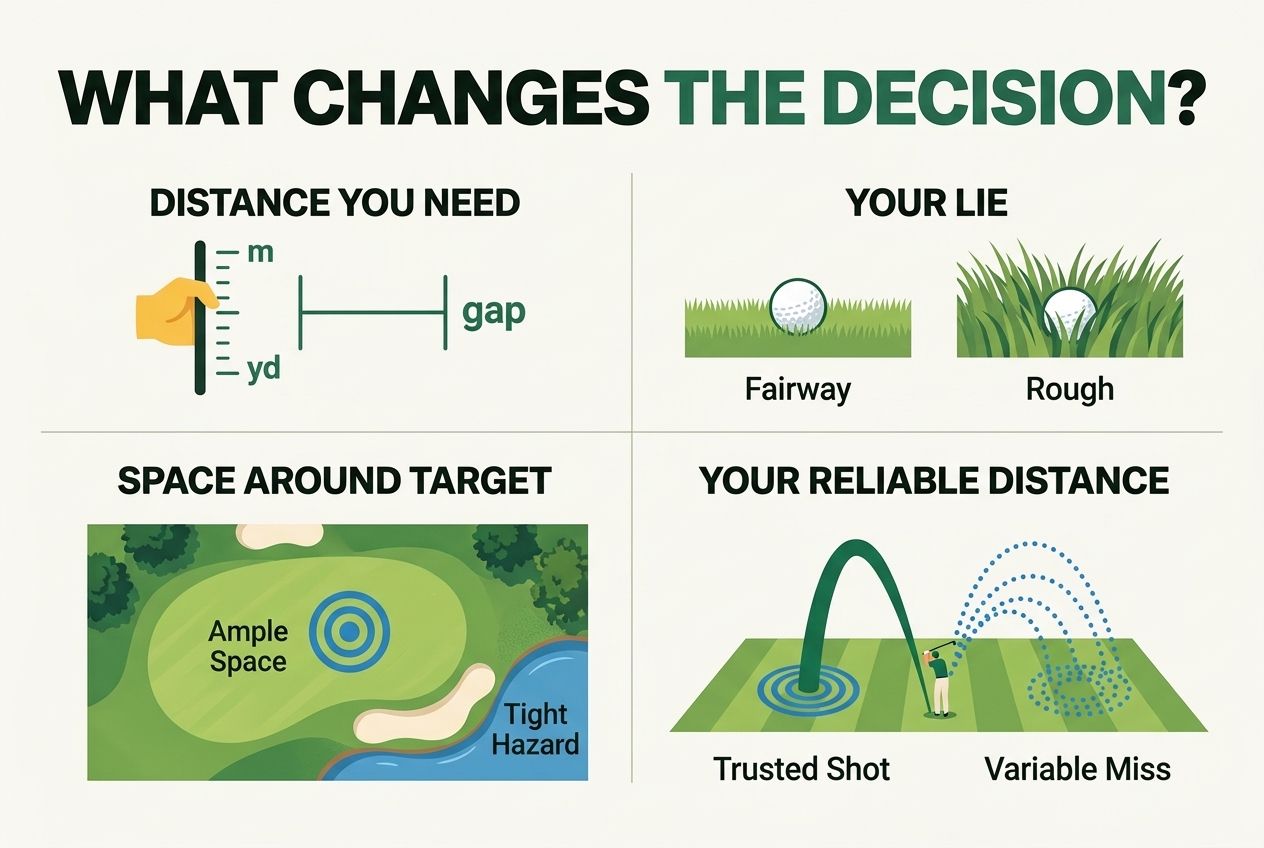
The Distance You Need to Cover
Start with the distance to the place you actually want the ball to finish. That might be the front of the green, the middle of the green or a safe area short of trouble. The flag isn't always the only number that matters.
Your Lie
A clean lie in the fairway gives you more options than a ball sitting down in rough or resting on an uneven slope. A difficult lie may mean choosing a club that helps you make solid contact rather than one that would be perfect from ideal ground.
The Space You Have
Look at what happens if the ball finishes short, long, left or right. A wide target with room around it can give you freedom. A narrow target surrounded by trouble may call for a more conservative decision.
Your Reliable Distance
This is where many golfers make the decision harder than it needs to be. Think about how far you normally hit a club when you're playing golf, not the one perfect shot you remember from the range.
None of these factors has to work in isolation. The useful decision is the one that brings them together.
Sometimes that means taking one more club. Sometimes it means taking less club because the shot needs to stay below a particular distance. The important part is understanding why you've made the choice.
A Simple Way to Choose Your Club Before You Swing
Once you start looking at more than just the distance, club selection can seem like it should become more complicated.
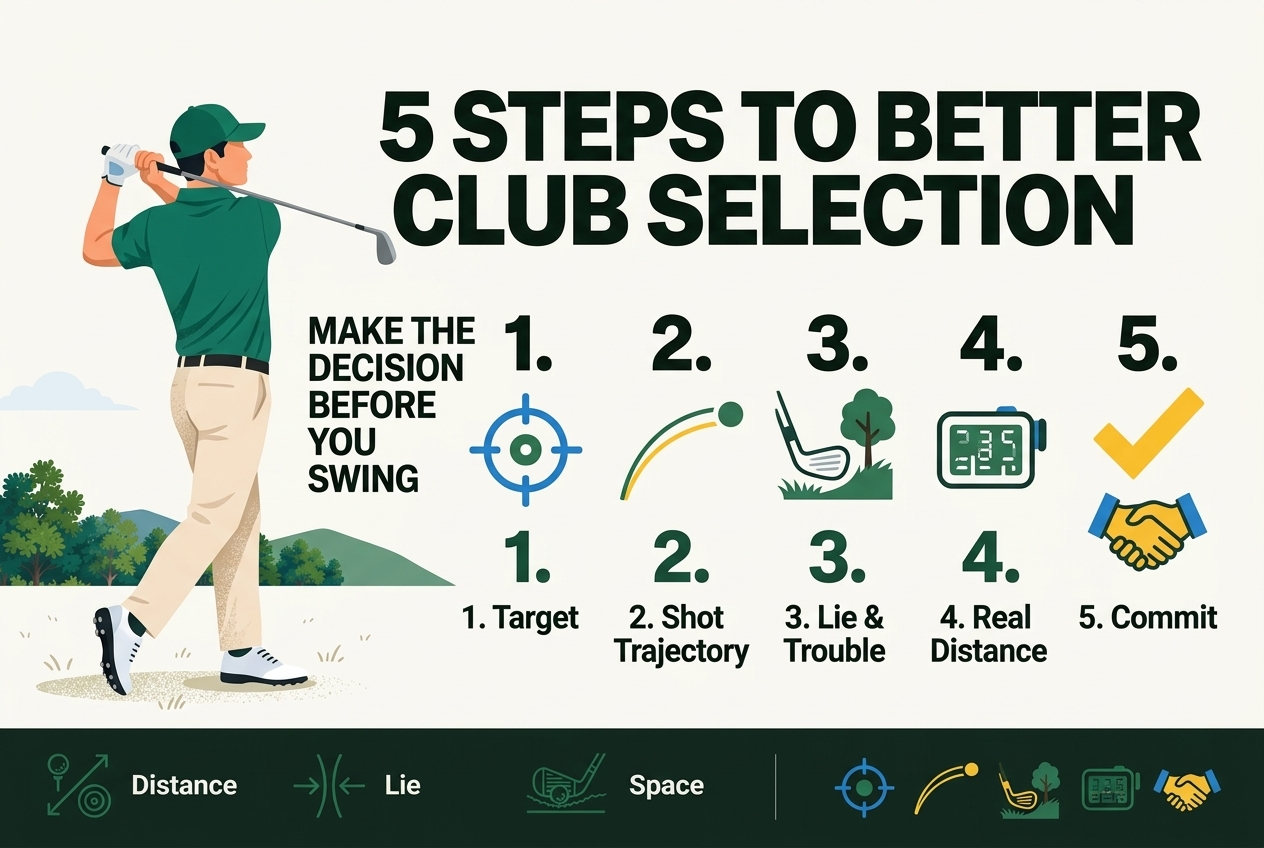
It doesn't have to.
Work through the shot first. Then choose the club that gives you the best chance of playing it.
Decide Where You Want the Ball to Finish
Don't automatically make the flag your target.
Look at the whole green or landing area. Is the middle the sensible target? Is there room short? Is one side safer than the other?
Choose the place that gives your ordinary shot some room.
Work Out What the Shot Needs to Do
Does the ball need to carry a bunker? Stop quickly? Stay below a tree? Run onto the green?
The shot you need can influence the club before you get to the exact distance.
A club that produces the right trajectory and landing pattern may be a better choice than one that simply matches the number on your distance device.
Check Your Lie and the Trouble
Be honest about what the ball is sitting on.
A poor lie can reduce your chance of making clean contact. Trouble around the target can change how much risk makes sense.
Sometimes the better golf decision is choosing the club that gives you a good chance of getting the ball into a useful position, rather than trying to manufacture the perfect shot.
Use the Distance You Actually Produce
Think about your normal golf shot.
Not the one you absolutely flushed on the range. Not the number you hit once with a perfect lie and a helping wind.
Use the distance you can reasonably expect to produce when you're standing on the course.
Make the Choice and Commit to It
Once you've considered the shot, the lie, the space and your reliable distance, make the decision.
You can always learn from the result afterwards. But standing over the ball still wondering whether you should have taken another club doesn't make the shot any easier.
Decide first. Then give the shot your full attention.
You don't need the perfect club. You need a club that makes sense for the shot in front of you.
You Don't Need to Know Every Number Perfectly
Better club selection doesn't mean carrying around a complicated chart of exact distances.
A rough understanding of your reliable distances is usually enough to make better decisions. Over time, playing golf will tell you plenty about which clubs you can trust for particular shots.
The useful habit is simply paying attention.
Before you choose a club, ask: What shot do I need, and which club gives me the best chance of playing it?
That question can stop you from automatically chasing the flag, trying to force a distance or choosing a club based on your best-ever shot.
Some days you'll get the decision wrong. That's golf.
But making the decision before you swing gives you something useful: a clear plan for the shot in front of you.
And a clear plan is usually more useful than standing over the ball with three different clubs still in your head.
Choose for the shot you have, not the perfect shot you imagine.
The right golf club isn't simply the one that matches the number to the flag. The lie, the trouble, the space around the target and your own reliable distances all deserve a place in the decision.
You don't need to make club selection complicated. Look at the shot, choose a sensible target, pick the club that gives you the best chance of producing it and then commit to the swing.
Make the decision before you swing. Give your ordinary shot some room. Then trust the club you've chosen.
Looking for something else?
Search A BETTER ROUND for another golf problem, question or idea.
Can’t find what you’re looking for? Have a golf question? Ask ABR →