

How to Use Golf Tips, YouTube Videos and Training Aids Without Getting Lost
You watch one video about your slice. Then another suggests a different fix. Before long, you have three new swing thoughts and a training aid in your shopping basket. How do you turn all that advice into something useful?
Can Online Golf Tips and Training Aids Help?
Yes—when they help you understand a specific problem, practise a suitable task or get useful feedback. The difficult part is deciding whether the advice fits your situation.
Start with a question about your golf. Check who the instruction is for, choose one task you understand and decide how you will assess it before making changes or buying equipment.
You do not need to act on everything you learn. Sometimes an explanation is enough. If the cause of a recurring problem is unclear, individual coaching can help you choose what deserves your attention.
A Good Tip Can Still Be the Wrong Tip for You
An instructor may be explaining a sensible correction for a golfer who makes a particular movement. That does not mean every golfer with a disappointing shot needs the same correction.
“My drives go right” describes an outcome. It does not tell you everything about the strike, starting direction, curve or movement that produced it.
Before searching for a fix, observe the pattern more carefully. Our guide to slicing gives you a more specific starting point for understanding a recurring curve.
Two Tips May Be Addressing Different Starting Points
One golfer might be asked to feel a shorter backswing. Another might need to complete a movement they are cutting short. Those instructions can sound contradictory when separated from the golfers they were intended for.
Combining both into your next session does not resolve that difference. You first need to know which task, if either, applies to you.
A Short Clip May Leave Out the Explanation You Need
A reel can demonstrate an exercise clearly. It may have less room to explain the starting problem, the intended golfer or how to judge the result.
Use it as an introduction when necessary. Look for the fuller explanation before copying a technical change you do not understand.
Before trying a correction, ask: “Do I know that I have the problem this is intended to address?”
Watching Can Prepare You to Practise
Reading can explain a term or help you plan a session. Video can show the setup and sequence of a drill. Both can be useful before you pick up a club.
But understanding an explanation and performing the task are different checks. After watching, decide whether you need to practise something, ask a question or simply keep the information for later.
This applies to ABR articles too. Use a guide to understand the task; seek individual feedback when you need someone to assess your own swing.
Five Questions to Ask Before Trying a Golf Tip
You do not need to investigate every video you watch. Use these questions when you are considering changing your practice or swing because of it.
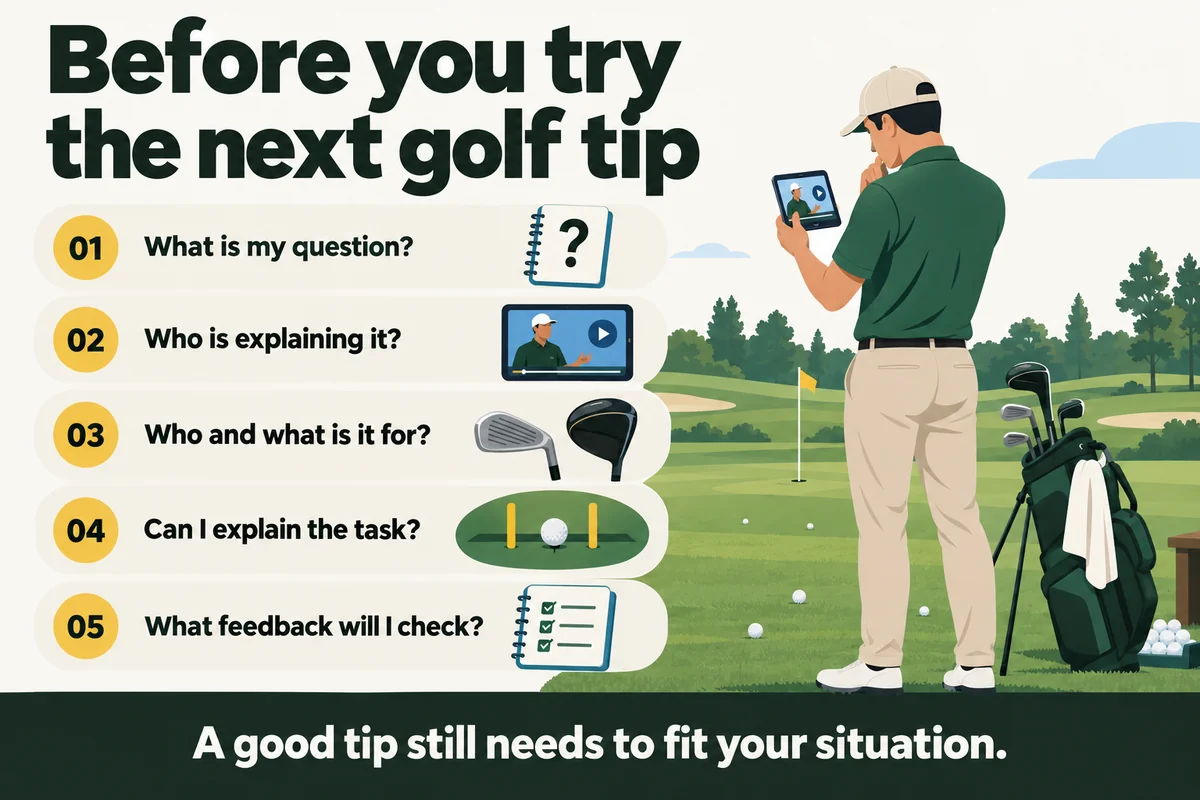
1. What Question Am I Trying to Answer?
Start with something specific: “How can I practise putting pace?” or “What does ground-first iron contact mean?”
A clear question makes it easier to recognise relevant advice and stop searching once you have enough information for the next step.
2. Who Is Explaining It?
Look for an identifiable instructor, relevant coaching qualifications and an explanation of the task. Popularity and an impressive playing record are not enough to tell you whether an exercise suits you.
Check whether the content is instruction, an account of personal experience or a product demonstration. If a purchase is involved, look for sponsorship and affiliate disclosures.
3. Who and What Is the Advice For?
Is it for a beginner learning basic contact, an experienced player changing a specific movement or someone trying to play a specialist shot?
Check the club and situation too. An iron exercise from the ground is not automatically suitable for a teed driver. If the advice does not explain its intended use, find that context before applying it.
4. Can I Explain the Task in One Sentence?
“Place two markers to make a putting gate, then roll the ball through it” describes an activity you can set up. “Fix my release” still leaves important questions.
Know the starting position, what you are trying to do and how to use any equipment. If you cannot explain those parts, clarify them before practising.
5. What Feedback Will Tell Me Something Useful?
Choose something observable: a ball passing through a gate, chips landing in a chosen area or a movement checkpoint agreed with your coach.
Feeling different is information, but it does not confirm the intended movement or a better shot. Decide what you will check alongside the sensation.
If the advice fits a plan you already have with a coach, it may be a useful reminder. If it appears to conflict with that plan, save it and ask about it before adding a second set of instructions.
What Would a Training Aid Add?
An aid might mark a target, show where contact occurred or guide a specific rehearsal. The useful question is what it helps you observe or practise.
You should be able to explain its role without repeating a promise from the packaging.
Identify the Feedback You Need
“I want to see whether my putt starts through this gap” is a clear reason to use a gate. “I want a better swing” does not yet identify an aid.
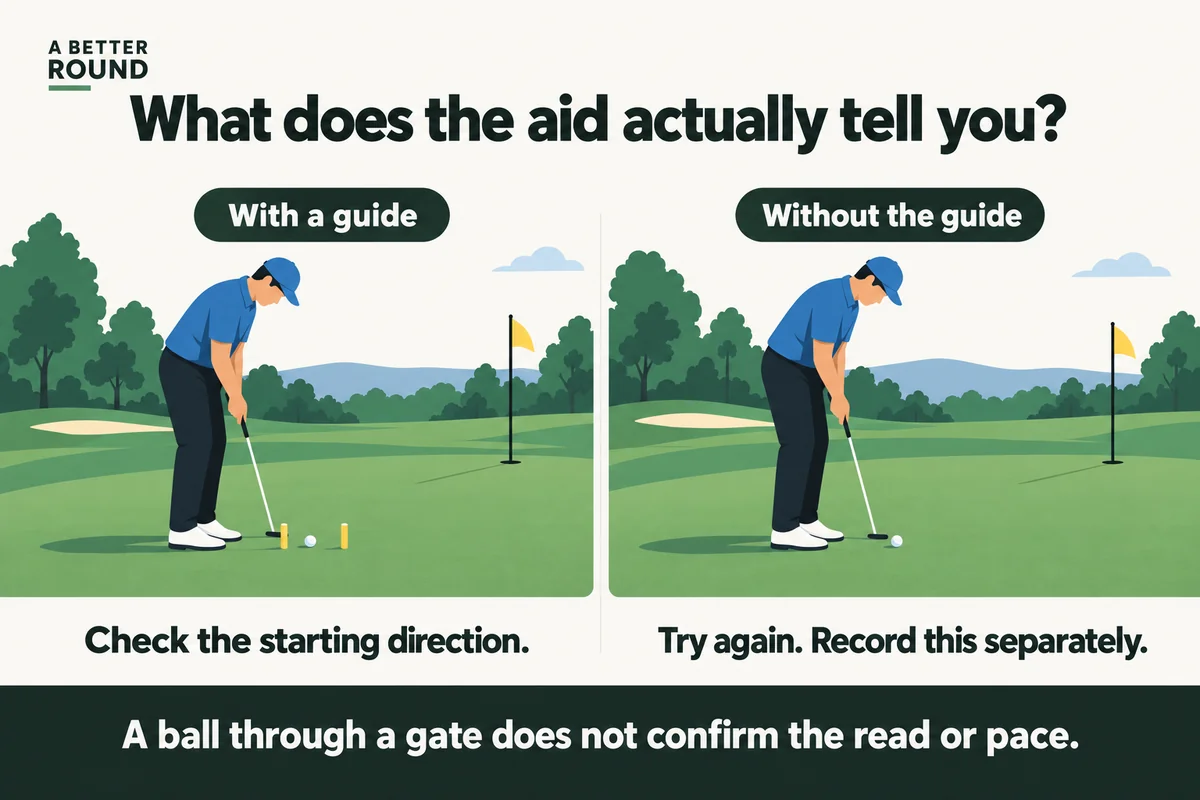
Also recognise the limit. A ball passing through a putting gate does not tell you that you read the slope correctly or chose the right pace.
Consider a Simple Substitute
Two flat markers can make a putting gate. A towel can mark a landing area where the facility permits it. A notebook or phone note can record results.
For a specific contact exercise, explore the Towel Behind the Ball Drill. Follow its setup rather than placing an obstacle at an arbitrary distance.
Household substitutes suit simple marking tasks. They are not substitutes for equipment that must contain real balls, attach securely or withstand impact. Keep hard objects clear of a full swing.
Understand Setup, Fit and Instructions
Check which clubs, movements and practice conditions the aid is designed for. Follow the manufacturer’s instructions, including space and clearance requirements.
If it guides body positions or restricts movement, ask a coach whether it suits your task and how to use it. Do not force a position or continue through pain.
Include Attempts Without It
After a manageable set with the aid, remove it when safe and appropriate, then try the task again. Can you reproduce the intended result without its physical guide or immediate feedback?
Keep those results separate. You are checking how the skill works when the practice conditions change, rather than assuming success with the device is the finished job.
Complete this sentence before buying: “I will use it to practise or observe…”
If the answer is still vague, clarify the task first. Borrowing or trying an aid during a lesson may help you understand its role before committing to a purchase.
Turn One Useful Idea Into a Practice Task
Once an explanation passes your checks, give it a manageable test. Avoid changing several things at once, because you will struggle to tell what you actually tried.
Write a Four-Line Practice Note
- Question: What am I trying to understand or improve?
- Task: What will I do, with which club and in which setting?
- Measure: What will I observe or count?
- Review: What will I check after the set and on another visit?
For example: “Practise the starting direction of a short putt. Use the same flat surface, starting point and generous gate. Record ten attempts before practice and ten afterwards. Repeat on another day.”
Keep the results as observations rather than proof. A small improvement can reflect warming up, familiarity with the task or normal variation as well as the idea you are testing.
Give the Task Attention Before Collecting Another Fix
Work through a small set, pause and review. If the instructions are unclear, resolve the question. If the task is too difficult, simplify it where appropriate.
You do not need to persist with a misunderstood exercise just because someone said it takes time. Equally, one poor attempt is not a complete evaluation.
For help organising the session, read what you should do at the golf range.
Check the Result Outside the Exercise
Once you understand the task, try a manageable change: remove a guide, choose a fresh target or play one attempt through your normal preparation.
Your pre-shot routine can provide a familiar sequence for that attempt. Keep this result separate from the repeated drill, because the conditions are different.
When Is It Time to Ask a Coach?
Seek individual feedback when you cannot identify the recurring problem, several tips seem equally plausible or you are unsure whether you are performing an exercise as intended.
It is also worth asking when a change creates a new persistent miss or your coach’s existing plan seems to conflict with something you have found online.
Bring the video or article, a short description of your usual shot pattern and any practice notes. Ask: “Does this apply to me, and what would you want me to check?”
A useful outcome from advice is: one clearer question or one understood task.
You can still enjoy watching golf instruction. Keeping a distinction between watching for interest and choosing something to practise makes it easier to leave the next appealing tip for another day.
Choose what deserves a place in your practice.
A useful article can explain something you have never understood. A video can make a task clearer. A training aid can provide feedback you were missing.
Start with your question, check whether the advice fits and decide what you will observe when you try it. Ask for individual help when you cannot make that connection confidently.
Take one understood idea into practice. Give yourself something clear to learn from it.
Choosing Instruction That Fits Your Golf
This PGA guide discusses choosing a coach and the role of swing aids within instruction. The filtering questions and practice-note format above are ABR suggestions for organising your next step.
PGA GUIDANCE How to Choose a Golf Coach Further reading on individual instruction and the purpose of swing aids.Looking for something else?
Search A BETTER ROUND for another golf problem, question or idea.
Can’t find what you’re looking for? Have a golf question? Ask ABR →