

How to Practise Golf at Home—and What to Check Elsewhere
You do not always have time for the range. Sometimes you have ten minutes, a putter and a stretch of carpet. Sometimes you have a backyard net. Both can give you something useful to work on, provided you understand what the practice is showing you.
Can You Practise Golf at Home?
Yes. Home practice can include short putting tasks, rehearsing your setup and pre-shot routine, and hitting balls into a suitable net where the space and equipment allow it.
Choose one task and a result you can actually observe. That might be a putt rolling through a gate or completing your preparation before every net shot.
Then check the parts your home setup cannot show. Full ball flight, carry distance, green speed, different lies and decisions during a round need suitable facilities, measurement or time on the course.
Choose the Task Before Buying the Setup
A net, mat or putting aid gives you somewhere to practise. You still need to decide what you want to learn.
If your task is starting a short putt along an intended line, a flat surface and two small markers may be enough. If you want to know how far your seven-iron carries, an ordinary net cannot answer that on its own.
Start with the question. Then choose the simplest suitable setup that gives you useful feedback.
What Can You Actually Observe?
Feedback means information about the attempt. A ball passing through a putting gate is feedback. So is seeing where a chip lands or noticing where an iron meets the ground.
The sound of a net shot might suggest a solid strike, but it does not tell you the whole flight. Feeling balanced does not confirm that the ball would have finished on the fairway.
Ask: “What will this setup let me check?” That answer should shape the session.
How Much Space Do You Need?
There is no single room size that makes every golf setup safe. Your height, club length, swing, ceiling, net design and manufacturer’s required clearances all matter.
Check the full movement, including the backswing and finish, with the longest club you intend to use. Allow a generous margin around the club rather than treating a slow rehearsal that just clears an obstacle as enough.
Keep people and pets outside the entire practice area. Check overhead fittings, furniture, windows and anything behind or beside a net. If you cannot provide enough clearance, choose putting or a smaller rehearsal that fits.
A Net Needs More Than a Clear Target
Use a golf net rated for the balls and shots you intend to hit. Follow its instructions for positioning, anchoring and hitting distance. Inspect the netting and frame before use, and allow for rebounds and mishits that could escape above or beside the target.
Use a stable hitting surface. Do not rely on a fence, bedsheet or household curtain to contain real golf balls. Foam balls reduce some risks, but they still need a suitable space and do not make an obstructed swing safe.
Four Useful Ways to Practise at Home
You do not need to recreate a golf facility. Choose an activity your space supports, then keep its purpose clear.
1. Putting: Practise a Repeatable Starting Line
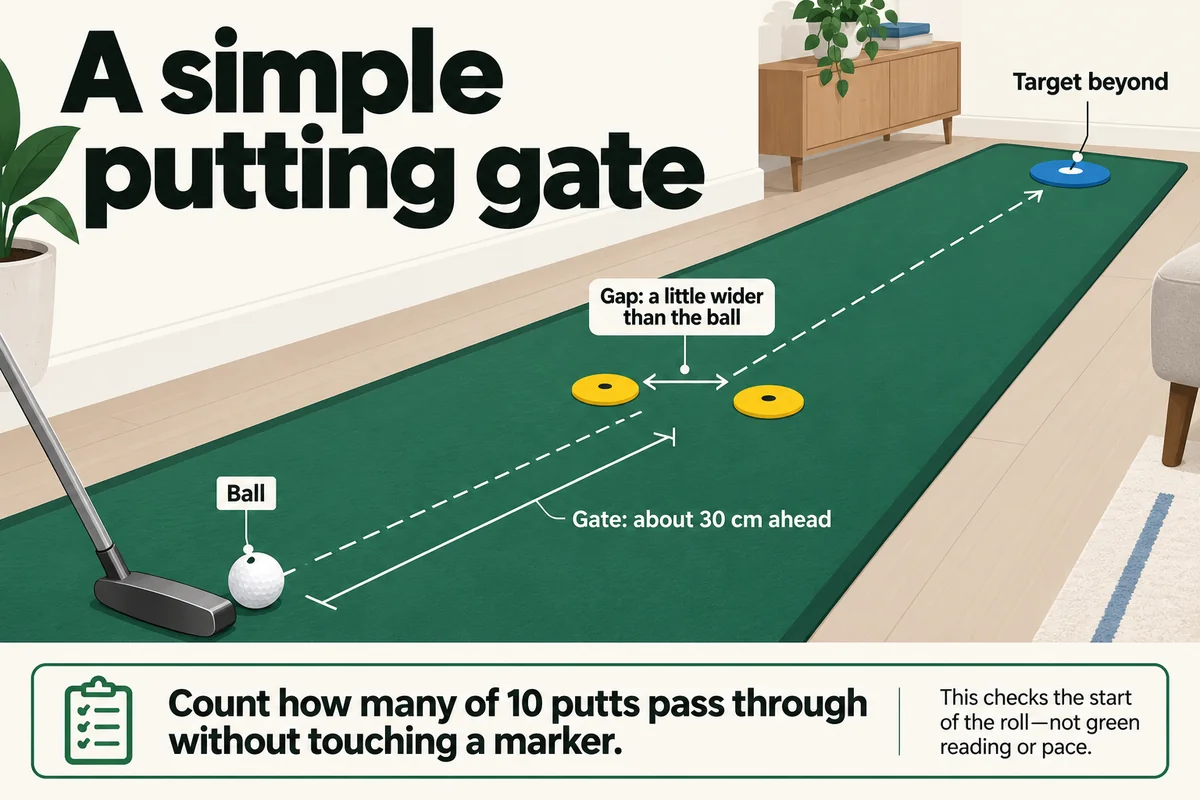
On a flat putting mat or suitable stretch of carpet, choose a straight intended line. Place two flat markers about 30 centimetres ahead of the ball, with a gap a little wider than the ball.
Putt through the gap towards a target farther along that line. Start with a generous opening and narrow it only when the task becomes comfortable.
Count: How many of ten putts pass through without touching either marker? Use the same starting point and gap when you repeat the test.
What it shows: Whether the ball passes through a small area near the start of its roll. An uneven surface can influence that result.
What to check elsewhere: Reading slopes, judging longer putts and matching the pace of a real green. Success through the gate does not guarantee a holed putt.
2. Rehearsals: Practise One Agreed Movement or Routine
Where you have enough clearance, rehearse a setup or movement you understand, ideally one chosen with your coach. Work at a comfortable speed and reset between attempts. You do not need a ball.
You can also rehearse the order of your preparation: choose an imaginary target, make your rehearsal, set up and pause before the intended shot.
Count: Complete five deliberate repetitions, checking the one feature you intended to rehearse. Avoid turning the session into a search for several new positions.
What it shows: You can rehearse a sequence or observe a position. A safely positioned mirror or phone can provide a visual check, although camera angle affects how movement appears.
What to check elsewhere: Whether the movement still works when you strike a ball and produces the intended result. A rehearsal alone cannot confirm that.
Our pre-shot routine glossary entry explains the preparation sequence you can bring into these rehearsals.
3. Net Practice: Give Each Ball a Purpose
With a suitable net, stable mat and enough clearance, choose one comfortable club and one task. That could be following a contact exercise from a lesson or completing your routine before every shot.
Hit a small set, step away between attempts and note what you can actually observe. If you use a swing feel, keep it to one cue rather than adding a new instruction after every strike.
Count: For routine practice, record how many of ten shots included your full preparation. If contact is the task, use suitable feedback and record uncertain strikes rather than assuming every good sound means a good shot.
What it shows: Depending on the setup, you may observe strike feedback and practise hitting a ball after your preparation.
What to check elsewhere: Full flight, curvature, carry and finishing position. A ball hitting the centre of a nearby net does not prove it would have stayed straight.
If contact is your priority, how to strike a golf ball explains what you are trying to achieve before you choose an exercise.

4. Backyard Chipping: Work on a Small Landing Task
If your space allows a short chip, use a suitable practice ball and a broad landing area a few metres away. Keep the motion small and use one club from one starting position.
Only use real golf balls where the entire setup can safely contain mishits. A garden boundary alone does not make it a suitable real-ball practice area.
Count: How many of ten attempts first land inside your chosen area? Make the area larger or the shot shorter if you rarely reach it.
What it shows: You can practise directing a short shot towards a landing area with that ball and surface.
What to check elsewhere: Carry with a real ball, contact from different lies and rollout on a green. Foam-ball distances and lawn rollout are not a wedge distance chart.
If none of these fits your space, you can still review notes from a lesson or plan your next practice task. There is no need to force club-and-ball practice into an unsuitable room.
What Needs a Range, Practice Green or Course?
Think of your next facility visit as a chance to answer the questions your home setup left open. Take one task with you and add the feedback you were missing.
The Range: Watch the Whole Shot
Use a range visit to observe starting direction, curve and where the ball lands. If you have been rehearsing a movement at home, begin with a manageable club and see what happens when the ball can fly.
Choose a generous target area and record ten attempts, including the poor ones. Note the pattern rather than judging the session by your best strike.
Known distances or suitable tracking equipment can help you investigate carry. Allow for range balls, weather and the measurement system when applying those numbers on the course.
For help structuring the visit, use our guide to what to do at the golf range.
The Putting Green: Add Pace and Slope
Keep a few short putts in the session, then try different distances. For example, play three balls each from roughly three, six and nine metres towards a hole.
Choose a generous finishing zone, such as within one metre of the hole, and count how many stop inside it. Shorten the distances or enlarge the zone if needed.
Add uphill and downhill putts once you have a starting point. You are now judging how the surface changes the required pace—something a fixed indoor putt cannot fully reproduce.
The Short-Game Area: Learn the Landing and Roll
Use real balls in a designated area to check how a chip lands and releases on a green. Start with one club, a straightforward lie and plenty of room for the ball to roll.
Count how many of ten shots reach the green, then observe the first landing point and final position separately. Later, change the starting position or lie.
Longer pitches need a designated space that safely accommodates the shot. Check facility rules: a putting green may not allow chipping, and a chipping area may not allow longer pitches.
The Course: Use the Skill With a Decision Attached
During a round, you have to choose a shot, account for the situation and play from the lie you find. You also have time between attempts and a result that matters to the hole.
Bring one intention into your next round, such as choosing a landing area before each chip. Notice whether you complete that preparation and what happens afterwards.
Follow course rules and maintain pace. Extra balls and repeated shots belong only in practice situations where they are permitted and do not affect other players.
The Process-Over-Score Round Tracker gives you a way to record the process you intend to use while playing.
Take a question with you: “Can I still do this when the distance, lie or target changes?”
Start With Ten Minutes and One Task
You do not need to practise everything every evening. Start with a short activity you can set up easily and repeat on another day.
Here is a putting example using the gate task above. Adjust the timing to suit your space and experience.
First Two Minutes: Set Up and Settle In
Check that the surface is reasonably flat and the area is clear. Choose a starting point, place the two gate markers and make a few easy putts. Use a gap that gives you a realistic chance of success.
Next Six Minutes: Play Small Sets
Play sets of five putts, collecting the balls between sets. Set up again before every attempt. Record how many pass through the gap and keep the target and starting point consistent.
If a putt misses, observe what happened before changing anything. One miss does not explain its own cause. Follow any specific instruction you have from your coach rather than building a new stroke around each result.
Final Two Minutes: Record a Repeatable Test
Play ten attempts from the same starting point and record the number that pass through. Note the gap and distance so you can reproduce the task.
On another day, repeat it before making the task harder. A single good set is encouraging; several comparable sessions give you a better picture of consistency.
A useful note is simple: “One-metre putts, same gate, seven through out of ten. Check short putts and pace on the practice green next visit.”
Keep a Bridge to Your Next Round
Write down what you still need to check outside. For net practice, that might be the full flight. For backyard chips, it might be real-ball carry and rollout. For rehearsals, it might be whether the movement helps when you hit a shot.
If you find yourself practising often without a clear purpose, choose a process goal such as completing your routine before each attempt. Keep that record alongside any shot results so you know which part you are assessing.
You can keep home sessions small and still make them purposeful. The important part is knowing what you are working on and what you will check next.
Make the space you have useful.
A stretch of carpet can give you a putting task. A suitable net can give you a place to rehearse and strike balls. A short session can keep you connected with something you are working on between visits to a golf facility.
Be clear about what the setup tells you. Then take the unanswered questions to the range, practice green or course.
Choose one task, observe what you can and give yourself a clear next check when you get back outside.
Looking for something else?
Search A BETTER ROUND for another golf problem, question or idea.
Can’t find what you’re looking for? Have a golf question? Ask ABR →