

Lost Balls, Lake Balls and Cheap Balls: What Should You Actually Play?
Golf balls can cost very little or a surprising amount for something you might lose on the next hole. But the cheapest ball isn't always the best value, and an expensive ball won't automatically make you a better golfer. The sensible choice depends on how you play, what you need from the ball, and how often it disappears into the trees or water.
Should You Play Cheap, Recycled or Premium Golf Balls?
For many recreational golfers, a good-quality budget ball or a carefully chosen used ball is a perfectly sensible place to start. You don't have to spend premium prices just because better players do.
Cheap new balls give you a consistent starting point without a big replacement cost. Recycled or lake balls can save money too, but their condition and history may vary. Premium balls can be worthwhile if you value their feel and short-game performance, and can make use of those differences.
The practical rule: choose a ball you can afford to lose, that performs consistently enough for your game, and that you can keep playing rather than changing every few holes.
Are Expensive Golf Balls Actually Better?
They can be. But that doesn't mean they're automatically the right choice for you.
Golf balls are sold at very different prices, and it's easy to assume the more expensive option must be the best one. Premium balls can offer particular combinations of feel, spin and flight. Budget balls can be designed to deliver useful distance and durability at a lower price.
The harder question is whether the differences matter to your game — and whether they're worth paying for when you might lose the ball before you've had much chance to use it.
The best-value ball isn't necessarily the cheapest one. It's the one that gives you the performance you need at a cost you're comfortable with.
Three Types of Ball, Three Different Questions
Cheap New Balls
Usually the simplest low-cost option. You know you're starting with a new ball, so you don't have to guess how much it has been played or whether its cover has been damaged. The question is whether its feel and performance suit you.
Recycled or Lake Balls
These can be an economical way to play a recognisable model for less. But “recycled”, “used”, “lake ball” and “refurbished” don't necessarily mean the same thing. The ball's original condition, time in use, recovery history and any refinishing can vary.
Premium New Balls
These may be worthwhile if you notice and benefit from differences in feel, spin and control around the greens. But paying more doesn't guarantee lower scores, particularly if you're still working on contact, direction or simply keeping the ball in play.
The Problem With Comparing Them by Price Alone
A new budget ball and a used premium ball are not a perfectly controlled comparison. One is inexpensive and unused; the other may be a more expensive model with an unknown amount of previous use.
A used ball in excellent condition may be a good buy. A heavily scuffed, cut or refinished ball may be a less attractive proposition, even if its original model was expensive.
Research into pond-submerged golf balls also suggests that the story is more nuanced than “lake balls are always shorter”. One study found no significant difference in distance or dispersion for a particular modern premium ball after extended submersion. That doesn't tell you everything about the used balls in a mixed bargain bucket, especially if they have also been played, damaged or refinished.
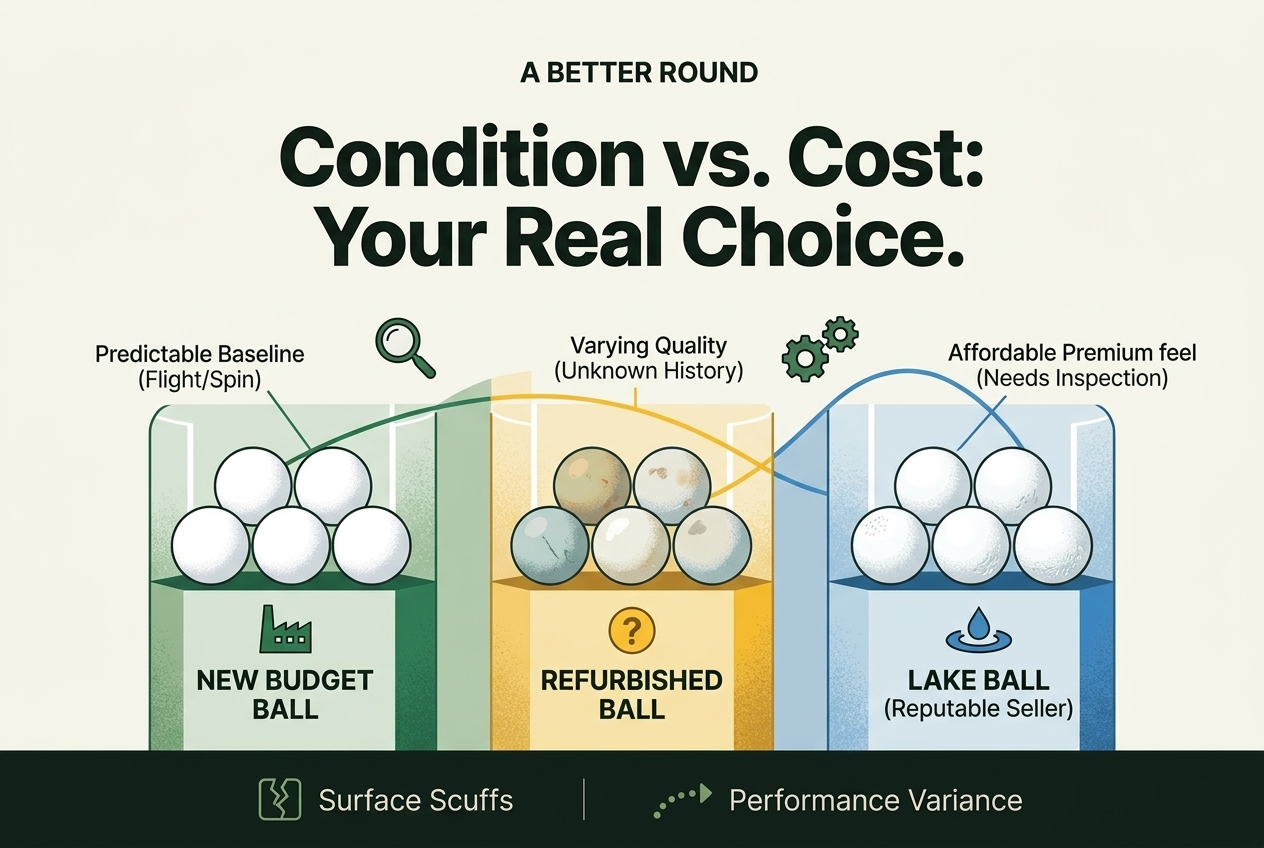
Don't pay a premium for a logo you don't need — but don't assume every used ball is a bargain just because it costs less.
Five Things to Consider Before You Buy
Forget the marketing for a moment. If you're choosing between a box of budget balls and a dozen recycled premium balls, start with what you'll actually notice on the course.

1. Condition
A new budget ball starts with a known history. A used ball might be in excellent shape, or it might have scuffs, cuts, worn markings or signs of refinishing. Look beyond the brand printed on it. Avoid balls with cuts, cracks or obvious damage to the cover.
2. Consistency
Playing the same ball model gives you a more consistent reference for feel and performance. A mixed bag of different models, conditions and constructions can make it harder to know whether a change in feel or flight came from your swing or the ball. You don't need a premium model to benefit from consistency.
3. Feel and Short-Game Control
Some golfers notice a meaningful difference in feel when putting and chipping, or in how a ball spins on approach shots. Others care more about a predictable flight and a durable, affordable ball. If short-game feel matters to you, compare a few options rather than assuming price tells the whole story.
4. How Often You Lose Balls
If you regularly lose two or three balls in a round, replacement cost deserves a place in the decision. A ball that costs less can help you play without worrying about every shot. But buying the absolute cheapest option isn't automatically best if you dislike its feel or find its performance unpredictable.
5. The Real Cost per Round
A dozen balls might look inexpensive, but the more useful question is how much you spend replacing the balls you actually lose. A slightly more expensive ball that you like and can buy consistently may be better value than a bargain pack you don't enjoy playing.
Don't Confuse a Ball's Price With Its Performance
A ball's construction and cover can influence its flight, feel and spin. But you don't need to understand every layer of golf-ball technology to make a sensible choice.
If you mostly want a dependable ball that launches well, travels a useful distance and doesn't cost much to replace, a budget model may do the job. If you have developed a preference for a particular feel or want more control on short shots, a more expensive model may be worth testing.
Choose for the shots you play, not the golfer you think you're supposed to be.
So, Which Golf Ball Makes Sense for You?
There's no single answer for every golfer. Use these as starting points, then pay attention to what you enjoy playing and what fits your budget.
Play Budget Balls if You Want Low-Cost, Consistent Replacements
A decent new budget ball is a strong option if you're still losing several balls a round, don't have a particular preference for feel, or simply want to keep the cost of golf under control.
The advantage is straightforward: you know the balls are new, and you can buy the same model again. That gives you a consistent starting point without paying premium prices.
Best starting point: a new budget model that you like hitting and can afford to replace regularly.
Buy Lake Balls if You Can Check the Condition and Trust the Seller
Recycled balls can be good value, especially if you want to try a more expensive model without paying its full new-ball price.
Look for clear condition grades, an honest description of whether the balls are used or refurbished, and a seller who explains what you're getting. Be wary of a bargain that mixes unknown models and conditions when consistency matters to you.
Remember that a ball recovered from water isn't automatically ruined. Equally, a clean-looking ball isn't proof that it has had little use or hasn't been refinished.
Best starting point: a clearly graded batch of used balls from a reputable seller, ideally all the same model and in a condition you are comfortable playing.
Consider Premium Balls if You Notice and Value the Difference
If you have a repeatable enough game to compare balls, you may notice differences in putting feel, wedge spin or how the ball behaves on approach shots. Those differences may be worth paying for if they matter to you.
But don't assume a premium ball will fix a slice, add a guaranteed amount of distance or turn a poor strike into a good one. Your swing, contact and delivery still have a much bigger role in the shot.
If you want to compare premium models, try them against your current ball under similar conditions rather than relying on price or advertising.
Best starting point: test one premium model you are interested in before committing to several dozen.
Avoid Heavily Damaged or Unclear Refurbished Balls
A ball with a cut, crack or significant damage to its cover is not worth choosing simply because it's cheap. Be cautious with refurbished balls if you cannot establish what has been done to them or how their condition has been assessed.
Refurbished balls may have been cleaned, refinished or marked again. That is different from buying an ordinary used ball that has simply been recovered and cleaned.
Best starting point: if the condition is uncertain, buy a less expensive new ball instead.
When in doubt, start with new budget balls. They're a simple way to control cost and establish a consistent baseline.
How to Find a Ball That Suits Your Game
You don't need a launch monitor or a formal fitting to make a sensible first comparison. Start with a simple test and pay attention to the shots that matter to you.
Step 1: Pick One Ball to Use as Your Baseline
Choose a ball you already play, or a new budget ball you are considering. Use it for several rounds if possible, so you have a reasonable feel for its flight, sound and performance.
Step 2: Compare Like With Like
If you want to try another model, compare it under similar conditions. Alternate between the two balls on the range or during practice, rather than hitting one model on a calm day and another in a strong wind and drawing conclusions from the difference.
Pay attention to more than your best shot. Notice the usual flight, how the ball feels off the putter, and how it behaves on the short shots you can compare fairly.
Step 3: Check What You Actually Notice
- Does one ball feel noticeably better to putt or chip?
- Do you see a repeatable difference in flight or distance?
- Does the ball give you the short-game response you want?
- Is the difference meaningful enough to justify the extra cost?
Don't read too much into one great drive or one poor wedge shot. Golf shots vary, and a single result isn't enough to prove that one ball is better for you.
Step 4: Work Out What You Can Afford to Lose
Be realistic about how many balls you lose in a typical round. If you often lose several, an expensive ball can quickly become a frustrating purchase. If you usually finish with the same ball you started with, the cost difference may matter much less.
You don't need to keep playing a ball you dislike just because it was expensive. Equally, if you enjoy a premium ball and it fits your budget, there's no reason to avoid it simply because you're not a low-handicap golfer.
Test for a difference you can actually notice — then decide whether that difference is worth paying for.
Play the ball that makes sense for you.
You don't need premium golf balls to enjoy golf or play well. A good budget ball can be a sensible choice, particularly if you're still losing several balls a round. Recycled balls can also offer value, provided you understand their condition and buy from a seller you trust.
Premium balls have a place too. If you notice and value their feel, spin or control, and the cost is comfortable, they may be worth playing. Just don't assume a higher price automatically means better results for your game.
Start with a ball you can afford to lose, stick with one model long enough to understand it, and only spend more when you can identify a difference that matters to you.
Looking for something else?
Search A BETTER ROUND for another golf problem, question or idea.
Can’t find what you’re looking for? Have a golf question? Ask ABR →