

What Should You Practise in Golf? A Beginner’s Guide
You have a bucket of balls, half an hour on the putting green or a little space at home. But what should you actually work on? Choosing a useful task can be harder than finding the time to practise.
What Should a Beginner Practise in Golf?
Start with a recurring problem that makes your rounds harder. That might be keeping tee shots in play, making reliable iron contact, controlling approach distance or getting a short shot onto the green.
Choose one main priority for the session, give yourself a specific task and record a simple result. Keep returning to the other parts of your game across the week or month.
If you have no playing experience to draw on, begin with basic contact, short shots and putting, and use an introductory lesson to help establish your setup and priorities. There is no single practice split that suits every beginner.
What Keeps Making Your Rounds Harder?
The last terrible shot you hit is very easy to remember. It does not automatically deserve your whole next practice session.
Think about your last two or three rounds instead. What kept happening? Were you searching for tee shots, leaving approaches short, taking two chips to reach the green or leaving long putts a long way from the hole?
You do not need detailed statistics. A few notes on your phone after each round can give you somewhere useful to start.
Describe the Problem Before Choosing a Drill
“My irons are bad” leaves you with a lot to solve. “I keep striking the ground before the ball” gives you a clearer starting point. So does “My solid approaches keep finishing short.” Those are different practice tasks.
One is about contact. The other may involve club selection, distance knowledge or the conditions. Sending both golfers to the same swing drill would miss that distinction.
If ground-first contact is your recurring issue, our guide to fat golf shots explains that problem in more detail before you choose an exercise.
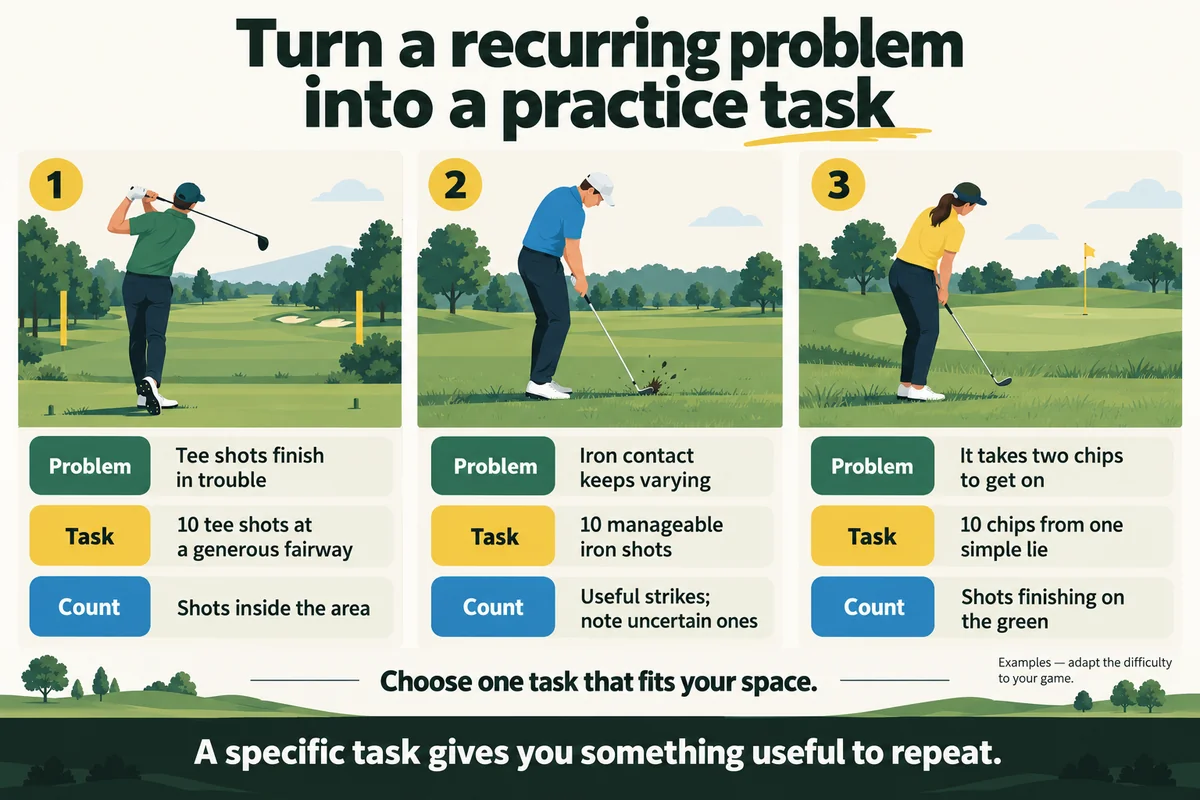
Give your session a job: “I’m practising getting this chip onto the green with one shot.”
Choose Something You Can Practise and Observe
Your biggest frustration and your best task for today might be different. A net can give you a place to work on contact, but without suitable measurement it cannot show where a full drive would finish. A putting green can give you immediate feedback on pace.
Choose a task that fits the space available. If the same problem persists and you cannot identify why, a lesson can help you choose what to work on rather than keep guessing.
Keep Some Variety Across Your Practice
One priority gives a session direction. It does not mean ignoring putting for a month because your driver is frustrating. Give the main problem more attention while keeping shorter sessions or a few minutes available for the rest of your game.
Six Parts of Your Game You Can Work On
You do not need to complete all six in one visit. Choose the area that matches your priority, then use its task as a starting point.
The distances and target sizes below are examples, not beginner standards. Make the task achievable enough to learn from, then adjust it as you improve.
1. Driving: Give Yourself a Playable Next Shot
If tee shots regularly leave you in trouble, start with where the ball finishes. Extra distance is less useful when you cannot play the next shot normally.
Try this: At the range, use two visible landmarks to imagine a generous fairway. Hit ten tee shots with your driver, stepping away and choosing your target before each attempt. Count every shot.
Where: A driving range with enough visibility to judge the flight. Use landmarks within the designated hitting area.
Measure: How many finish inside your imagined fairway? Note whether the others miss left or right. If you cannot see the landing, record that uncertainty rather than treating it as a precise result.
A recurring rightward curve is a more specific problem to investigate. Our guide to slicing can help you understand it before you add a correction.
2. Iron Contact: Make a Useful Strike More Often
If some irons travel normally and others barely advance, making contact more predictable is a useful priority. For a normal iron shot from the ground, the aim is to strike the ball before the turf.
Try this: Choose a comfortable short or mid-iron. Hit ten balls with a manageable swing, observing whether you struck the ground first, caught the ball very thinly or made a useful strike.
Where: A grass range is useful for seeing where the club meets the ground. A mat or secure net can also be used, but a mat can make ground-first contact harder to recognise.
Measure: Count the useful strikes out of ten using the same definition each time. Record uncertain strikes separately. Distance is secondary for this task.
For a clearer explanation of contact, read how to strike a golf ball. The Line Drill gives you a related exercise for working on ground contact.
3. Approaches: Match the Club to the Distance
An approach is a shot intended to reach the green. You can strike one cleanly and still finish well short or wide. That makes distance and target selection worth practising separately from contact.
Try this: Choose a visible target within a comfortable iron distance and a generous landing area around it. Hit ten shots, recording short, long, left, right or inside the area. Note obvious mishits separately.
Where: A range with known target distances, a suitable simulator or a designated practice area.
Measure: Count shots inside the area and look for a repeated pattern among your solid strikes. If most finish short, check the distance and club choice before assuming your swing needs rebuilding.
Watch where the ball first lands when possible. That is its carry distance. Range balls, wind and different surfaces mean these observations are a guide, not an exact on-course distance chart.
4. Chipping: Get Onto the Green in One Shot
A chip is usually a short shot near the green that spends relatively little time in the air before rolling. Start with an uncomplicated lie and room for the ball to run.
Try this: Choose one club, one starting position and a broad landing area on the green. Chip ten balls towards the same target, watching where each lands and how far it rolls.
Where: A practice green that allows chipping or a designated short-game area. Follow the facility’s rules about markers and equipment.
Measure: First count how many finish on the green. Then count how many land in your chosen area. Once getting on is reliable, add a generous finishing zone around the hole.
Keeping the club and starting position the same initially makes it easier to compare attempts. You can introduce different lies and targets later.
5. Pitching: Carry the Ball to a Landing Area
A pitch generally travels higher and carries farther through the air than a chip. It is useful when you need to cover more ground before the ball can land. There is no universal distance where a chip becomes a pitch.
Try this: Using one wedge, choose two manageable landing distances, such as 15 and 25 metres. Play five balls to each with a comfortable motion, observing the first landing point rather than only the final position.
Where: A designated pitching area or range where those distances are safe and permitted.
Measure: Count how many land within a generous band around each distance, such as five metres short or long. Widen the band or shorten the task if needed.
Start from a straightforward lie. Higher shots over obstacles can wait while you build a more dependable basic pitch.
6. Putting: Separate Starting Direction and Pace
A short putt that starts away from your intended line and a long putt that stops three metres short need different practice tasks. Choose which one you are working on.
Try this for short putts: Find a relatively straight putt of about one metre. Play ten attempts from the same position, setting up again each time.
Try this for pace: On a practice green, putt three balls each from roughly three, six and nine metres. Choose a generous finishing zone, such as within one metre of the hole in any direction.
Where: A practice putting green. An indoor mat can provide a repeatable short-putt task, although it will not reproduce every green’s pace or slope.
Measure: Record short putts holed out of ten, or long putts finishing in the zone out of nine. Keep those results separate so you know what you are measuring.
These tasks help you notice patterns. A small set of shots is a starting point for your next session, rather than a verdict on your ability.
How to Turn One Priority Into a Session
“Work on my short game” is an intention. “Practise landing ten chips on this part of the green” gives you something to do when you arrive.
Here is an example of a 30-minute chipping session. The same structure can be adapted to another skill or a shorter visit.

Get Comfortable With the Task
Choose a straightforward lie, one club and a broad target. Make a few gentle rehearsals and play some easy chips. Use this time to settle in and check that the task suits your current ability.
Record Your Starting Point
Play ten chips. Count how many finish on the green and how many land in your chosen area. Keep the starting point and target the same so you have a result you can repeat later.
Work on One Task
Play small sets towards that landing area. Watch where the ball first lands and then how it rolls. Pause between sets to decide whether the target is appropriate and what you want to try next.
If you are following a coach’s instruction, keep the exercise consistent with it. Avoid adding a new swing tip every time a ball finishes somewhere you did not intend.
Finish With Different Shots
Play one ball at a time from a few permitted positions. Choose the landing area, complete your preparation and accept the result before moving to the next shot. Record how many finish on the green.
This is a different test from repeating one chip. Keep its score separate from your starting-point result.
Your pre-shot routine gives you a preparation sequence to rehearse during those final attempts. If you want a scored practice activity, explore the Pressure Practice Challenge.
For a session built around a bucket of balls, use our guide to what to do at the golf range.
You should be able to finish the sentence: “Today I worked on…” without saying “a bit of everything”.
You Can Practise in More Than One Place
The range is useful, but it is only one environment. A putting green, short-game area or suitable space at home can give you a different task to work on.
Match the Space to What You Want to Learn
A backyard net can let you rehearse a movement and work on contact. Unless you have suitable tracking equipment, it cannot confirm the full flight, distance or finishing direction. A ball hitting the middle of the net is not proof of a straight drive.
An indoor putting task can give you feedback on a short, repeatable roll. A practice green adds the opportunity to judge different distances, slopes and speeds.
At home, check the full swing arc, the space around you and whether the net and surrounding setup can safely contain the ball. Use a task that fits your space; full shots are not essential to make a short session worthwhile.
Give Reading and Videos a Specific Job
Reading an explanation or watching a lesson can help you understand a task. Before you open another video, decide what question you want answered.
“How can I practise putting pace?” is a useful question. It gives you a way to choose relevant advice and an activity to try afterwards.
A short reel may leave out who an exercise suits or what problem it addresses. Look for that explanation before copying a movement. Keep a note of one useful task rather than saving ten unrelated fixes for the same session.
Use Feels and Aids to Support the Task
A feel is your description of a sensation or intention, such as a quieter change of direction. It is personal: feeling something does not confirm exactly how you moved.
If you test a cue, give yourself several attempts and observe the result. A pleasant sensation alone does not tell you whether contact, direction or distance control improved. Keep the task clear enough to judge.
Apply the same question to a training aid: what feedback will it give you? A target marker may be enough for a landing task. More equipment is useful only when you know how it supports the practice you have chosen.
Repeat a Fair Test Before Drawing Conclusions
Record the task, conditions and result in one short note. For example: “Ten chips, same club and starting point: seven on the green, four in the landing area.”
Repeat that task on another visit. Keep the setup similar where possible and note meaningful changes, such as a much faster green or stronger wind.
A better score at the end of one session is encouraging. See whether you can repeat it on another day and whether the same problem becomes less frequent during rounds.
You can also choose a process goal, such as preparing fully before each practice shot. Record that alongside the shot results so you can distinguish what you did from where the ball finished.
Before your next session, write down: one priority, one task and one thing to count.
Give your next session one useful job.
You do not need a perfect practice schedule to start. You need a task that connects with something you want to do more reliably when you play.
That could mean keeping more drives in play, making a useful iron strike or getting a straightforward chip onto the green. Choose somewhere suitable, practise it and keep a small record of what happens.
Start with your golf. Choose one priority. Give yourself something clear to try again next time.
Looking for something else?
Search A BETTER ROUND for another golf problem, question or idea.
Can’t find what you’re looking for? Have a golf question? Ask ABR →